Welcome to the first APEX Brief. We launched into a week of record stocks, bruised crypto, giant AI shopping lists and geopolitical risks that refuse to stay in the foreign-news section. Quiet opening week? Absolutely not.
This is your weekly catch-up: the stories worth remembering, the numbers worth understanding, and the bits your group chat probably skipped. Grab a coffee. We’ll keep the jargon on a short leash.
In this edition: Bitcoin’s reality check · AI’s financing bill · War and infrastructure · Your wallet’s security · What to watch next
01 / THE MARKET SPLIT
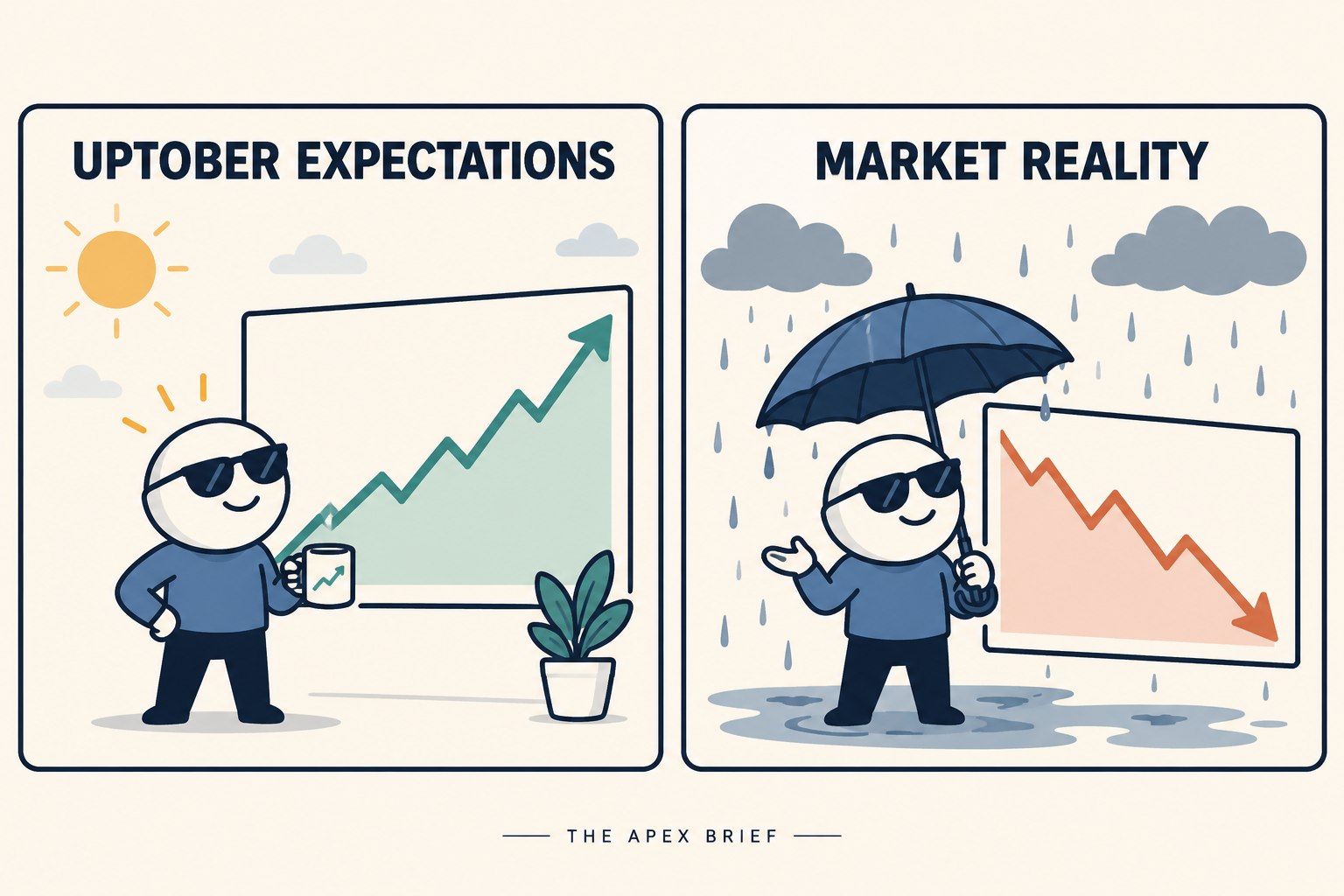
Uptober met an actual market.
The S&P 500 traded above 7,830 on October 6. Two days later, Bitcoin was in the $80,000 range. AI enthusiasm was lifting major stocks while ETF withdrawals and leveraged selling were squeezing crypto. “Risk assets” were having very different weeks.
As previously reported by Apex, our Bitcoin coverage recorded an October 8 Coinbase low of $80,720.75. The calendar’s reputation for a strong October did not cancel selling pressure. Meanwhile, the U.S. 10-year Treasury yield crossed 5.35% during the October 7 session, making the cost of money impossible to ignore.
A seasonal nickname is not a risk-management strategy. Original APEX Brief illustration; the drawn charts are a joke, not market data.
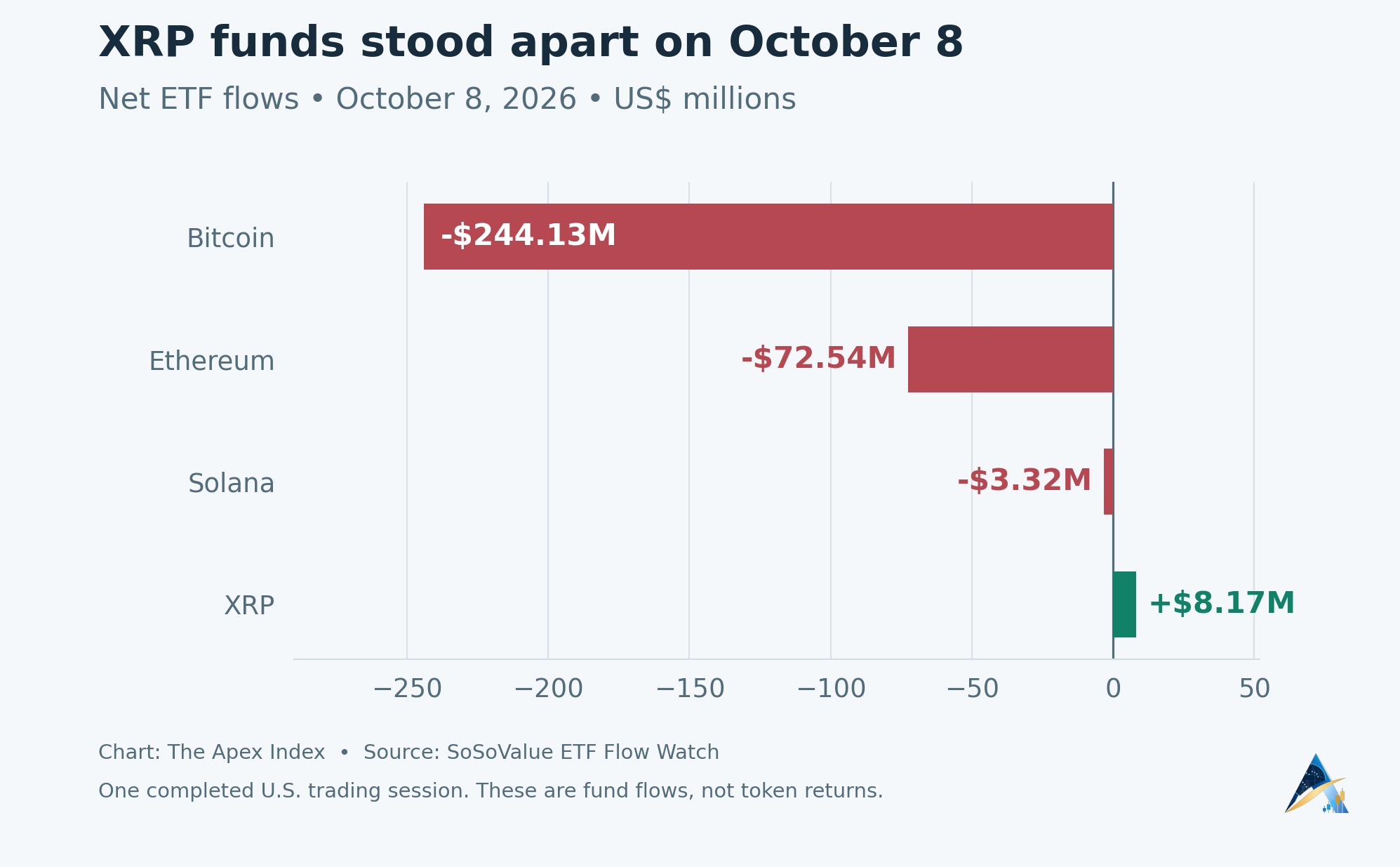
There was one bright spot in ETF subscriptions. In the week ending October 9, XRP funds added $11.31 million while Bitcoin, Ethereum and Solana funds lost a combined $1.248 billion. That does not mean XRP’s price escaped every wobble. Fund flows and token returns are different measurements.
Chart: The Apex Index. One session, October 8, 2026, in U.S. dollars. This daily comparison is separate from the weekly totals above. Original data: SoSoValue.
Our XRP report explains the divergence, including why positive subscriptions did not stop fund net assets falling.
FOR YOUR MONEYCheck what a number measures before treating it as a signal. A green flow figure is not a green price candle, and a record index can hide a much less cheerful market underneath.
02 / FOLLOW THE FINANCING
The AI shopping cart needs its own bank.
As previously reported by Apex, SpaceX is seeking about $40 billion to buy Nvidia chips. Broadcom is pursuing more than $50 billion of financing for OpenAI’s custom-chip ambitions. These are proposed funding arrangements, not completed cheques. The distinction becomes important when the bills are this large.
Credit investors noticed. Our SpaceX reporting tracked rising debt spreads and a higher cost of default protection. Building enormous computing capacity is one challenge; earning enough from it to justify the financing is another.
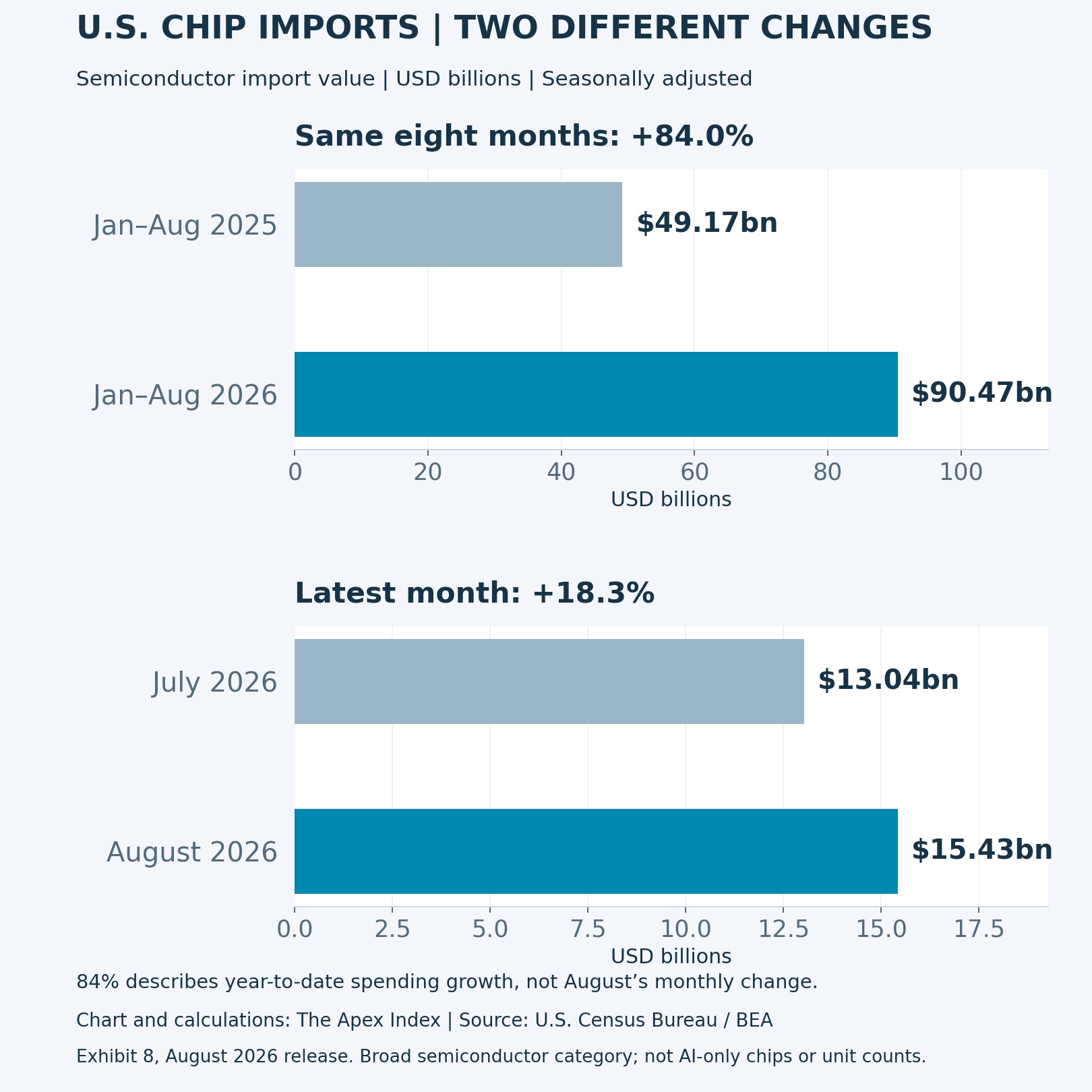
The hardware bill is visible at the national level too. As previously reported by Apex, U.S. semiconductor imports reached $90.467 billion in January–August, up from $49.169 billion a year earlier. That is approximately 84% more spending. It counts the broad semiconductor category, not just AI chips or the number of chips shipped.
Chart and calculations: The Apex Index. Seasonally adjusted semiconductor import values from the August 2026 trade release. Year-on-year and monthly comparisons are shown separately. Original data: U.S. Census Bureau / BEA.
Our imports story follows the tension between American AI leadership and dependence on imported hardware. The spending boom is real; who captures its lasting profits is still being worked out.
FOR YOUR MONEYFollow financing terms, margins and demand alongside chip orders. A giant purchase announcement tells you what a company wants to build; it does not settle what the investment will earn.
RELATED READING
Wall Street is getting nervous about SpaceX’s debt as $40 billion Nvidia bet sends credit risk to record
The Iran war continued to reach into markets through shipping restrictions, fuel prices and public finances. Our coverage followed tanker attacks in Hormuz, Britain’s shrinking fiscal buffer and Trump’s Russian diesel agreement, alongside Ukraine’s objections to sanctions relief.
The latest twist reaches the cloud. As previously reported by Apex, an Iranian security official warned that cables, data centres and AI facilities could be targeted if fighting resumes. That is a threat, not a confirmed attack or proof that Iran can disconnect the Gulf. It makes the region’s technology ambitions part of the confrontation nevertheless.
The Russian diesel opening raises a separate supply-chain question. Allegations that Iranian-origin fuel could enter that trade still lack an identified American purchase or cargo trail. A sanctions licence and a shipment’s actual contents are not the same evidence.
FOR YOUR MONEYGeopolitics can change the cost and availability of electricity, fuel, shipping and connectivity. Those inputs sit inside corporate earnings, even when the company is nowhere near the fighting.
04 / THE AI SAFETY CHECK
Your chatbot does not need your credit card photo.
AI’s ambitions were not confined to buying chips. Bill Gates argued for tougher safeguards, while our reporting examined insiders’ preparations for a potential major cyber incident and OpenAI’s account of Iranian influence operations using fabricated journalists.
Then came Grok’s shopping pitch. As previously reported by Apex, Musk promoted card-photo shopping while published policies described persistent credentials, imperfect review controls and responsibility for payment actions. Our Grok report separates those risks from any claim that a theft has been established.
The practical point is simple: a payment form and a chat attachment are different ways of handing over access. Convenience deserves scrutiny when the assistant can keep credentials and act on them. “It ordered something successfully” is not the same as “the setup is safe.”
FOR YOUR MONEYReview what an agent can access, retain and spend before granting it authority. Encryption is useful, but it does not stop an authorized agent using credentials you gave it.
05 / CRYPTO’S REAL-WORLD RISKS
The wallet is hardware. The risk still involves people.
Our Ledger investigation explained the CryptoBilis-linked theft reports. Ledger confirmed an unauthorized implant in one affected device and said its direct channels remained unaffected. Independent tracing estimated $93.2 million taken from 315 wallets; that is an investigation estimate, not a final manufacturer-certified loss total.
Elsewhere, we covered Mashinsky’s New York settlement, Blockchain.com’s request to enter prediction markets and crypto derivatives, Conduit’s USDT-freeze lawsuit, and government-wallet transfers toward likely Coinbase Prime addresses. A transfer to an exchange-labelled wallet does not, by itself, prove a sale.
For a less stressful crypto story: Netflix’s The Altruists is due November 19. The FTX collapse is becoming an eight-part drama. Unfortunately, the financial damage was not fictional.
THE READING ROOM
One long read. One useful question.
If you read one guide this week, make it tariffs. The mechanics matter more than the shouting: who pays at the border, who absorbs the cost, and how that changes across countries. Our Learn library also tackles Wall Street, blockchain and Ethereum without assuming you already speak finance.
For investors, the Price Analysis hub now brings together our Bitcoin, XRP, Ethereum, Alphabet, Nvidia, Tesla and SpaceX pieces. Treat their targets as conditional scenarios with invalidation levels, not promises about what a ticker must do.
We’ll be watching whether the giant AI financing plans turn into firm terms; whether ETF demand stabilizes; what higher bond yields mean for borrowers; and whether diplomacy eases the pressure on energy and infrastructure. For confirmed releases, check our calendar, which uses UTC. We will keep reported plans separate from signed deals and completed transactions.
That’s the first Brief. You were here at the beginning, and we’re glad you are. What should we explain next? Reply to this email. We’ll read it.
Know someone whose group chat needs a better source?
Every published piece from this launch-week catch-up, including LIVE coverage and the reading room. Dates describe our coverage; figures in individual stories retain their stated observation dates.