

A company wants to build a factory. A government needs to refinance its debt. A pension fund must invest money that its members will need decades from now. Somewhere between those decisions, someone has to assess the risk, find the funding and agree a price. Much of what we call Wall Street happens in that space.
Its influence can reach you without your ever buying an American share. A lender’s decision can affect an employer’s expansion. A rush into dollars can increase the cost of imports elsewhere. An investment fund’s vote can help decide who sits on a company’s board. Understanding Wall Street means following those connections, rather than treating every move in New York as an instruction to the rest of the world.
A street, a history and a shorthand
Wall Street is an actual street in Lower Manhattan. Its name comes from the settlement’s old stockade. Over time, the address became shorthand for the U.S. securities industry and, more loosely, the banks, investment firms and markets associated with American finance. Those meanings overlap, but they are not interchangeable.
The New York Stock Exchange’s own history traces its origins to the Buttonwood Agreement, signed by 24 stockbrokers on May 17, 1792. They established arrangements for trading and commissions. A more formal organisation, the New York Stock & Exchange Board, followed in 1817. The exchange’s development helped turn scattered transactions into an organised market.
Today, the industry extends far beyond that short street. Trading desks, asset managers, research teams and technology firms operate across New York, other American cities and international financial centres. A transaction associated with Wall Street might involve a borrower in Europe, a fund in Asia and a broker working nowhere near Manhattan.
Nor is Wall Street a single organisation. There is no chief executive of the whole system. Banks compete with banks; investors argue over prices; borrowers negotiate with lenders; exchanges compete for business. Some firms are immensely influential, but influence in one part of finance does not confer authority over every other part.
Who actually makes the decisions?
Investment banks help companies and governments raise money, arrange mergers and find buyers for new securities. They may advise on the terms of a deal or agree to underwrite it, assuming specified risks while placing the securities with investors. They earn fees, but a proposed financing still depends on customers accepting its terms.
Commercial banks take deposits, provide payments and make loans. Some large banking groups combine these activities with investment banking and markets businesses. A decision to extend credit can keep a business growing; a refusal can force it to scale back, find another lender or offer more collateral.
Asset managers invest under mandates from clients or fund investors. Their customers can include pension schemes, insurers, institutions and households around the world. Hedge funds use a variety of strategies, sometimes involving borrowing. Private equity firms acquire stakes in businesses; private credit funds lend outside the conventional banking system. These labels describe different activities, rather than a common investment philosophy.
Brokers connect customers to markets. Dealers may trade using their own capital, and market makers quote prices at which they are willing to buy or sell. Exchanges provide organised trading venues. Clearing and settlement organisations help complete transactions and manage the obligations between participants. This infrastructure receives less attention than famous bankers, but a failure in it can interrupt everyone else.
The U.S. Securities and Exchange Commission’s account of market participants separates these functions. That distinction matters: an exchange is not your investment adviser, a broker is not necessarily the issuer of the security you buy, and a fund manager does not personally own every asset managed for clients.
Inside firms, authority is divided too. Executives choose strategy, investment committees approve allocations, risk teams set limits and boards oversee management. A celebrated trader may control a substantial position while remaining subject to funding limits, compliance requirements and instructions from people whose names never appear in a headline.
Where the money goes
When a company issues new shares, investors provide equity funding in return for ownership rights. When it issues bonds, it borrows and undertakes contractual obligations to creditors. A bank loan is another route to financing. The choice affects repayment requirements, ownership and the risks borne by different participants.
Most ordinary stock-market trading is different. Buying an existing share normally transfers money to its seller, rather than directly to the company. Yet the market still matters to the issuer. A reliable market can make investors more willing to buy new shares, while the price influences the terms on which future capital can be raised.
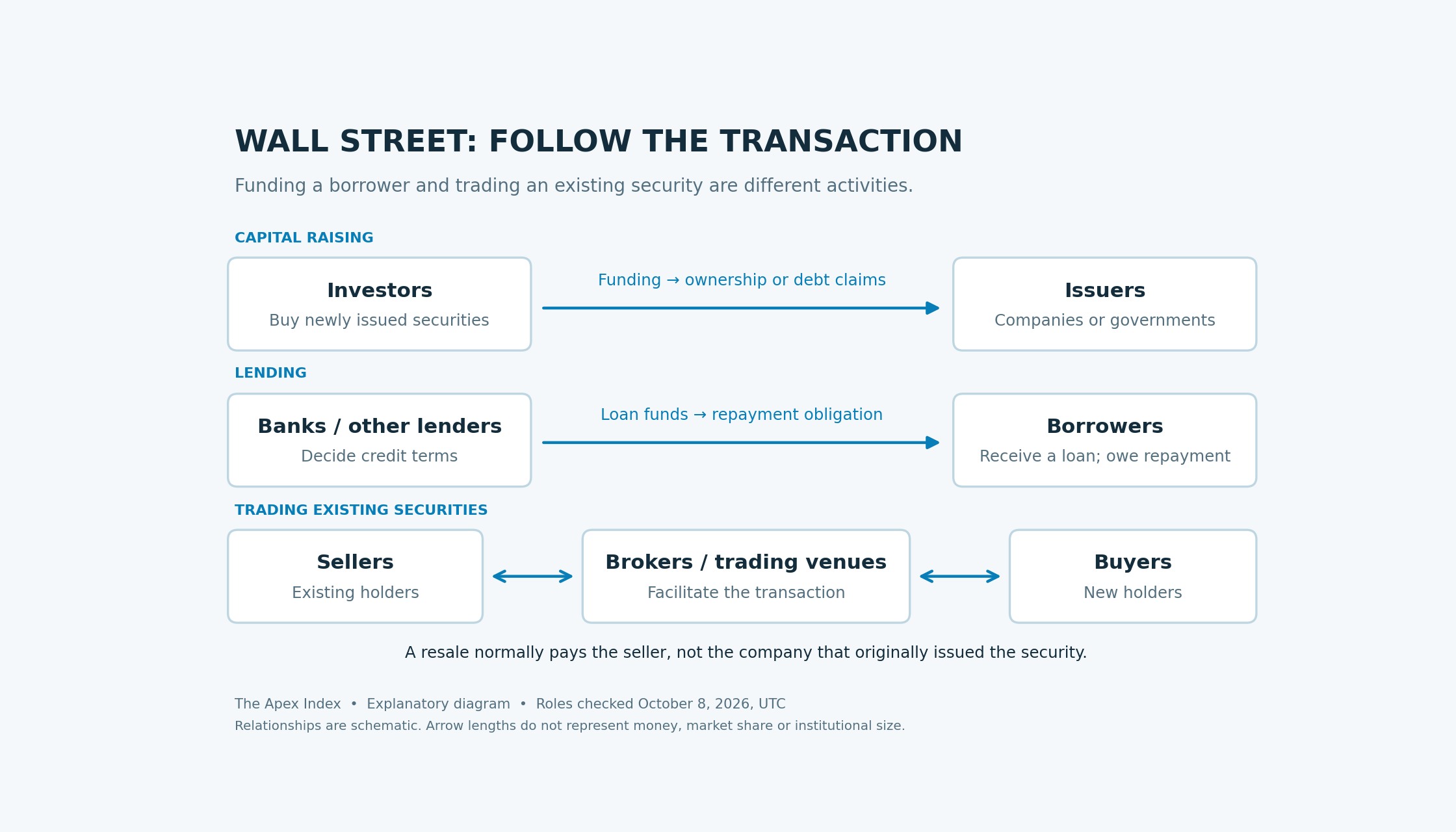
The diagram separates funding from trading. Its arrows describe functions, not the size of any institution or today’s market flows. A household investing through a fund can participate indirectly; a company borrowing from a bank follows another channel. Individual transactions can involve several channels, intermediaries and jurisdictions.
This is why a functioning market offers more than a screen of prices. It allows investors to enter and exit positions, businesses to compare financing options and savings to be committed to projects. These services have costs and risks. Access is unequal, and a liquid market is never a promise that every security can be sold at a favourable price.
The power to set the terms of funding
Wall Street’s most practical form of power is the ability to influence which projects receive money and on what terms. An investor can demand a higher return. A lender can insist on a covenant restricting borrowing or distributions. An underwriter can advise that a proposed issue is unlikely to find enough buyers at the desired price.
Consider a hypothetical manufacturer planning a new plant. Its management expects the project to work if financing remains affordable. If lenders demand higher interest and investors want a larger ownership stake, the project’s economics can deteriorate even before construction begins. The company may postpone hiring or change its plans. Finance has affected a real industrial decision.
That power belongs to more than the bank arranging the deal. The ultimate buyers can refuse to participate. Pension trustees may decide that the risk does not suit their obligations. An insurer may face limits on the securities it can hold. A borrower with several credible alternatives has more negotiating room than one dependent on a single lender.
Apex had earlier reported that SpaceX was seeking a major financing package to fund Nvidia chips. The significance for this guide is the mechanism: an ambitious investment plan has to be matched with lenders and investors willing to fund it. Seeking financing is not the same as having the full amount committed, and a proposed deal should never be described as completed merely because talks are under way.
There is also a difference between an individual firm’s preference and a market-wide reassessment. One lender withdrawing may be replaceable. Many investors simultaneously demanding more compensation can raise borrowing costs across an industry. That is when financing conditions become an economic force, affecting businesses that have no direct relationship with a famous Wall Street institution.
Ownership, voting and the pressure of prices
Shareholders can influence companies through voting rights, engagement and the threat of selling their holdings. Depending on the share structure and applicable law, votes can affect board elections and other corporate decisions. Concentrated ownership can give a relatively small number of institutions an important voice.
But an asset manager’s assets under management are not a pile of money belonging to its chief executive. The underlying investments are held for funds or clients, with rights and responsibilities determined by their arrangements. A manager’s influence also depends on whether it has voting authority, what its mandate permits and how the company’s own voting structure works.
Prices exert another kind of pressure. A weak share price can make issuing equity less attractive, upset existing investors or leave a company vulnerable to outside pressure. A rising price can improve financing options. That does not mean the latest trade reveals the company’s exact economic value: prices reflect competing assessments, changing conditions and the transactions that happen to clear.
Analysts contribute research and forecasts, while ratings firms assess credit risk. Their opinions can influence decisions, especially when investors or contracts refer to ratings. An opinion remains an opinion. Fees, business relationships and incentives deserve scrutiny, and an impressive title does not make a forecast certain.
Why the rest of the world feels the effects
U.S. markets matter internationally because overseas companies and governments use dollar funding, investors hold American securities and financial institutions operate across borders. A decision made in one country can change the choices available in another. The connection can be direct, through a loan, or indirect, through exchange rates and portfolio movements.
Imagine a business whose revenues are mainly in its home currency but whose debt must be serviced in dollars. If that currency weakens, servicing the same dollar obligation can consume more local income. If refinancing also becomes more expensive, the business faces pressure from two directions. The outcome depends on its hedging, contracts and cash reserves, not merely its location.
Changes in benchmark borrowing costs matter too. The U.S. 10-year Treasury yield is one reference investors watch when evaluating other dollar assets. A company’s borrowing cost also includes compensation for its own credit and liquidity risk. A government-bond move is therefore part of the explanation, rather than a complete price for every borrower.
Equity indices provide another reference point. The S&P 500 index tracks a defined group of large U.S. companies; it is not a measure of every household’s living standards or the entire global economy. A strong index can coexist with financial strain elsewhere, including among people with little exposure to shares.
London, continental European centres, Tokyo, Hong Kong, Shanghai and other markets have their own institutions and sources of capital. Local regulations, central banks and domestic investors matter. Wall Street is a major hub in a network, and calling it powerful should not erase the choices made outside the United States.
Where that power ends
Private financiers cannot simply rewrite securities law, order a central bank to change interest rates or compel a customer to accept a deal. Governments set legal frameworks; regulators supervise and enforce within their mandates. Courts can resolve disputes. Investors can withdraw mandates, borrowers can seek alternatives and shareholders can challenge management, although those options vary in strength.
The Federal Reserve is a central bank, not an investment bank controlled by Wall Street executives. Its decisions can profoundly affect financial conditions, but its public responsibilities are different from a private firm’s commercial objectives. Treating the two as the same institution obscures who is accountable for a policy decision and who is responding to it.
The Federal Reserve’s latest published Financial Stability framework, from May 2026 and checked on October 8, distinguishes shocks from vulnerabilities. Its monitoring covers valuation pressures, borrowing by businesses and households, financial-sector leverage and funding risks. Those are routes through which trouble can spread, rather than a ranking of which financier is most powerful.
Competition constrains firms, but it does not eliminate unequal bargaining power or conflicts of interest. A bank may have several commercial relationships with the same company. An investor may face complex fees or limited alternatives. Disclosure and regulation can reduce some problems; they do not remove the need to ask who benefits from a recommendation or transaction.
Why influence can turn into fragility
Borrowing can magnify gains and losses. In a deliberately simplified example, an institution owns $100 of assets funded by $90 of debt and $10 of equity. A $5 loss on those assets, with the debt unchanged and no other adjustments, halves the equity to $5. A modest asset loss has caused a much larger percentage loss for the owners.
Liquidity is a different problem. A firm can hold assets with long-term value but struggle to raise cash when obligations fall due. If lenders demand repayment or investors withdraw funds, it may have to sell quickly. Several institutions making similar sales can push prices lower and put further pressure on borrowers and collateral.
These mechanisms help explain why the 2007–09 financial crisis affected employment and production far beyond trading desks. The breakdown involved leverage, funding stress and interconnected exposures. Financial institutions lost money and failed; disruptions in the financing system transmitted the damage to households and businesses.
A crisis also reveals the limits of individual power. An institution can be large, well connected and staffed by experts, yet remain vulnerable to counterparties refusing to lend. Public intervention raises difficult questions about stability, accountability and who bears losses. Preventing wider harm does not make every private decision that preceded the intervention defensible.
How to read Wall Street without being dazzled by it
When a headline says Wall Street wants something, identify the people and institutions behind the phrase. Is it describing a bank’s analyst, an asset manager, a group of lenders or an actual market move? Those are different kinds of evidence. One interview or research note cannot establish the opinion of an entire industry.
Then follow the incentive. An adviser may be paid to complete a transaction; a fund must operate within its mandate; a lender wants repayment. Compare the claim with filings, financing terms and the issuer’s disclosures. Distinguish money sought from money raised, managed assets from a firm’s own capital, and an estimate from a completed transaction.
For readers anywhere in the world, the useful question is what the development changes: the cost of borrowing, access to funding, the value of savings or the risks attached to an investment. Wall Street has substantial influence over each. Understanding the channel makes that influence easier to judge, and makes it harder for a grand name or a confident prediction to substitute for evidence.