
President Donald Trump has denied suggesting that America's enemies should attack Los Angeles or San Diego, saying his remarks were a comparison between higher gasoline prices and the danger of an Iranian nuclear weapon. He accused news organizations of deliberately presenting that argument as an invitation to bomb American cities.
The denial follows his October 5 rally in Grand Island, Nebraska, where he named both cities while defending the war with Iran. The dispute has drawn criticism from California politicians across party lines, against a backdrop of elevated fuel costs and an approaching November 3 midterm election.
In his original Truth Social post, Trump wrote:
The Fake and Artificial News is out there trying to say that I’m inviting the enemy to bomb San Diego and Los Angeles when, in actuality, what I was talking about was that a temporary increase in the price of Gasoline is a small price to pay for Iran not having a Nuclear Weapon and, if you want to see a big price, can you imagine what it would be like if they bombed San Diego and/or Los Angeles?
He said he was comparing a temporary increase at the pump with the bombing of major cities, not asking an enemy to attack places he loves. The post does not announce a new military operation or report an actual attack on either city.
What prompted the backlash
The original rally transcript records Trump describing higher prices as a small cost of keeping the country and world safe. His next passage included:
They can take out a city. Let them take, let it, let them take out Los Angeles. Let them take out San Diego.
He then described the situation as a “very small price to pay” and predicted it would end soon. The wording prompted the criticism; his subsequent denial says the intended comparison concerned gasoline costs, rather than accepting the destruction of the cities.
White House communications director Steven Cheung defended the comments on October 6, saying Trump meant American cities would have been threatened if a nuclear Iran had not been stopped. That is the administration's explanation of the hypothetical danger, not evidence of a specific attack plan against California.
Republican criticism alongside Democratic anger
California Governor Gavin Newsom condemned the remarks on October 6, calling Trump “deranged and dangerous.” Republican San Diego County Supervisor Jim Desmond, a Navy veteran running for Congress, also rejected the framing in his own response that day:
As a Navy veteran, I served to protect Americans, not write off American cities as an acceptable price of war. Our job is to keep Americans safe, stand up to our enemies, and make sure a threat like that never becomes reality. No American city is expendable, and no American family should ever be treated as collateral damage.
Those objections concern the president's language about protecting American communities. Trump's denial answers the interpretation of that language without resolving the separate question of how long households will face higher energy costs.
The gasoline comparison has a measurable backdrop
Fresh October 8 AAA data put regular gasoline at about $4.36 per gallon nationally, $6.38 in Los Angeles-Long Beach and $6.37 in San Diego. All three averages were above their month-ago readings, despite small declines from the previous day.
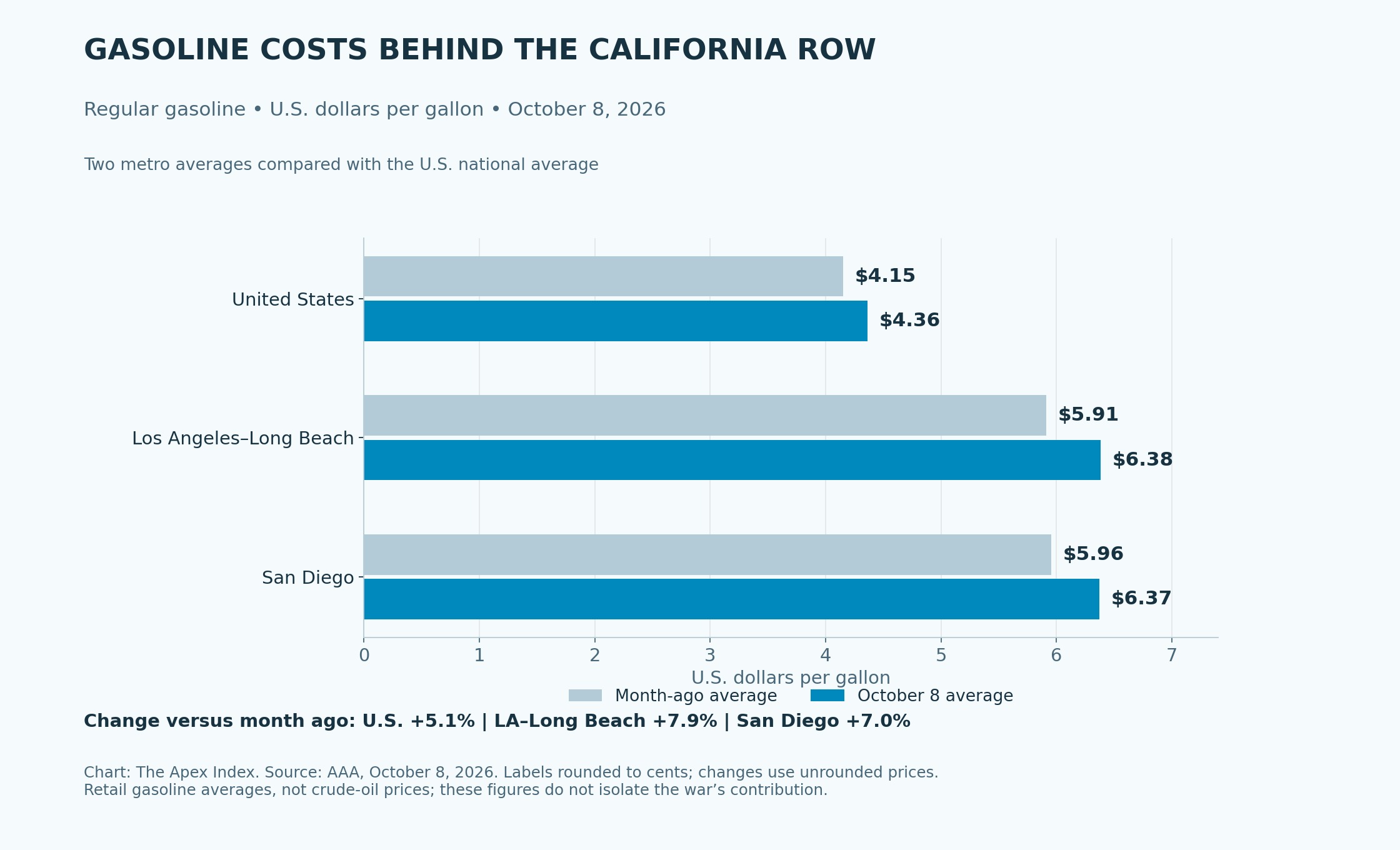
These are retail pump averages, not crude-oil prices. They show what drivers face but do not isolate the war's contribution from refining, taxes, distribution or other influences. Nor do they establish that the increase will be temporary.
As previously reported by Apex, tanker strikes and threats to shipping have complicated passage through Hormuz. Apex had earlier reported that Washington was weighing pre-midterm strike options without a final decision. That uncertainty makes Trump's promised relief dependent on developments his denial does not settle.