
New York has permanently barred Celsius founder Alex Mashinsky from the securities, commodities and cryptocurrency businesses under a settlement announced October 9 that carries up to $35 million in conditional financial obligations. The agreement extends his exclusion from finance beyond the 12-year federal prison sentence he is already serving.
The monetary terms hinge on his compliance with federal forfeiture and imprisonment requirements. They do not represent a fresh $35 million payment already collected for customers. The business ban is broader than crypto lending, reaching investment advice, management, promotion and other financial roles.
A permanent ban with a personal-trading exception
Attorney General Letitia James’s October 9 announcement concludes the state lawsuit filed in January 2023. More than 26,000 New Yorkers were among the investors drawn into Celsius, which marketed high yields and safety while putting customer assets into risky strategies.
She said:
Alex Mashinsky promised New Yorkers that his company was a secure place to invest their hard-earned savings, only to leave them penniless when his risky investments collapsed.
The October 8 court agreement bars Mashinsky from acting as a broker, dealer, issuer, investment adviser, manager, director, consultant or other participant in securities and commodities businesses, including digital assets. It also prohibits compensated investment communications and helping entities solicit investors.
His own personal purchases and sales are expressly excepted from the transaction restriction. The settlement shuts him out of the business of handling or promoting investments for others; it does not prohibit him from holding cryptocurrency himself.
How the $35 million is structured
The first component is a $25 million damages obligation to New York. It is deemed satisfied if Mashinsky pays a qualifying $10 million to the federal government under his forfeiture order. Qualifying payments after May 20, 2025 receive dollar-for-dollar credit toward that federal requirement.
A separate $10 million judgment is tied to completion of his prison sentence. The clause also addresses court-ordered reductions, compassionate release, good-time and earned-time credits, First Step Act release and specified Bureau of Prisons programs. Those provisions matter when assessing whether the sentence-linked obligation remains payable.
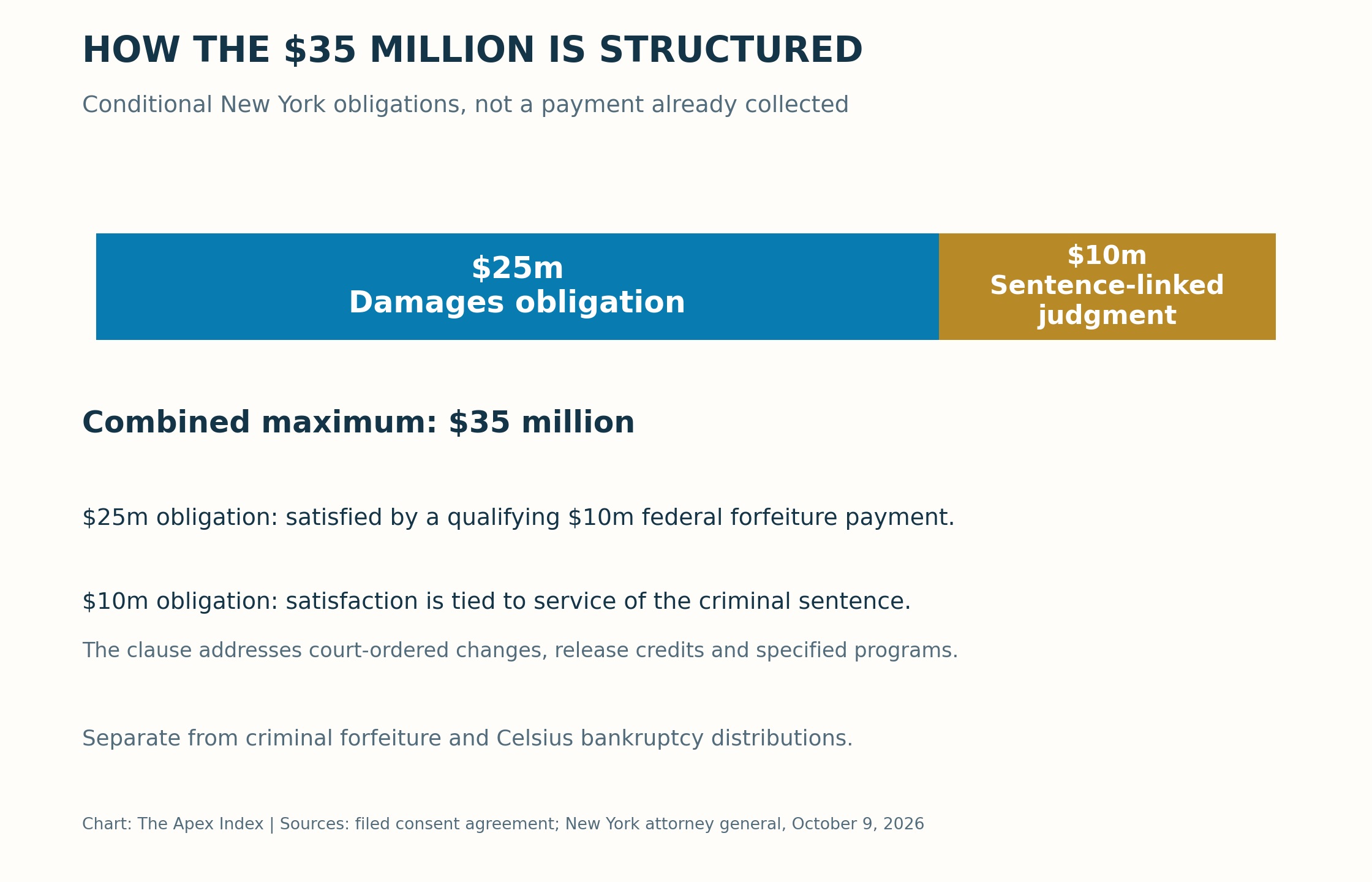
The state can enforce the monetary relief as a judgment. The two components are separate from the more than $48 million criminal forfeiture ordered in the federal case and from distributions through Celsius’s bankruptcy.
Fraud behind the lending pitch
Mashinsky admitted in the settlement that he violated New York law through misleading statements about regulatory approval and omissions concerning his own CEL token sales. He had already pleaded guilty in December 2024 in the parallel federal prosecution.
The Justice Department’s May 8, 2025 sentencing announcement described how customer deposits helped finance purchases that inflated CEL’s price while Mashinsky secretly sold his holdings. U.S. Attorney Jay Clayton said:
In the end, Mashinsky made tens of millions of dollars while his customers lost billions. America’s investors deserve better. The case for tokenization and the use of digital assets is strong but it is not a license to deceive.
Celsius halted withdrawals on June 12, 2022 and filed for bankruptcy the following month. Prosecutors said customers had $4.7 billion in inaccessible assets when withdrawals stopped. Those historical balances should not be confused with today’s settlement obligations or remaining creditor claims.
Recoveries continue on a separate track
The October 9 update puts bankruptcy distributions above $3.4 billion as of August 2026. Separately, a July Federal Trade Commission settlement required three Celsius founders to pay $16.5 million collectively, including $10 million from Mashinsky.
As previously reported by Apex, federal regulators have also begun consulting on a dedicated registration path for crypto exchanges. That process concerns future market structure; Mashinsky’s settlement addresses misconduct already established in his cases.
For former Celsius customers, the immediate development is a permanent industry exclusion backed by conditional financial judgments. Bankruptcy recoveries, federal forfeiture and New York’s enforcement powers remain distinct routes, each with its own terms.