
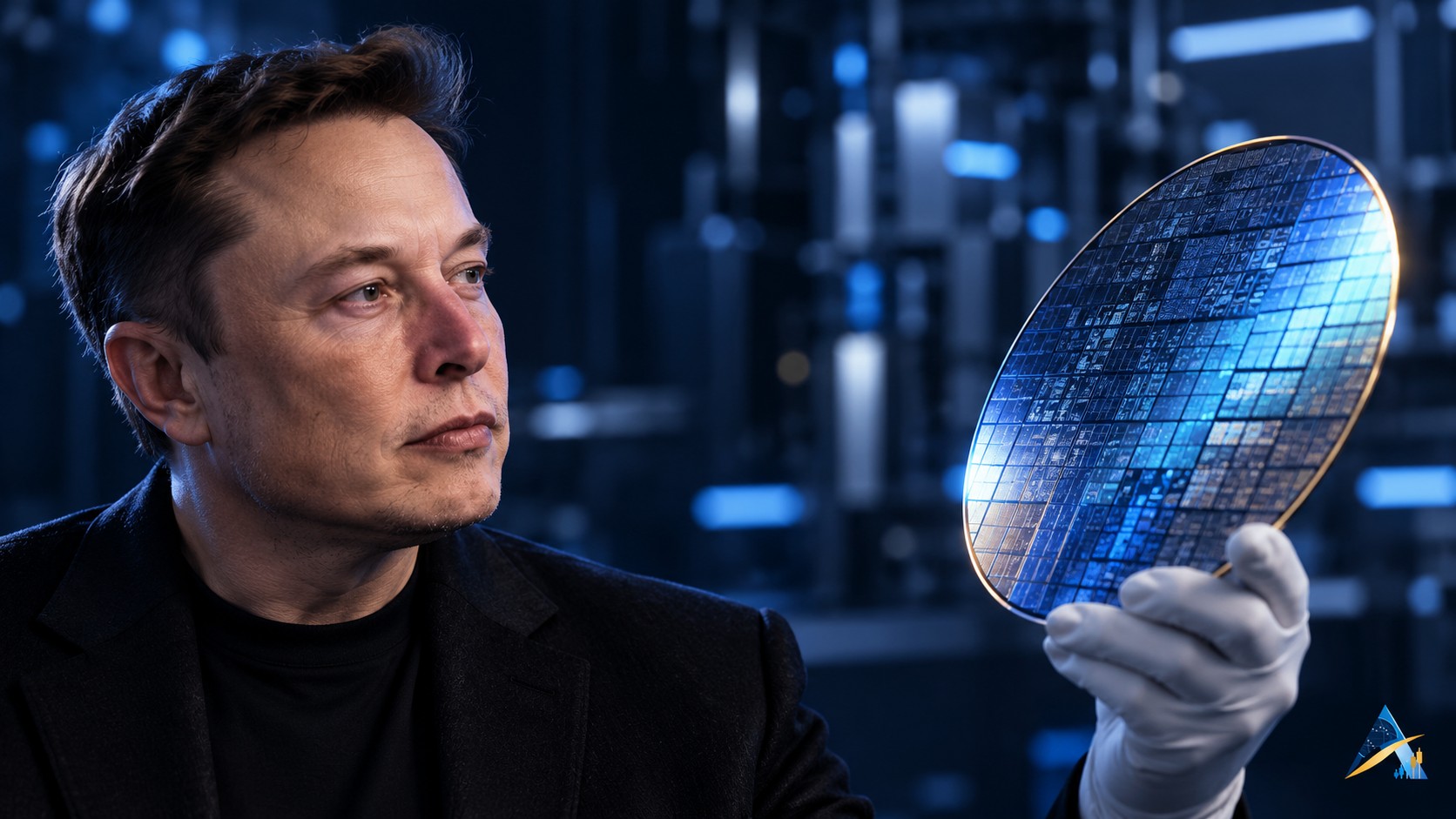
Elon Musk is pushing Tesla and SpaceX into a $16.8 billion chipmaking venture while admitting he does not yet know how to manufacture the processors himself. Speaking by livestream at Saturday’s X Takeover event outside Tesla’s Austin factory, he said his companies could eventually outperform established semiconductor producers, but acknowledged that getting there could take years.
The project is Terafab, a planned Texas complex combining logic chips, memory and advanced packaging. The $16.8 billion is the companies’ estimated initial investment, announced in August, rather than a newly disclosed personal cheque from Musk. His latest remarks expose the gap between the scale of that commitment and the manufacturing expertise still needed to deliver it.
Musk admits he has more to learn
According to Bloomberg, Musk told the October 10 gathering that he currently has “no idea how to make microchips.” He nevertheless argued that experience building customised equipment could help his companies improve semiconductor manufacturing.
He described the challenge and his expectations:
I think it is accurate to say it’s one of the hardest things to do in the world.
I don’t want to be complacent or entitled or anything, but, I think probably we’ll figure out how to make chips better than anyone. Honestly. I don’t know how long it’s going to take us to do that. It might take us quite a few years.
That is a claim about future capability, rather than a production result. Building custom machinery can improve a factory, but advanced chipmaking also requires precise process control, reliable materials and consistently high yields. A large building cannot compensate for too many unusable chips coming off its production lines.
A factory built around Musk’s own demand
SpaceX’s August 6 announcement placed the main facility in Grimes County, Texas, with at least 3,000 jobs expected. Tesla had already broken ground on a research fabrication facility at Giga Texas in April, described as the larger project’s precursor.
The planned customers sit inside Musk’s corporate network: Optimus robots, self-driving Cybercabs and proposed orbital data centers. That gives Terafab potential demand from the outset, although demand alone does not establish whether its chips can be manufactured competitively.
SpaceX described the intended scope:
A vertically integrated factory with more than 100 million square feet of manufacturing space is planned. This facility will house the manufacturing, packaging, and testing of advanced logic and memory devices.
The initial investment estimate covers the first phase. Future expansion could require substantially more capital. Bringing manufacturing, packaging and testing together could shorten development cycles, but the companies still have to demonstrate working processes and repeatable output.
Outside suppliers still matter
Intel confirmed its involvement in April, offering chip design, fabrication and packaging expertise. The established manufacturer’s participation helps explain how Musk could pursue the project despite his admission of limited personal knowledge. It does not eliminate questions about technology, delivery schedules or the division of responsibilities.
Musk also acknowledged exploratory contacts with Taiwan Semiconductor Manufacturing Company in an October 3 post: “Just discussions, but something may come of it.” Those words confirmed talks, rather than a completed agreement to run or own the factory.
As previously reported by Apex, SpaceX is seeking $40 billion in financing to purchase Nvidia chips, with the proposed transaction expected to close in 2027. Buying existing hardware and developing an internal production capability can proceed together. Terafab does not instantly replace outside suppliers.
For Tesla customers, dependable chip supply affects how quickly autonomy and robotics products can scale. For investors, the question is whether the factory’s output can justify its capital requirements. Musk’s confidence is clear; the evidence that matters next is manufacturing yields, costs and usable processors delivered on schedule.