

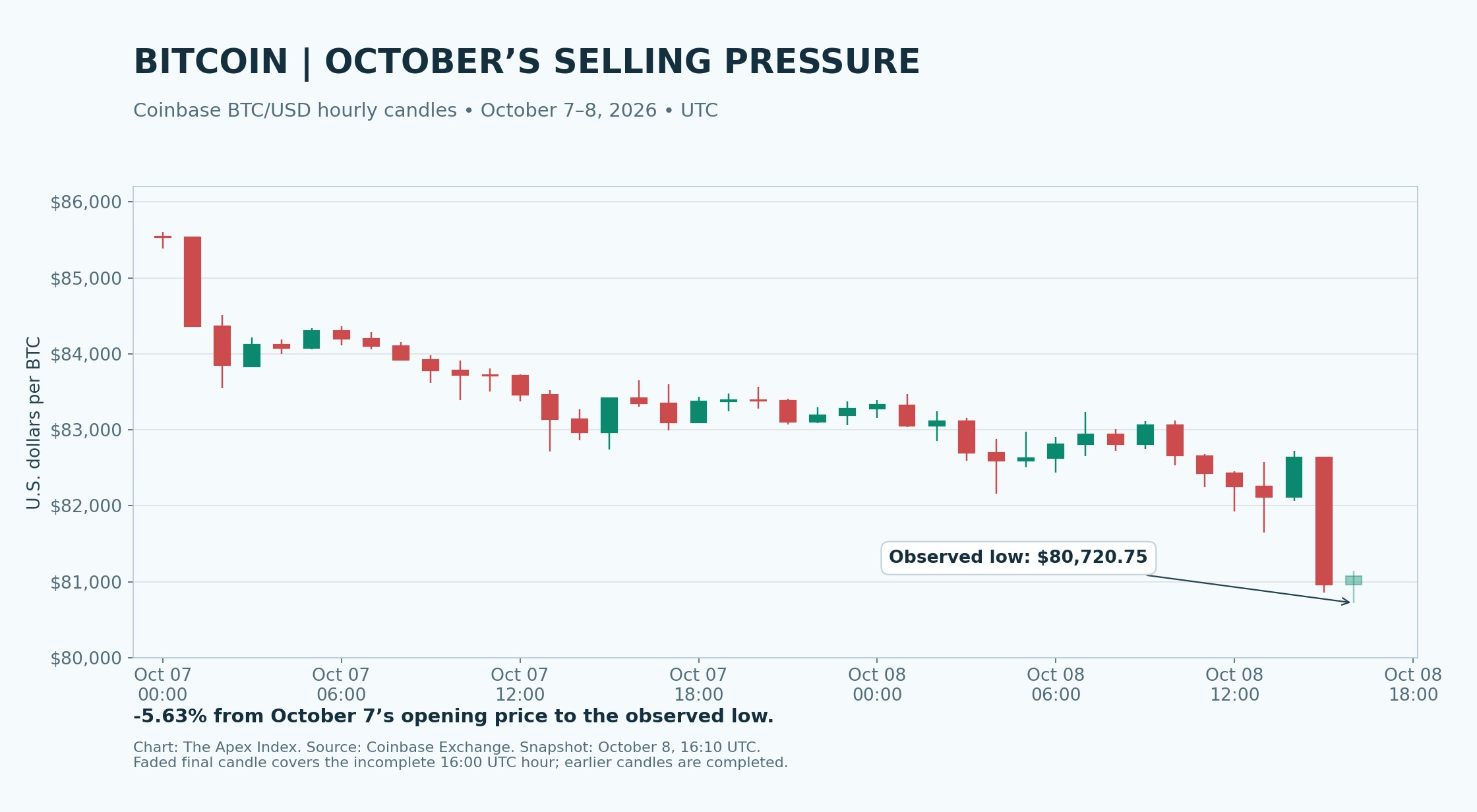
Bitcoin sank into the $80,000 range on October 8 as withdrawals from U.S. spot exchange-traded funds and a fresh wave of derivatives liquidations battered hopes for an Uptober recovery. Coinbase recorded an intraday low of $80,720.75, with the price back near $81,065 at 16:10 UTC.
The decline has put Bitcoin about 3% below its September closing price on the same exchange. October's established reputation as a strong month for the cryptocurrency is meeting a less accommodating reality: investors are withdrawing money while high borrowing costs make risk harder to justify.
ETF withdrawals hit the bid
SoSoValue's completed October 7 table showed $487.07 million in net withdrawals from U.S. spot Bitcoin ETFs. BlackRock's IBIT accounted for $207.67 million, followed by Fidelity's FBTC at $105.15 million and ARK & 21Shares' ARKB at $101.71 million. Their combined redemptions dominated the session.
The funds still held $107.40 billion in net assets, with cumulative net inflows of $57.33 billion. That larger base matters: Wednesday's withdrawals represent a sharp daily reversal in demand, rather than evidence that the entire institutional trade has disappeared. Trading value was $2.80 billion, which measures turnover and should not be confused with fresh money entering the funds.
ETF withdrawals can reduce an important source of marginal buying, but the figures do not identify every seller behind Thursday's move. They describe the previous completed U.S. session, while Bitcoin continues trading across exchanges around the clock.
Leverage adds another layer
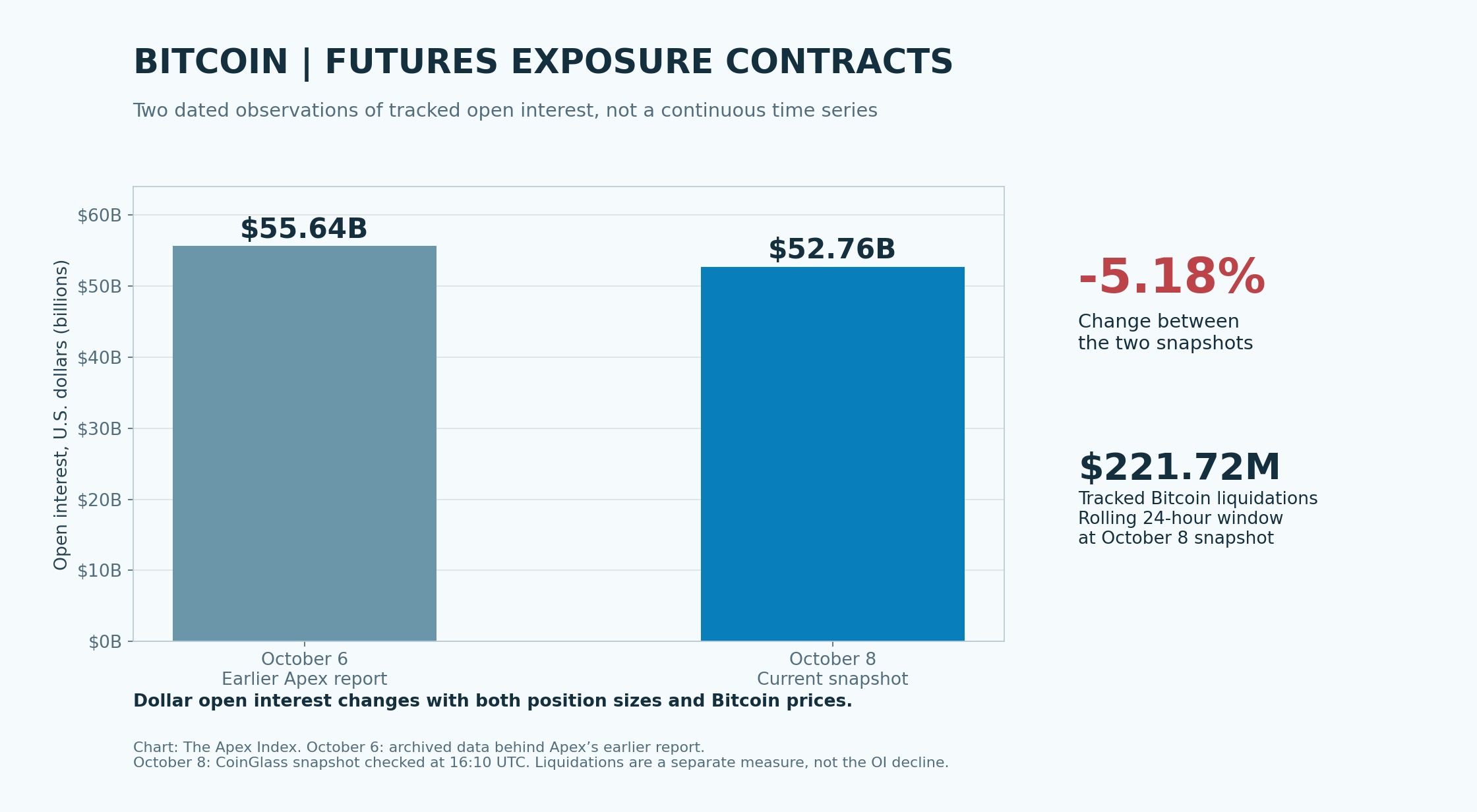
CoinGlass data showed $221.72 million in Bitcoin futures liquidations over the preceding 24 hours at the checked snapshot. That figure covers tracked Bitcoin contracts, rather than every cryptocurrency, and the available snapshot does not separate long from short positions.
As previously reported by Apex, Bitcoin open interest stood near $55.64 billion on October 6. The comparable current reading was $52.76 billion, a decline of about 5.2%. A fall in dollar-denominated open interest can reflect both closed positions and lower underlying prices, so it does not mean that the entire difference was liquidated.
The combination is nevertheless uncomfortable for bulls. Falling prices, heavy turnover and forced position closures can intensify short-term selling even when buyers begin absorbing the first wave. The recovery above the intraday low had not repaired the damage to October's performance.
Higher rates challenge the rebound
Newly released Federal Reserve minutes added a difficult backdrop. The September meeting record, released October 7, described persistent inflation and pressure from energy prices and AI investment:
Participants noted that inflation remained elevated and that they had not seen sufficient progress on lowering inflation in recent months. They noted that ongoing geopolitical developments, which had pushed up prices for crude oil and refined fuel products, and surging AI-related investments were contributing to inflation pressures.
Most participants assessed that another rate increase would likely be appropriate by year end, while emphasizing that subsequent decisions would depend on incoming information. That outlook leaves little room for assuming an imminent easing cycle will rescue speculative assets.
SoSoValue's October 8 research described the immediate amplification mechanism directly:
ETF redemptions and leveraged liquidations are amplifying the volatility.
The research also cautioned that divergent crypto and AI performance does not establish that the same money has moved between them. A capital-rotation narrative is plausible, but fund-flow and price data alone cannot prove it.
CoinGecko's latest checked reading was approximately $80,943, down 3.15% over 24 hours. Venue prices and provider refresh times differ, which explains why that aggregate quote was below Coinbase's contemporaneous trade.
Uptober remains a well-established market pattern. This session shows why the pattern needs actual buying to sustain it. With ETF demand weakening and leverage unwinding against restrictive financial conditions, the calendar has offered little protection from the selloff.