

Russia's plague scare has revived memories of COVID, but the death of a Siberian laboratory worker does not establish a new pandemic. The cause remains unresolved, and public health assessments have not identified sustained transmission. For markets, the immediate issue is uncertainty over what happened and whether containment measures could disrupt economic activity.
The economic consequences would depend on infections, restrictions and changes in spending. Investors already face elevated borrowing costs: the latest yields demonstrate how expensive government financing has become. Another disruption would reach an economy contending with inflation and geopolitical pressures.
Irkutsk governor Igor Kobzev said testing found no microorganisms associated with the woman's professional activities and described pneumonia of undetermined origin. That official account leaves the underlying pathogen unidentified; it does not confirm plague.
In its October 6 assessment, ECDC reported:
“there are no reports of secondary cases and no evidence of sustained human-to-human transmission that would cause further spread of the disease.”
The WHO explains that plague is bacterial, caused by Yersinia pestis, and can be treated effectively with antibiotics when identified early. Pneumonic plague can spread through respiratory particles and requires rapid containment. Those characteristics distinguish it from COVID's viral infection and complicate direct comparisons.
An October 6 assessment from the UN health agency put the risk at moderate to low locally, low across Russia and very low for its European region. That assessment remains provisional.
What the COVID market pattern actually shows
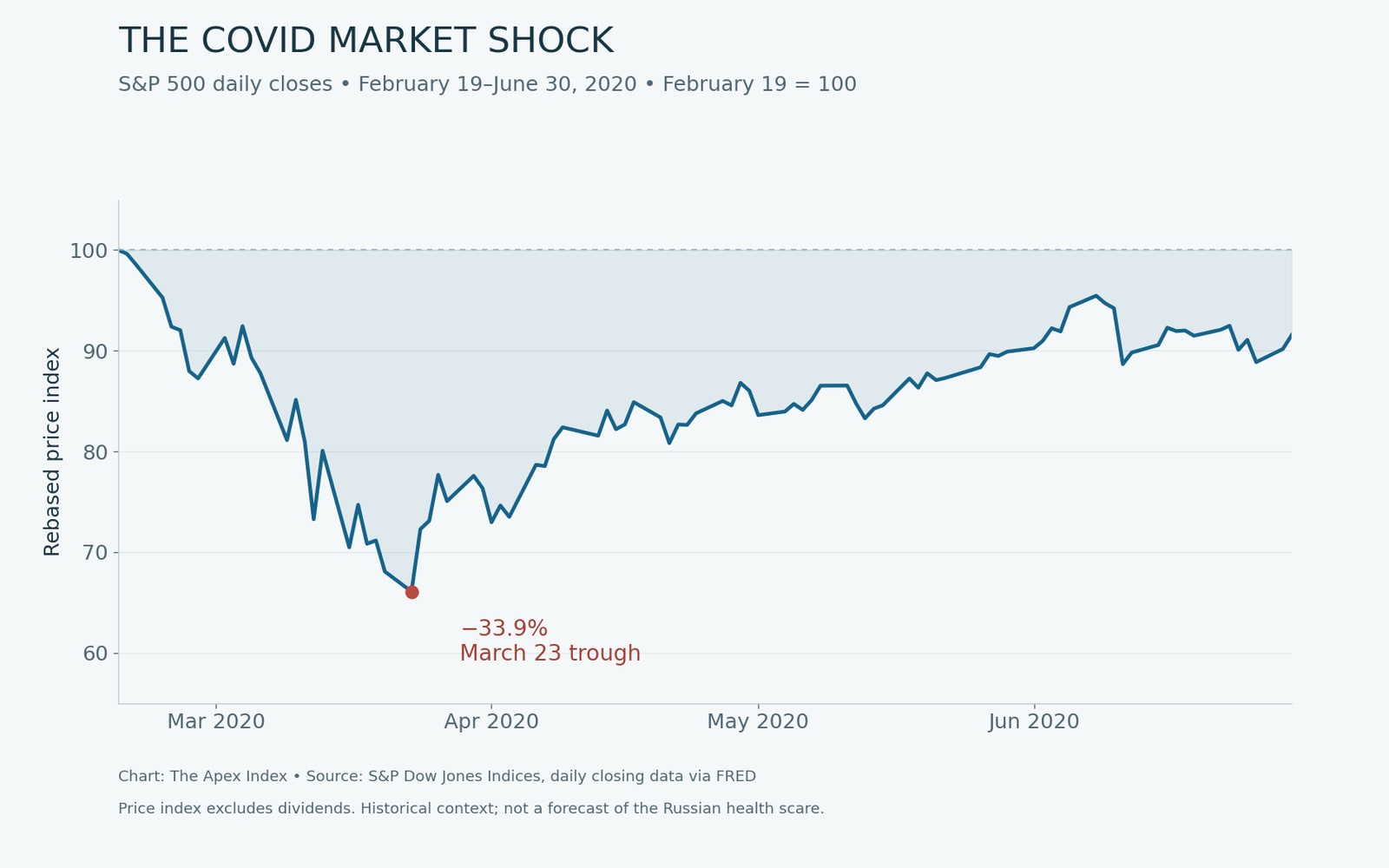
During COVID's initial market shock, the S&P 500 fell from 3,386.15 on February 19, 2020, to 2,237.40 on March 23, a closing-price decline of 33.9%. The historical chart documents that episode. It provides context for a severe shock, rather than predicting an equivalent Russian outcome.
The economic damage extended beyond share prices. World Bank data put the contraction in global output at roughly 2.9% in 2020. Workplace closures, disrupted production and reduced travel transmitted a health emergency into household incomes, corporate revenues and international commerce.
Policy support changed the recovery path. The Fed cut its target range to 0%–0.25% in March 2020 and announced asset purchases. Its September 2026 statement, by contrast, raised the range to 3.75%–4% while describing inflation as elevated. Today's rates leave a different starting point for any response.
Today's economy needs evidence before a pandemic repricing
An October 7 intraday TradingView snapshot placed the American benchmark near 7,794, down about 0.3%, with its equity quote delayed. The 10-year Treasury yield was around 5.31%. Those readings do not resemble March 2020's collapse, and they cannot identify which headlines drove individual trades.
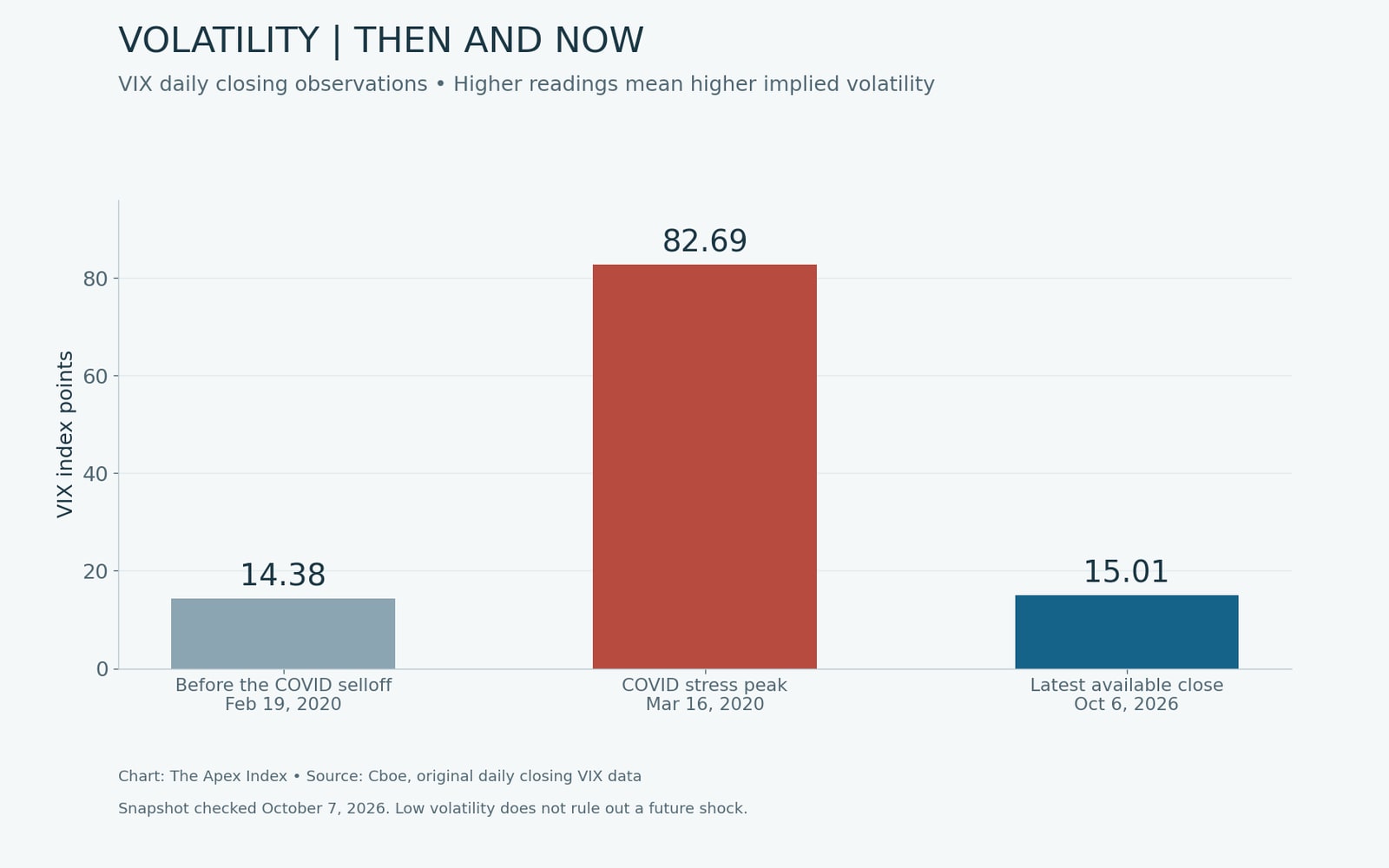
Cboe volatility data reinforce the contrast: the VIX closed at 15.01 on October 6, compared with 82.69 on March 16, 2020. The second chart compares daily closes, not a forecast. Relatively low implied volatility does not guarantee that an unanticipated event would be harmless.
The IMF projects global growth of 3.0% in 2026 and 3.4% in 2027 in its July outlook. That baseline reflects competing war and technology forces, with stalled disinflation. It is not a projection of damage from the Russian health scare.
If the incident remains contained, economic effects could stay local. Confirmed transmission across borders would raise risks for travel and consumer demand; disruption to commodity exports could instead aggravate inflation. Existing shipping pressures make that distinction consequential. The evidence to watch is verified cases, transmission chains and actual restrictions, before extrapolating COVID's losses.
For equities, the mechanism matters: cancelled bookings hurt travel businesses, while delayed shipments squeeze manufacturers. Neither pathway is established by publicly available evidence about the Russian incident.