

Broadcom is working to arrange more than $50 billion in financing for OpenAI’s custom artificial-intelligence chips, putting a vast funding requirement behind the effort to develop an alternative to Nvidia hardware. The discussions could support several gigawatts of computing capacity, but the amount and terms remain unsettled.
Apollo and Blackstone are among the potential lenders approached. Talks are early, the financing size could change, and no completed transaction has been announced. People familiar with the discussions expect a deal to close before the end of 2026, rather than describing money already raised.
The Wall Street Journal reported the talks in an exclusive published October 7. The proposal is part of a fresh wave of chip-financing negotiations involving Oracle and SpaceX, as AI infrastructure spending draws increasingly on specialist lenders.
Custom chips need more than a design
OpenAI’s program is known internally as Nexus, with its first two chip generations named Jalapeño and Serrano, according to the report. The financing would support hardware developed with Broadcom; it is not a proposed purchase of additional Nvidia chips.
The scale builds on an older, directly relevant agreement. In their October 13, 2025 announcement, OpenAI and its partner outlined plans for 10 gigawatts of custom accelerators, with deployments targeted from the second half of 2026 through the end of 2029. OpenAI would design the accelerators and systems, while Broadcom would contribute development, deployment and networking technology.
That 10-gigawatt program describes the wider multiyear program. The latest financing discussions reportedly cover several gigawatts, so dividing the proposed funding by the entire partnership’s capacity would produce an unsupported cost estimate. Gigawatts measure power capacity, not the number of processors or their computing performance.
Developing custom hardware gives an AI lab scope to tailor systems to its own models and workloads. The original partnership announcement describes Ethernet networking alongside the accelerators, underscoring that the project includes connected racks and systems rather than an isolated processor.
The Nvidia alternative is therefore a hardware strategy, not evidence that competing products have already been displaced. The financing proposal does not establish final chip pricing, performance benchmarks or the completed delivery of the proposed capacity. Engineering progress and funding commitments remain separate milestones.
Wall Street finances the compute buildout
The broader funding problem is timing. Hardware must be paid for before the resulting computing capacity generates its full revenue. The latest report says Oracle is discussing a chip purchase with Apollo and Goldman Sachs, potentially using a separate company that buys hardware and leases it back over time.
That proposed leasing arrangement concerns Oracle. It should not be treated as Broadcom’s confirmed structure. The separate OpenAI financing discussions are still early, leaving room for the amount, participants and final terms to change before lenders commit their capital.
The same-day market context shows why funding terms matter. As previously reported by Apex on October 7, SpaceX’s five-year default protection reached a record since trading began in June as investors assessed its proposed $40 billion Nvidia-chip financing. Our earlier credit coverage separates that repricing from any claim that default is imminent.
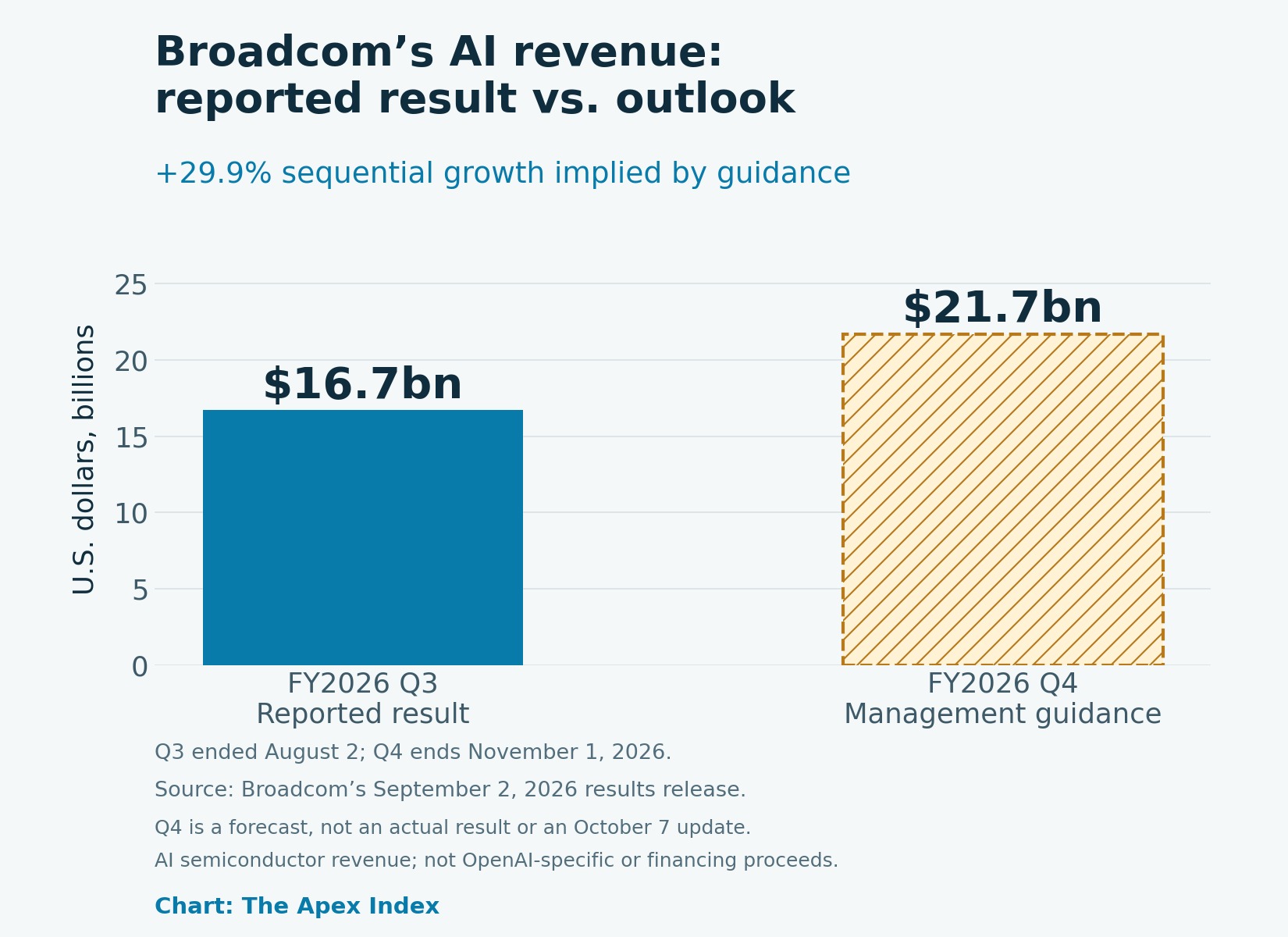
Older company figures provide relevant operating scale. In its September 2 release, Broadcom reported $16.7 billion of third-quarter AI semiconductor revenue and guided to $21.7 billion for the fourth quarter. That outlook implied 29.9% sequential growth, calculated from the rounded figures disclosed, and remains a forecast rather than a reported result.
The company also reported $13.665 billion of third-quarter free cash flow. That measures cash generation over one quarter; it is not cash earmarked for OpenAI’s project or proof that the financing can be repaid on a particular timetable. Lenders still need terms connecting upfront hardware purchases with future customer payments, while the negotiations remain unfinished.