
Donald Trump opened the U.S. market to Russian diesel on October 9 after a call with Vladimir Putin, offering Moscow sanctions relief as Ukraine warned the deal would help finance a longer war. The announcement landed while Ukrainian negotiators were in Florida seeking a path toward de-escalation.
The clash exposes competing priorities: Trump wants cheaper fuel ahead of the November 3 midterm elections; President Volodymyr Zelensky wants Russia’s energy earnings constrained until Moscow stops attacking Ukraine. Washington has authorised diesel transactions without making that permission conditional on an energy ceasefire.
A diesel deal with immediate political stakes
In his original announcement, Trump described the call as highly successful and said Russia would supply more than 300,000 tons immediately, another 500,000 tons in November and one million immediately afterward. A further three million would depend on the condition of Russian refineries.
He did not identify the buyers, shipment routes or the portion destined for America. Nor did he say whether November cargoes would arrive before Election Day. Announced supply is therefore not fuel already delivered to U.S. pumps.
Trump framed the agreement around domestic costs:
Lower prices for Americans, especially our Great Farmers, Ranchers, and Truckers, is my Greatest Priority. This is a very big and important announcement.
Diesel powers trucking, farm machinery and other commercial activity, making its price relevant to freight bills and the cost of moving food and goods. More available supply could ease pressure, but delivery schedules, refinery output and transport costs will determine how quickly customers benefit.
What Washington actually authorised
The Treasury’s Office of Foreign Assets Control issued General License 135, permitting transactions involving the sale, delivery, offloading and importation of Russian-origin diesel, including imports into the United States. It expires on April 7, 2027. This extends relief beyond November’s election.
The permission covers specified Russia-related sanctions restrictions. It excludes debits to U.S.-held accounts belonging to Russia’s central bank, National Wealth Fund or finance ministry. It is a targeted diesel authorisation, rather than the removal of every restriction on Moscow.
Kyiv wants reciprocal restraint, not unconditional relief
Speaking to reporters, Zelensky accused Washington of undermining the negotiations. The Kyiv Independent quoted him saying:
I believe our team is simply being used as a smokescreen. This is certainly not honest, and it is certainly not how partners should act.
His negotiators were in Florida for discussions with U.S. officials on ending the war or obtaining a ceasefire. That made the timing of the diesel permission particularly contentious for Kyiv.
Zelensky’s October 9 statement argued that easing sanctions without a clear, lasting de-escalation agreement gives Russia more resources and time to continue fighting. His objection was not simply to a cheaper fuel price, but to the economic leverage Washington was relinquishing.
Gifts to Putin will not bring peace or any benefit to the civilized world. Russia will repay the diesel with further terror and perfidy. Allowing Russia to sell petroleum products is an investment in a war that must be ended, not prolonged.
Ukraine is offering a reciprocal halt to attacks on energy infrastructure. Zelensky said Kyiv would stop setting Russian refineries on fire if Moscow stopped destroying Ukraine’s energy system. He argued that the United States has sufficient influence to secure that compromise.
That leaves the sequencing unresolved. Washington has made diesel sales easier; Kyiv wants an enforceable Russian commitment in exchange. The licence itself contains no requirement for a halt to strikes, leaving Ukraine’s proposed bargain separate from the newly authorised trade.
The pressure behind Trump’s move
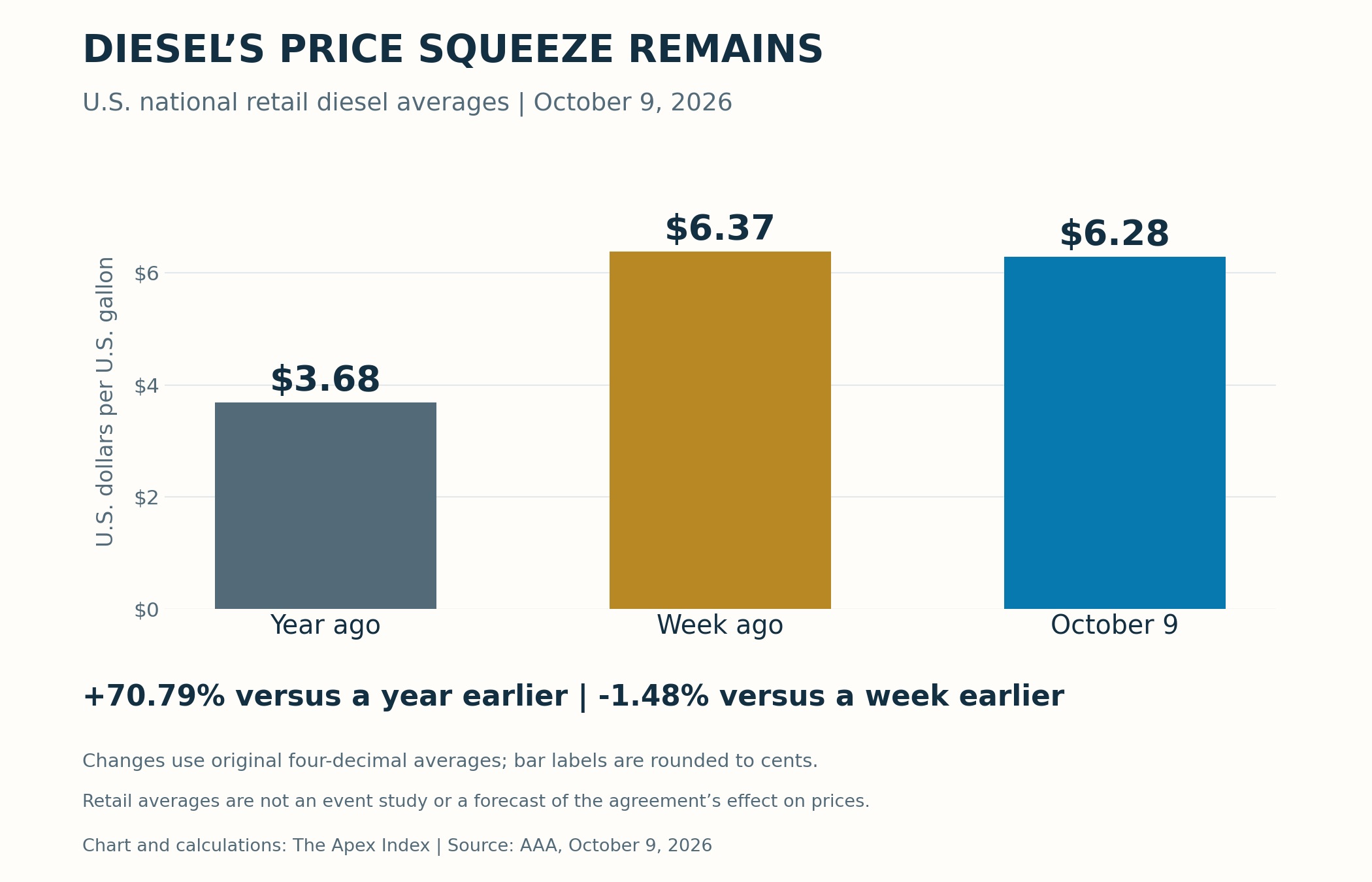
AAA’s October 9 national average put U.S. retail diesel at $6.2785 per gallon, about $6.28. That was 70.79% above the year-earlier average of $3.6761, although 1.48% below the week-earlier $6.3726. The recent dip has not erased the wider squeeze.
As previously reported by Apex, tanker attacks and Iranian threats have complicated shipping through Hormuz. Those disruptions make additional supplies politically attractive, while uncertainty over Russian refining complicates the delivery promise.
The decisive test is now twofold: whether Russian cargoes reach buyers and meaningfully reduce costs, and whether Russia agrees to reciprocal restraint. Trump has announced the trade opening. Ukraine is warning that cheaper diesel without de-escalation could leave Putin better financed and the war no closer to ending.