

America’s semiconductor import bill rose 84% in the first eight months of 2026, exposing a tension at the heart of Donald Trump’s AI ambitions: the United States wants to lead the technology while buying substantially more of its essential hardware from abroad.
The increase is in spending, not the number of chips. Imports reached $90.467 billion from January through August, compared with $49.169 billion in the same period last year. The broad semiconductor category includes more than AI processors, so the figures cannot establish how much of the increase went specifically into data centres.
What the 84% actually measures
The original figures, published October 6 by the Census Bureau and Bureau of Economic Analysis, show an additional $41.298 billion in semiconductor purchases. The exact increase is 83.99%, rounded to 84%. These are seasonally adjusted dollar values, not an estimate of America’s share of global chip production.
Yahoo Finance’s October 10 report described the AI data-centre build-out as accelerating America’s reliance on foreign semiconductors. The latest official trade observations cover August, showing how the infrastructure boom is reshaping the hardware bill.
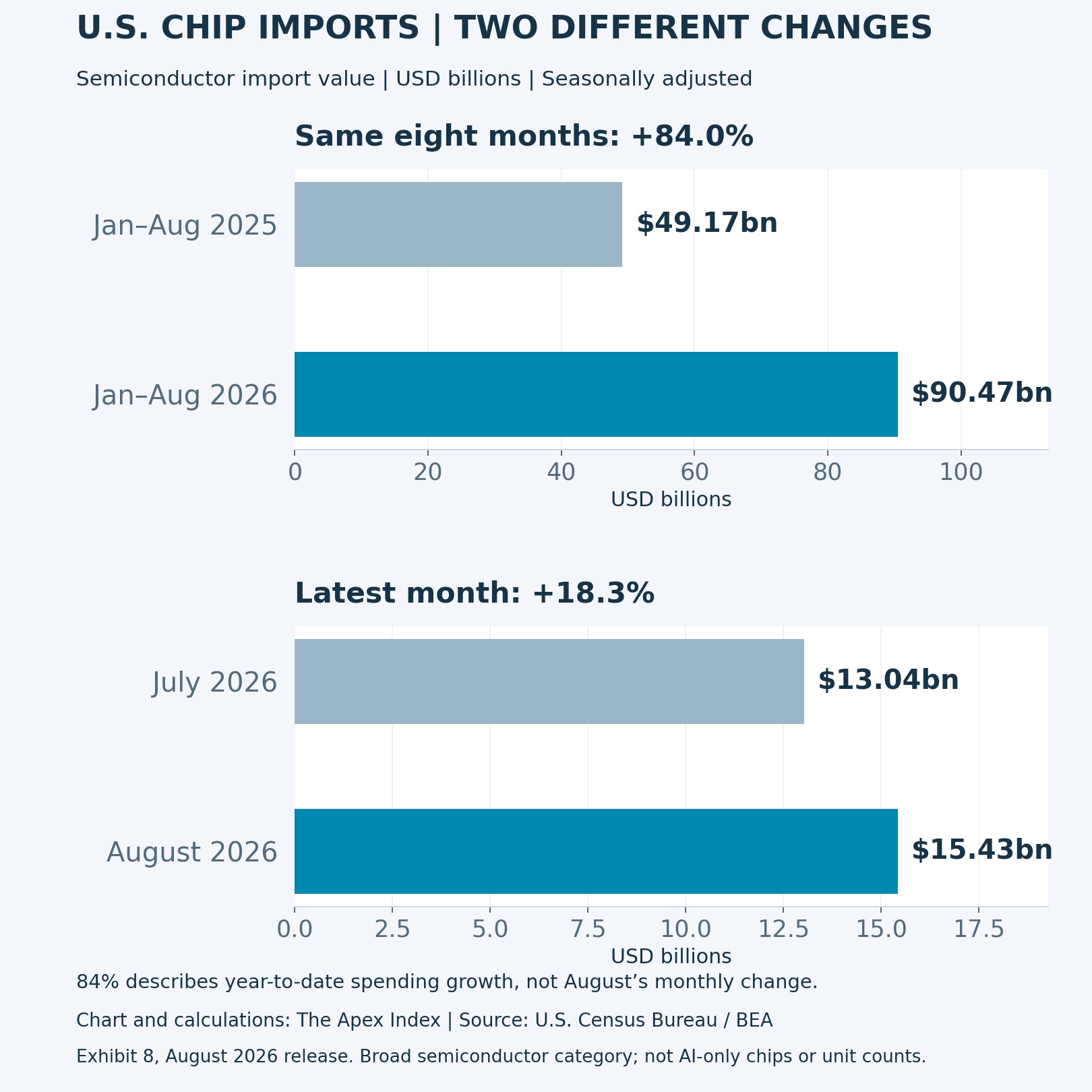
August alone recorded $15.429 billion of chip imports and $7.797 billion of exports, leaving a $7.632 billion semiconductor trade deficit. Imports rose 18.3% from July, a different comparison from the headline’s 84% annual increase.
Exports are growing too. January–August semiconductor exports reached $56.816 billion, up $11.629 billion, or 25.7%, from a year earlier. The imbalance reflects import spending growing much faster, rather than American chip exports collapsing. Product prices and the mix of chips purchased can also affect these dollar totals.
Trump’s manufacturing goal runs into the build-out
The administration’s July 2025 AI Action Plan made technological dominance a national-security objective. Trump framed the ambition in its opening statement:
As our global competitors race to exploit these technologies, it is a national security imperative for the United States to achieve and maintain unquestioned and unchallenged global technological dominance. To secure our future, we must harness the full power of American innovation.
The document also set an explicit manufacturing objective:
America must bring semiconductor manufacturing back to U.S. soil. A revitalized U.S. chip industry will generate thousands of high-paying jobs, reinforce our technological leadership, and protect our supply chains from disruption by foreign rivals.
As previously reported by Apex, total U.S. imports reached $420.8 billion in August, with the trade deficit widening to $105.6 billion. The chip increase sits inside that broader goods-import surge, rather than accounting for the entire deficit.
That policy seeks faster permitting for chip factories, data centres and energy infrastructure. But those projects solve different problems on different schedules. Building computing capacity can increase demand for imported hardware before new domestic fabrication capacity is ready to supply it.
American technology can still depend on foreign factories
Chip design, fabrication, packaging and installation need not happen in the same country. An American company’s processor can therefore contribute to an import bill without transferring its intellectual property or corporate ownership abroad. Conversely, leadership in chip design does not eliminate exposure to overseas production or delivery bottlenecks.
The scale of planned purchases reinforces the urgency. As previously reported by Apex, Broadcom is seeking more than $50 billion in financing for OpenAI’s custom-chip effort. That is a procurement and financing plan, not a measured contribution to the import figures, but it illustrates how large the infrastructure commitments have become.
The Semiconductor Industry Association’s 2026 industry report explains why this demand reaches beyond the best-known AI processors. Advanced logic, memory and analog chips all support AI systems. Expanding computing capacity therefore pulls on several parts of the supply chain, while chip factories also serve communications, transport and other industries. The import category captures that broader demand.
For Washington, the challenge is to expand domestic capacity without starving the AI build-out of hardware it needs now. Higher imports alone cannot establish the foreign share of U.S. chip consumption, but the widening gap between imports and exports makes the manufacturing promise harder to deliver. September’s trade figures are due November 4.