
SpaceX’s borrowing ambitions are colliding with growing anxiety in the credit market. The company’s default protection reached a record on Wednesday as investors assessed a proposed $40 billion financing package to buy Nvidia chips, turning the AI expansion into a sharper test of lenders’ appetite.
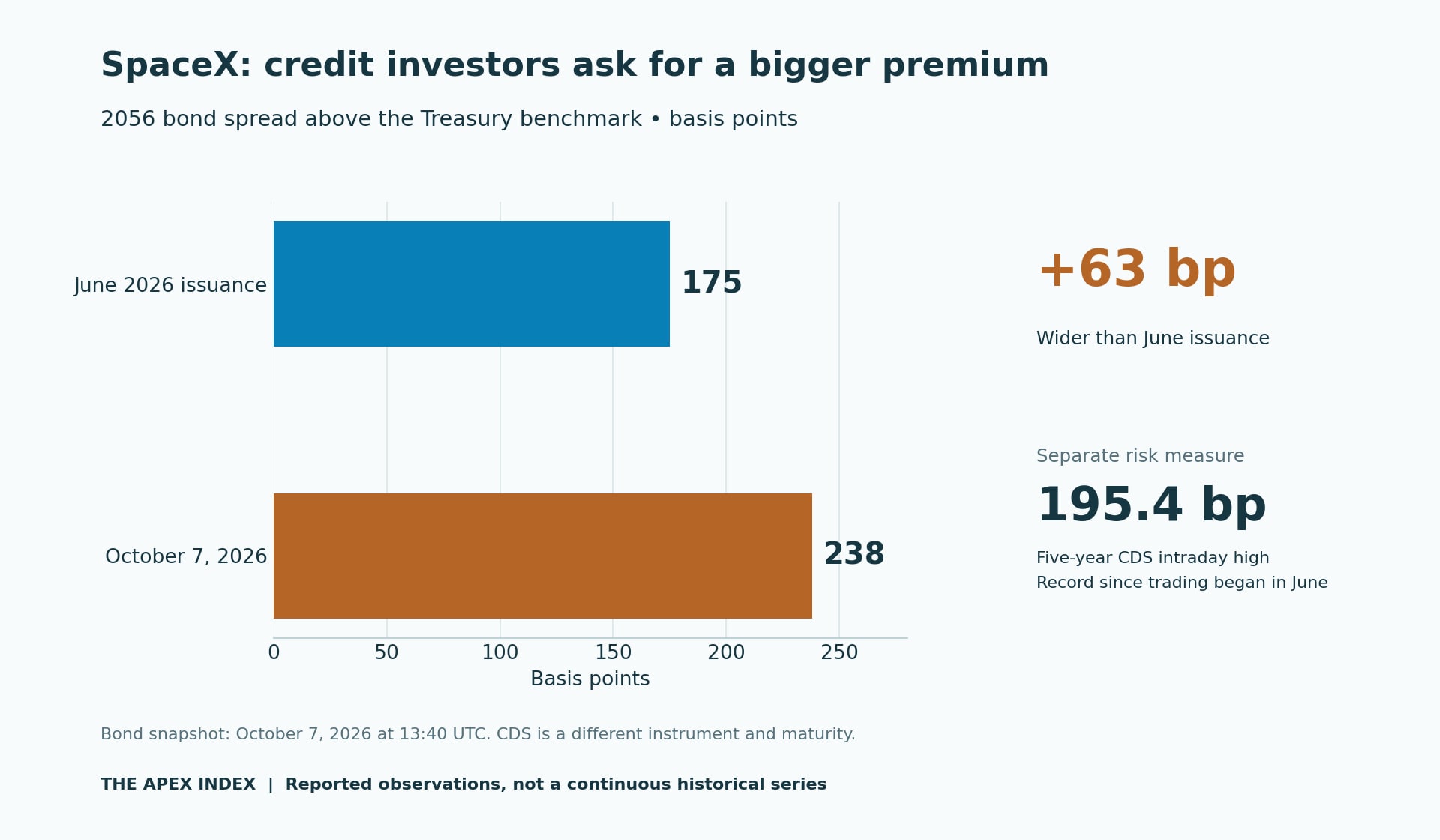
Five-year credit default swaps climbed as much as 14.5 basis points to around 195.4 basis points annually. That was the highest intraday reading since the contracts began actively trading in June, rather than a record spanning the company’s entire history. Its longer-dated bonds also weakened.
The original Bloomberg report cited ICE Data Services for the swap pricing. The move means investors demanded more compensation to insure against a credit event. It does not establish that a default is imminent or translate directly into a probability of bankruptcy.
Credit investors demand more compensation
The pressure extended to SpaceX’s 6.65% bonds maturing in 2056. Their spread widened 12 basis points to 238 basis points by 13:40 UTC on October 7, according to FINRA TRACE figures cited in the report. The same issue had been sold at a 175-basis-point spread in June.
That leaves the spread 63 basis points wider than at issuance. Investors are asking for more return above the Treasury benchmark, separate from the government bond yield itself. The 6.65% coupon remains a contractual payment rate; it should not be confused with the bond’s changing market yield.
The accompanying chart separates that bond comparison from the swap quote. Both indicate repricing, but they cover different instruments and maturities. Treating them as one continuous risk series would exaggerate what the available observations actually show.
A wider spread can lower an existing bond’s price and raise the hurdle for future borrowing. That matters while Treasury yields are already elevated: companies must compensate lenders for both the underlying interest-rate environment and their own credit exposure.
Long maturities amplify the effect of changing discount rates on bond prices. A lender holding debt through 2056 must also assess hardware replacement, competition and the durability of customer demand over decades. Those uncertainties can command a higher premium even when a borrower has ample cash today. Our bonds guide explains why interest-rate sensitivity and repayment risk require separate judgments about the borrower’s creditworthiness.
Chip spending meets funding discipline
The financing proposal remains a negotiation. The Financial Times reported roughly $10 billion in bank loans and $30 billion in investment-grade debt, with Apollo expected to lead the transaction and Pimco among lenders in discussions. Closing was envisaged for 2027, rather than an immediate completed borrowing.
That timing leaves room for the size, structure and pricing to change. The latest reporting says discussions are early and could finish without a deal. Nvidia benefits from the prospect of a substantial order, but the financing headlines alone do not establish finalized purchases or secured funding.
SpaceX’s own quarterly filing provides the operating context. It reported $100 billion in cash, cash equivalents and marketable securities at June’s end, alongside second-quarter revenue of $7.814 billion and a $541 million net loss. Those figures argue against reading the spread move as evidence of an immediate liquidity crisis.
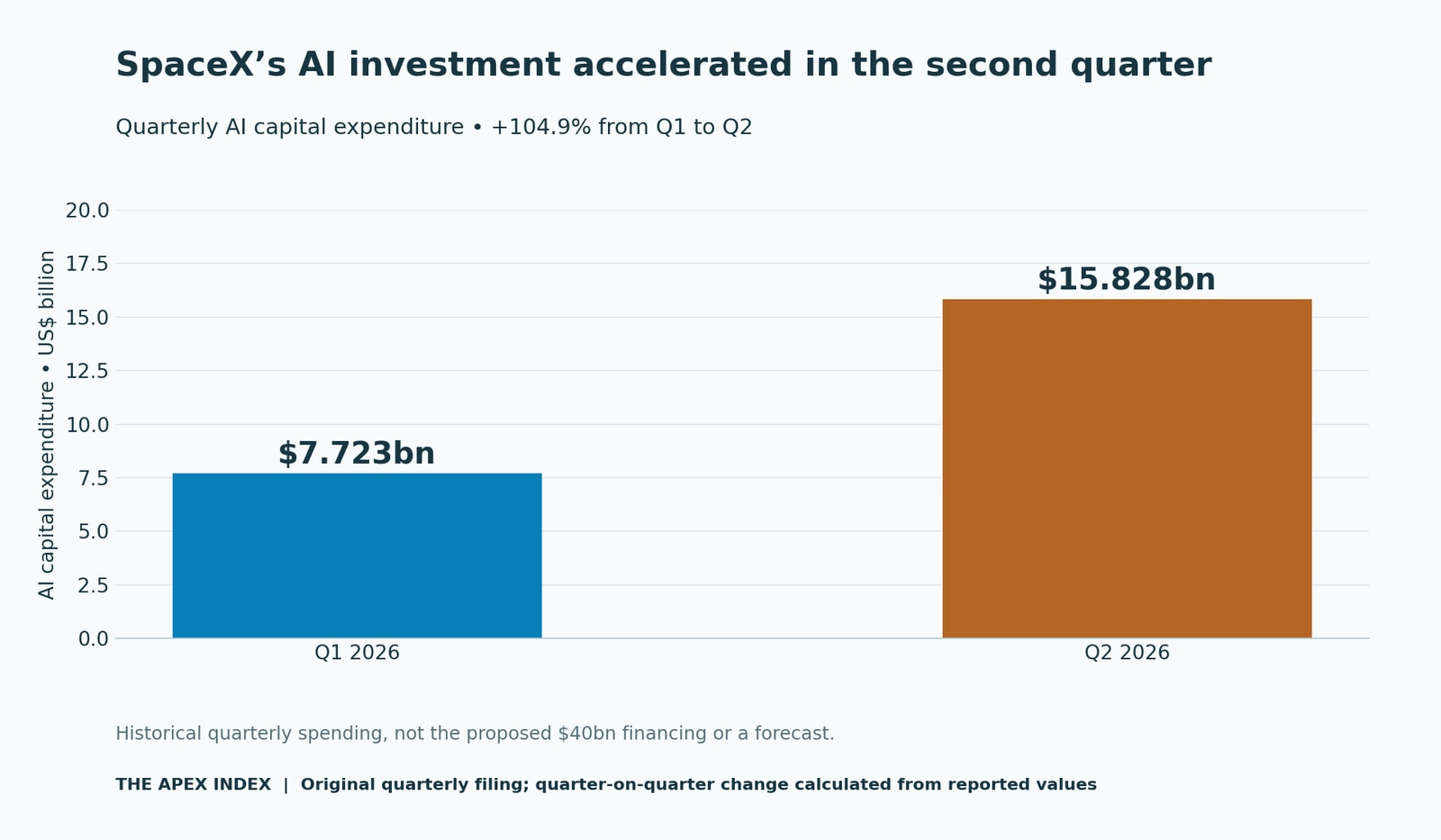
The spending requirements are substantial nonetheless. AI capital expenditure reached $15.828 billion in the second quarter, compared with $7.723 billion in the first. AI revenue was $2.561 billion for the quarter. Infrastructure spending and quarterly revenue are different measures, but their scale helps explain why lenders scrutinize funding plans.
The central question is whether compute investments produce durable cash flows before their financing burden rises further. Bondholders face that repayment test regardless of enthusiasm surrounding Musk, the chips or the broader AI boom.