
Tesla and SpaceX offer different versions of the same investing challenge: buying ambitious businesses without overpaying for milestones still ahead. TSLA has an earnings test approaching; SPCX has a fresh wireless catalyst and a heavy investment programme. Neither company's appeal makes its stock automatically cheap.
The Apex Index's October 8 snapshot, retrieved at 21:11 UTC, puts TSLA at $375, down 0.74%, and SPCX at $160.57, down 4.19%. Both quotes carry a 15-minute delay. This Q4 framework runs through December 31 and uses conditional triggers, not promised year-end closing prices.
Tesla: a delivery beat still needs earnings
The October 2 release confirms Q3 financial results on October 21. Vehicle deliveries reached 486,532, beating the September 29 company-compiled analyst mean of 461,974 by 5.3%. But deliveries fell 2.1% from Q3 2025. Energy-storage deployments of 13.7 GWh missed the earlier 15.9 GWh mean by 13.8%.
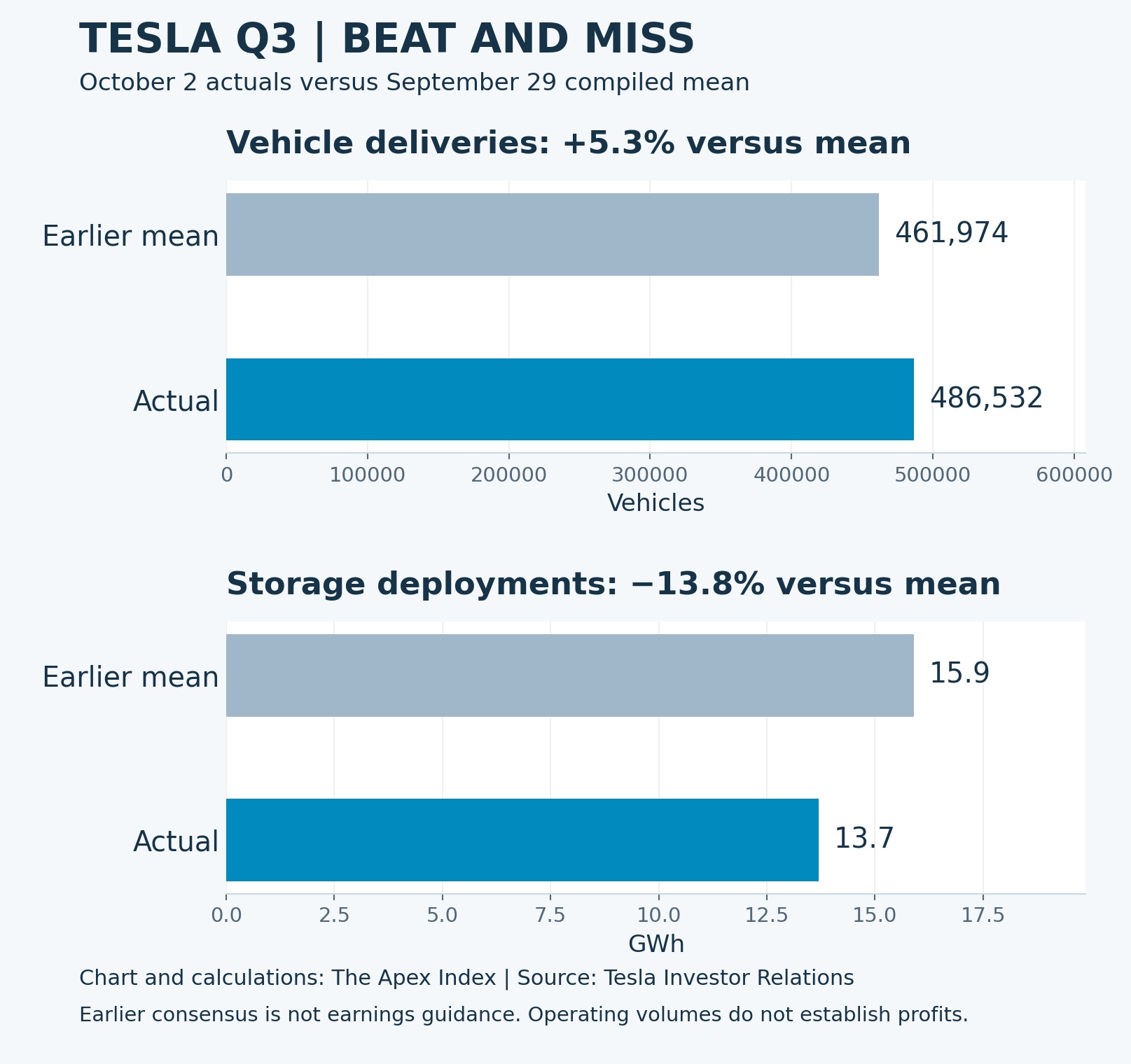
Those mixed operating signals explain why earnings matter more than the delivery headline. The older July 22 update recorded a Q2 operating margin of 1.4% and negative free cash flow of $1.092 billion. Q3 investors need better margins and cash conversion, not just more vehicles shipped.
The fresh technical scans put TSLA at roughly 348 times trailing diluted earnings. That is a historical multiple, not forward consensus. As previously reported by Apex, Cybercab and Optimus feature prominently in its ambitions. Paying that multiple assumes future businesses can generate profits beyond the current vehicle operation.
A revenue beat supported by discounting would carry different implications from stronger sales with expanding margins. The useful comparison is consistent GAAP profitability and cash generation across periods, rather than mixing delivery growth with adjusted earnings to declare the shares inexpensive.
Daily RSI is 55.8, while MACD is positive above its signal. However, ADX around 16.9 indicates weak trend strength, and price remains below the $391.13 200-day average. The $367.80 20-day and $353.27 50-day averages describe a recovery within an unfinished longer-term repair.
A sustained break above the trailing-month $386.83 high, followed by acceptance above $391.13, would support a retest of the three-month $406.59 high. That $391–$407 zone is roughly 4.3%–8.4% above the snapshot. Losing $367.80 and failing to reclaim it shifts attention toward $353.27 and the $345.88 month-low reference.
SpaceX: opportunity versus funding demands
As previously reported by Apex, the October 8 Starlink announcement combines a new 800 MHz spectrum agreement with authorization for 15,000 mobile satellites. The license transfer still needs FCC approval. It expands the addressable business opportunity without establishing new Q3 revenue, a retail launch date or proven indoor performance.
Earlier Apex financing coverage described the Q2 loss, substantial cash reserves and proposed chip borrowing. The original August 4 filing additionally shows first-half operating cash inflow of $3.466 billion against $34.487 billion of investing outflows. Investing cash flow includes more than capital expenditure; it is not interchangeable with free cash flow.
That gap makes funding discipline central to valuation. Cash reserves provide runway, but the investment case still requires growing services to cover development and infrastructure costs. Unlike Tesla's confirmed October 21 report, the original SpaceX investor calendar checked for this analysis lists no upcoming Q3 event. Provider date estimates are not company confirmation.
SPCX's daily RSI is 56.9 and ADX is 27.7, with MACD above its signal. Price exceeds the $153.83 20-day and $143.23 50-day averages. No 200-day value is available in the verified feed. Compared with TSLA, the directional structure is stronger, although the latest session's decline warrants caution.
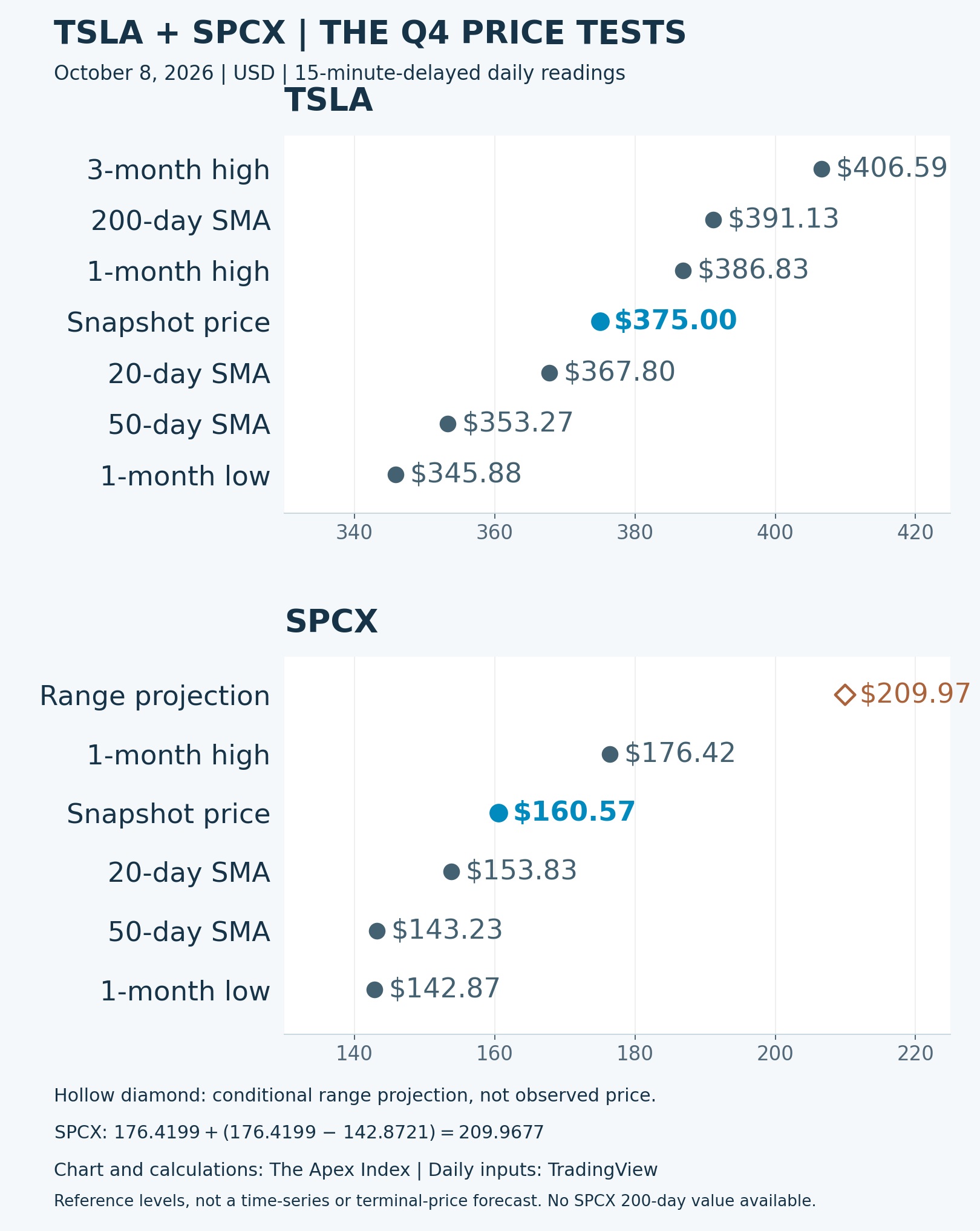
The bullish trigger is sustained acceptance above the trailing-month $176.4199 high, followed by a successful retest. Adding the $33.5478 monthly range produces a conditional $209.97 extension. Those references imply approximately 9.9% and 30.8% upside. The extension is a geometric projection, not a probability estimate or fundamental fair value.
A failed reclaim after losing $153.83 weakens that setup and exposes the $143.23–$142.87 support cluster, about 11% below the snapshot. The upside projection remains inactive until the breakout conditions hold.
Are either worth buying now?
Both merit monitoring, but neither qualifies as an uncomplicated value purchase. Tesla needs earnings confirmation and a recovered long-term trend; SpaceX needs breakout confirmation alongside funding visibility. Daily ATR is approximately $11.73 for TSLA and $7.15 for SPCX. Those trailing ranges are not options-implied earnings moves, and earnings gaps can exceed them. Moving averages also change: use updated levels and position sizes that survive a failed thesis.
Owning both spreads exposure across different operations but retains dependence on Musk-led execution and ambitious investment programmes. A technical breakout can establish a trade setup without establishing investment value. For longer-term buyers, durable cash generation remains the test that a rising chart cannot replace.