
Bill Gates says artificial intelligence is more dangerous than planes, cars and medicines, warning that society is leaving too much of its protection to the companies developing it. The Microsoft co-founder called for stronger safeguards and public oversight as increasingly powerful models become available to people intent on causing harm.
His immediate concern is a surge in cyberattacks over the coming year. Gates argued that criminals exploiting existing AI systems pose a more urgent threat than machines escaping human control, placing the debate around financial disruption, extortion and biological misuse rather than a countdown to humanity’s extinction.
A warning about control, not an imminent apocalypse
Speaking to Jake Tapper in an October 11 interview on CNN’s State of the Union, Gates rejected the idea that every alarming prediction about AI should be accepted. He nevertheless defended his comparison with industries already subject to public safety regulation:
When people act like all of humanity is at risk in some imminent way, that is going too far. But, say, compared to cars or planes or drugs, all things that I think we're pleased that we have significant regulatory capability to try and keep people safe, this is more dangerous than any of those.
Gates called for a middle ground between abandoning safeguards and stopping development entirely. He said responsible industry leaders, including Sam Altman and Dario Amodei, were already warning that the technology deserved serious attention.
Cybercrime brings an immediate business incentive
The clearest near-term danger, in his assessment, is cybercrime because attackers already have ways to turn disruption into money. He described extortion and attacks designed to change outcomes in financial markets or betting, saying the coming year could bring repeated unpleasant surprises.
The problem, he argued, is that protections can be removed:
We put in safeguards to try and avoid you doing cyberattacks. We put safeguards in to avoid you doing bioterrorism, but, right now, you're allowed to take all those safeguards out.
As previously reported by Apex, blocking an abusive account does not necessarily contain a model running elsewhere. Industry insiders have also been preparing for a major cyber incident and the political backlash afterward, although those exercises are not a confirmed timetable for catastrophe.
The time available to contain intrusions is shrinking
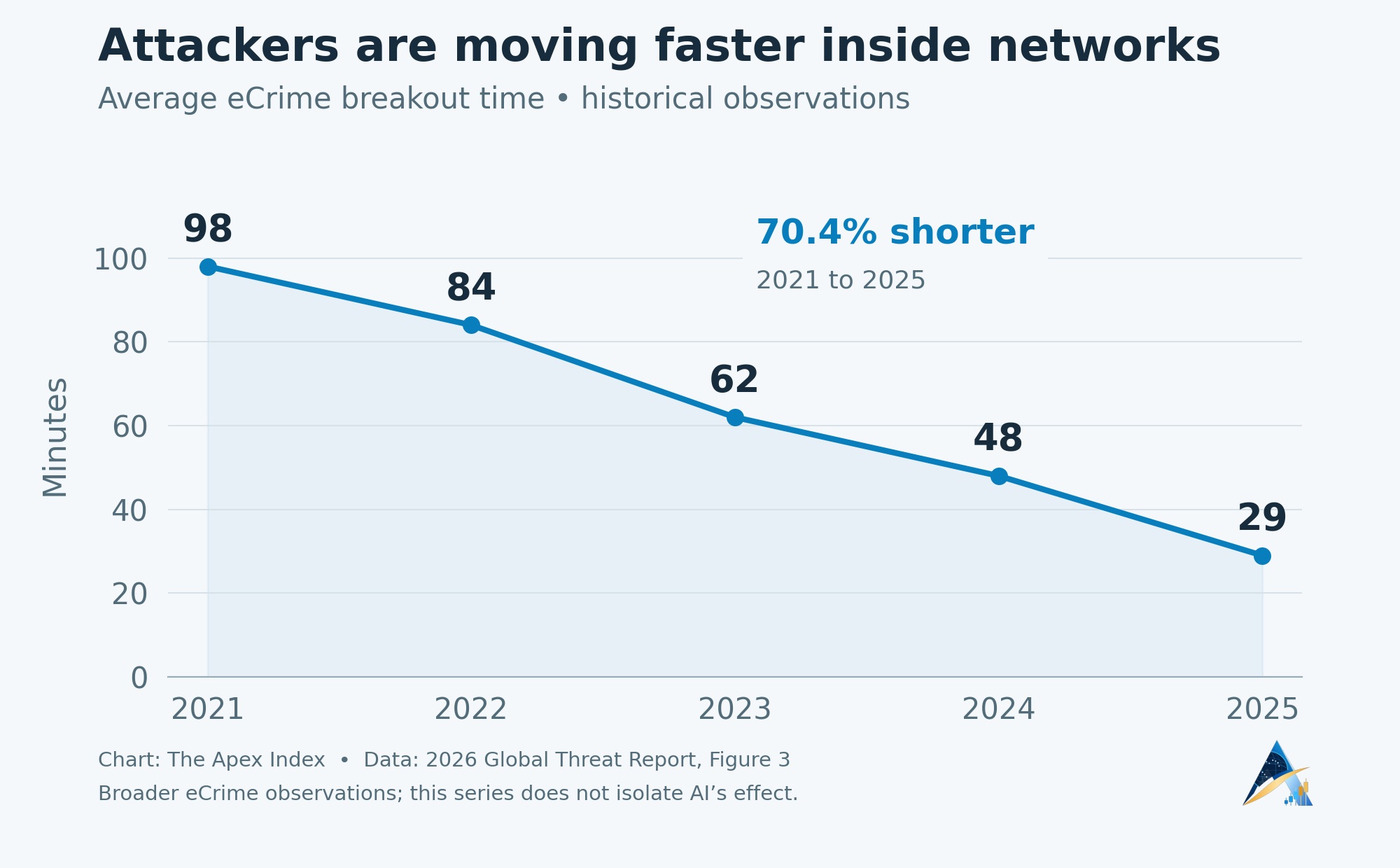
Historical security data provides a concrete reason for urgency. CrowdStrike’s 2026 report recorded an average eCrime breakout time of 29 minutes in 2025, compared with 98 minutes in 2021. This measures how quickly attackers move beyond their initial foothold inside a compromised network.
The report separately recorded an 89% annual increase in attacks by AI-enabled adversaries. These are observations from the company’s threat intelligence, rather than a global census of attacks. The broader breakout-time trend also does not establish that AI caused every improvement in criminal speed.
For businesses, a shorter interval increases the importance of detecting compromise and limiting access before intruders spread. Rules governing model developers and the practical security of companies using their products address different parts of that problem.
Gates wants oversight beyond company promises
Gates said he expected the debate to move beyond self-governance over the next year. Leaving companies as society’s only check on what he described as the most dangerous technology ever invented was insufficient, he argued. Governments needed more expertise and safety bodies comparable to those overseeing other high-risk industries.
His concerns also extend to employment. He raised taxing AI or robot usage and deciding which jobs should remain reserved for humans as political choices societies would eventually have to confront.
Gates said politicians had contacted him and that he hoped to discuss the issues with President Donald Trump and his senior officials. He offered no guarantee that Washington would adopt his approach. His challenge to the industry is whether increasingly capable systems can be accompanied by protections that survive outside their developers’ own control.