

A tariff begins at the border, but its effects rarely stay there. A charge on an imported washing machine can reach a household’s shopping budget. A duty on steel can change the economics of building a factory. An increase on electronic components can squeeze a manufacturer that sells entirely within its own country.
That is why tariffs matter to consumers, workers, businesses and investors. The practical questions are how the charge is calculated, who pays it first, how the cost travels through the economy and whether the policy achieves what its government intended.
This guide explains tariffs across economies, rather than the rules of one country. Official sources were checked on October 8, 2026, UTC. As one national example, the U.S. International Trade Commission’s current schedule is 2026 Revision 20, published September 28. The worked percentages below are hypothetical; actual bills depend on the importing jurisdiction, product, origin and rules in force.
What is a tariff?
A tariff is a tax imposed on goods crossing a country’s customs border, most commonly on imports. In an ordinary import transaction, the importing jurisdiction collects the duty from the importer responsible for the customs entry. The foreign government does not automatically write a cheque to cover it.
A tariff changes the price of bringing a product into a market. That can make an imported product less competitive against a locally made alternative, raise government revenue or give a government leverage in negotiations. Those objectives can overlap, but the economic results depend on how companies and customers respond.
Tariffs are usually associated with goods rather than an ordinary cross-border purchase of a service. A government can also tax services or regulate their supply, but that is a different mechanism. Countries can impose export duties too; an export tariff is charged on goods leaving the jurisdiction rather than arriving in it.
A tariff is also different from a quota. A quota limits the quantity that can enter under specified conditions. A tariff charges money. A tariff-rate quota combines the two by applying one duty rate within an allowed quantity and a higher rate beyond it.
How is the tariff bill calculated?
The simplest form is an ad valorem tariff: a percentage of the goods’ customs value. Suppose a shipment has an accepted customs value of $10,000 and the applicable duty is 10%. The tariff is $1,000. The shipment’s value plus that duty is $11,000, before any other relevant costs.
At a hypothetical 25% rate, the duty would be $2,500 and that subtotal would become $12,500. The additional charge is calculated on the customs value, not automatically on whatever price a retailer eventually charges a customer.
Customs value often starts with the transaction value: the price actually paid or payable for goods sold for export to the importing country. Required adjustments can include certain royalties, packing or items supplied to the producer. Freight and insurance treatment depends on the jurisdiction. An invoice total and the final customs value therefore need not be identical.
A specific tariff uses a charge per unit, weight or volume. A hypothetical $2 duty per kilogram on a 500-kilogram shipment produces a $1,000 bill, regardless of whether the goods are inexpensive or premium. A compound tariff combines a percentage charge with a specific duty.
There can also be several layers of duty. Assume, purely for illustration, that a normal 5% tariff and an additional 20% tariff both apply to the same $10,000 customs value and the rules make them additive. The total is $500 plus $2,000, or $2,500. It is not automatically calculated as 20% of the value after adding the first duty. The legal instructions determine which charges apply and how they interact.
Import VAT, excise duties and administrative charges can sit alongside customs duty. They should not all be described as tariffs. In some systems, import VAT is calculated on a base that includes customs duty and other costs. Businesses need to separate each charge before comparing suppliers or estimating the cash required to import.
Who pays first, and who carries the cost?
The importer’s legal obligation and the tariff’s ultimate economic burden are different questions. The importer pays or arranges payment at customs. It then decides whether it can recover that cost from someone else.
A retailer may increase its selling price. A manufacturer may accept a smaller margin to preserve market share. An importer may negotiate a discount from its overseas supplier. Several participants can share the burden, and the distribution can change over time.
For example, a business buying an imported component for $100 and facing a hypothetical 20% tariff initially faces a $20 duty, assuming the customs value remains $100. If it raises its own selling price by only $8, customers have not absorbed the entire border charge. Part may be covered by lower profits, lower supplier prices or savings elsewhere.
The supplier’s willingness to discount matters. So does the customer’s ability to buy an alternative. A specialised industrial component with few substitutes creates a different negotiation from a widely available household product. Exchange-rate movements can also soften or amplify the change in local-currency costs.
The timing matters economically. Existing inventory, long-term contracts and promotional pricing can delay a visible increase on the shelf. A company can absorb the shock temporarily and raise prices when it replenishes stock. An immediate absence of a retail price increase does not prove that the tariff has no cost.
Why do governments introduce tariffs?
One motive is protection: making foreign products more expensive can give domestic producers room to compete. A government may want to preserve employment, encourage a new industry or reduce dependence on an overseas supplier of strategically important goods.
Another motive is bargaining. A tariff can be used to press a trading partner to change a policy or enter an agreement. Governments also collect revenue from duties, although higher rates do not guarantee proportionately higher receipts if imports shrink, switch suppliers or qualify for relief.
Some measures respond to specific trade problems. Anti-dumping duties address imports sold below the legally determined normal value. Countervailing duties address qualifying foreign subsidies. Safeguards can respond to injurious import surges under their own legal conditions. These are distinct procedures; calling every duty a punishment for unfair trade misses important differences.
Protection can benefit one producer while increasing another’s costs. A tariff on imported steel may support a steelmaker, but a domestic machinery company using that steel may face a more expensive input. The policy’s outcome depends on both sides of that relationship, along with investment, productivity and what trading partners do next.
Can tariffs eliminate a trade deficit?
A trade deficit means a country imports more than it exports over the measured period. It is an accounting balance, not a customs invoice. Tariffs can change the composition and volume of goods trade, but they do not mechanically determine the overall balance.
Imports can shift from the targeted country to another supplier rather than disappear. Domestic production may also need imported machinery, fuel or components to expand. Trading partners can retaliate against exports, while changes in exchange rates and domestic spending can offset some of the initial effect.
At the economy-wide level, the external balance is connected to national saving and investment. A country investing more than it saves needs financing from abroad. Reducing one category of imports does not by itself remove that underlying relationship.
As previously reported by Apex, the latest August U.S. trade release showed imports increasing faster than exports. That is useful context for understanding the size of cross-border demand, but one month’s trade figures do not establish what caused the movement or prove that a tariff policy succeeded or failed.
Do tariffs cause inflation or higher interest rates?
A tariff can raise the prices of affected imports and products made with imported inputs. It can also give competing domestic suppliers more room to raise their own prices. The effect on a broad consumer-price index depends on the affected products’ weight in household spending and how much of the cost is passed through.
Researchers at the Federal Reserve examined earlier tariff episodes in a May 2025 study. They found increases in consumer goods prices and stressed that import exposure, substitution and pricing assumptions matter. That historical research helps explain the transmission mechanism; its estimates are not a forecast for October 2026.
A one-time price-level increase is different from a permanently accelerating inflation rate. If a tariff raises prices once and then stops changing, its direct contribution to year-over-year inflation can eventually fade. Further tariff increases, wage responses, shifting expectations or repeated supply disruptions can make the process more persistent.
A central bank must weigh those inflation risks against the possibility of weaker demand and investment. It might keep policy tighter if inflation expectations deteriorate, or respond differently if growth slows sharply. There is no automatic rule that every tariff increase produces an interest-rate increase. The outlook depends on the broader economy and the central bank’s mandate.
Why product codes and origin matter
The headline rate in a political announcement is only the beginning of a real customs calculation. Authorities classify goods using a tariff schedule, usually built on the international Harmonized System. The shared six-digit structure helps identify products, while countries add further digits and their own legal detail.
Material, function and technical characteristics can change classification. A finished product and one of its components may fall under different headings. Searching a familiar retail name is not enough; the explanatory legal notes and descriptions can determine which code is correct.
Origin is another separate test. The country a package was shipped from is not necessarily the country where the goods originate. Routing an item through a third country does not automatically change its origin. Rules can look at production, substantial transformation, tariff classification or the value of local content, depending on the applicable regime.
A preferential rate under a trade agreement also requires qualifying conditions and documentation. Membership in an agreement does not make every shipment from a partner duty-free. An importer must establish that the particular goods satisfy the relevant origin rules and any other requirements.
Additional measures can matter even where a normal tariff line says “free.” The U.S. schedule has special provisions in Chapters 98 and 99, while anti-dumping and countervailing duties require separate checks. The ordinary tariff line is therefore an important starting point, rather than a complete assurance that no import duties will apply.
What does tariff history teach us?
Tariffs have been used for revenue and industrial protection for centuries. Their risks become especially visible when several countries respond to each other. A measure aimed at helping one industry can become part of a cycle that changes market access across many sectors.
The U.S. Tariff Act of 1930, commonly called Smoot-Hawley, is the best-known example. A push to protect agriculture expanded into a broader increase in protection. It took place during the Great Depression, when falling incomes, financial distress and weakening demand were already damaging trade.
The State Department’s Office of the Historian records U.S. imports from Europe falling from $1,334 million in 1929 to $390 million in 1932, while exports to Europe fell from $2,341 million to $784 million. Those are historical nominal trade values, not inflation-adjusted amounts or a measure of today’s economy.
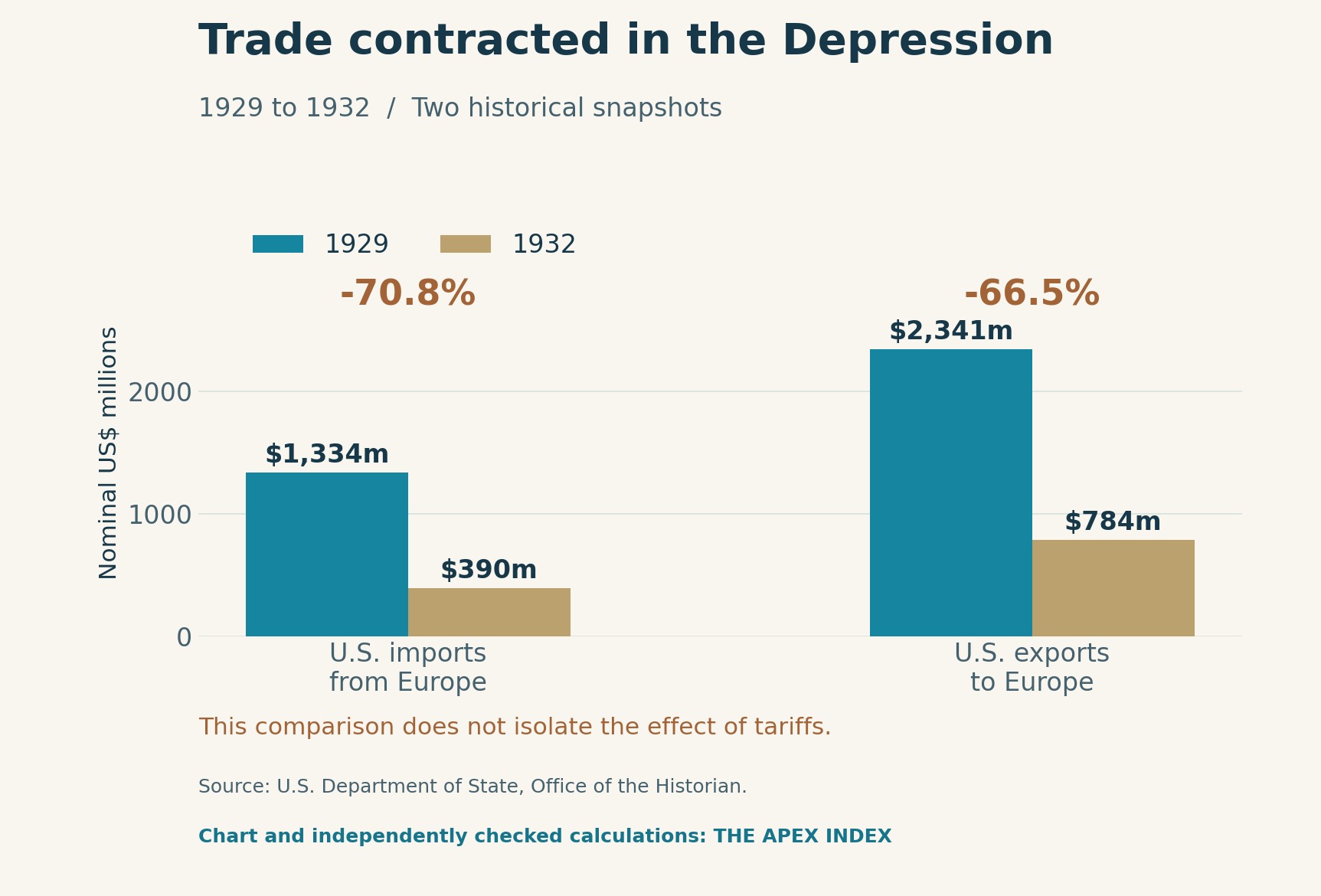
The chart makes the contraction visible, but it cannot isolate the effect of tariffs. The period also involved collapsing demand and severe financial disruption. Treating the entire fall as a tariff effect would confuse events occurring together with evidence that one caused all the others.
That distinction matters when assessing modern policy too. A useful analysis compares actual outcomes with a credible estimate of what would have happened without the measure. It also considers retaliation, substitution, domestic input costs and the time needed to build alternative production capacity.
How should a business or investor assess tariffs?
Start with exposure rather than a company’s nationality. A domestic manufacturer can depend heavily on imported inputs. A multinational can produce inside the market where it sells. Revenue location alone may tell you less than the company’s sourcing, factories and supply-chain contracts.
Then assess pricing power and margins. Can the business charge more without losing customers? Can it replace a supplier without compromising quality or waiting years for capacity? Is the affected input a small expense or a large share of the finished product’s cost?
Cash flow also deserves attention. A duty creates a payment obligation before the goods necessarily generate revenue. Stockpiling ahead of a policy change can increase inventory and financing needs. Delays, extra documentation and uncertainty over the eventual duty can complicate investment even when a company expects to recover the cost later.
For investors, the useful questions are how management describes the exposure, what assumptions its guidance makes and which changes would invalidate those assumptions. A protected producer, an importer and an exporter facing retaliation can experience the same policy very differently. A tariff headline alone is insufficient to identify a winner.
How to read a tariff headline properly
Ask which goods are covered, which origins are affected, how the rate is calculated and what existing duties remain relevant. Check the exclusions, preferential treatment, implementation instructions and whether the measure is an announcement, an effective rule or a proposal.
Keep the policy objective separate from the evidence of its results. Higher revenue, more domestic production, lower imports and better household purchasing power are different outcomes. A policy can move one of them in the intended direction while moving another against it.
For a live transaction, use the importing jurisdiction’s official schedule and customs guidance, along with any applicable trade-remedy instructions. Recheck them before committing to a shipment. A current general explainer helps you understand the system; the product-specific legal documents determine the actual bill.