

The U.S. 10-year Treasury yield crossed 5.35% on Wednesday before easing, taking a benchmark for borrowing costs to its highest levels since 2002. Investors selling government bonds pushed yields higher, intensifying pressure on financing costs as markets prepared for fresh debt supply and details of the Federal Reserve's latest policy decision.
The selloff stretched beyond the American benchmark. The 30-year Treasury yield reached roughly 5.73%, while long-dated British debt and government bonds in France and Italy also came under pressure. The moves left borrowers facing a more expensive market for locking in funding over longer periods.
An intraday TradingView snapshot subsequently showed the 10-year session high at 5.365%, approximately 5.37%, with the latest quote near 5.31%. That distinction matters: crossing 5.35% describes an intraday milestone, not a final closing yield. The same provider recorded a 5.731% high for the American 30-year benchmark.
Higher borrowing costs meet renewed inflation pressure
The Fed raised its policy range by a quarter percentage point to 3.75%–4% on September 16 in a unanimous decision. Its statement described economic activity as expanding at a solid pace, domestic spending as resilient and capital investment as robust. It also said inflation remained elevated, despite the central bank's commitment to its 2% objective.
Minutes from that meeting were still pending as investors assessed Wednesday's bond move. The published decision establishes the rate increase; the minutes can explain the discussion behind it. A firmer inflation outlook can keep expected short-term rates higher, although long-term yields also reflect compensation for maturity risk and the balance between supply and demand.
For existing bondholders, rising yields mean falling prices. Longer maturities generally carry greater sensitivity to a change in yields, so the same rate move can produce a larger price loss on longer-duration securities. A higher yield therefore offers a different return to a new buyer while reducing the market value of an older holding.
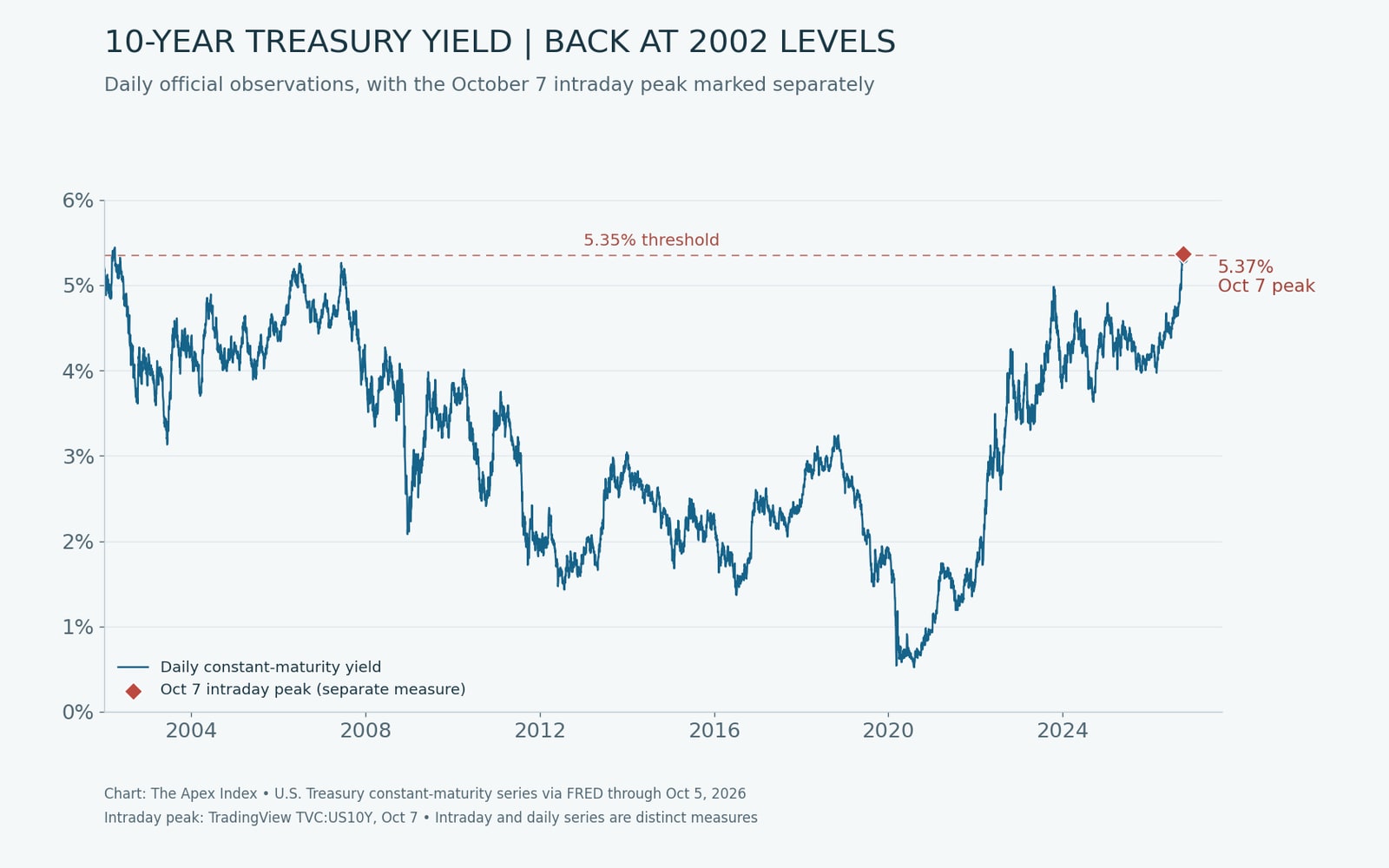
The historical chart uses official daily constant-maturity observations through October 5, when the 10-year reading was 5.31%. Wednesday's intraday peak is marked separately. It is not inserted as a daily observation, and the two measures should not be treated as identical closing prices.
The rise is substantial even before Wednesday's peak. The daily series began 2026 at 4.19%, putting the latest available official observation 1.12 percentage points higher. That is a 112-basis-point increase. Changes of that size can alter refinancing calculations for companies and households, but a Treasury quote is not itself a mortgage offer: lenders add credit, liquidity and other pricing considerations to the government benchmark.
A $39 billion auction tests demand for duration
The Treasury scheduled a $39 billion reopening of its 10-year note for Wednesday. The original auction record showed no awarded yield or bid-to-cover ratio at the time of checking. Demand and the eventual clearing yield will provide evidence about investors' willingness to absorb that supply at the prevailing level of borrowing costs.
An auction's bid-to-cover ratio compares bids with the amount sold. The awarded yield, read alongside market conditions immediately before bidding closes, can help assess how readily buyers accepted the offering. Those results should be evaluated together rather than treating a single number as a complete measure of demand.
Private borrowing adds another dimension to competition for investor capital. SpaceX is seeking $40 billion to buy Nvidia chips in financing expected to close in 2027, according to the original FT report. That proposed transaction illustrates the scale of AI infrastructure funding, but does not establish that one company's financing plans caused Wednesday's government bond selloff.