
Nvidia investors face two different tests at Q3 earnings: whether the company delivers its ambitious operating outlook, and whether the result is strong enough for expectations already embedded in NVDA. Another large revenue number alone would not resolve the second question. The forward outlook, profitability and quality of demand deserve equal attention.
The quarter in question is fiscal 2027 Q3, rather than calendar-year Q3. At 23:17 UTC on October 7, The Apex Index’s market-data snapshot showed NVDA at $237.47, down approximately 0.74%, with the provider identifying a 15-minute delay. That is a timestamped snapshot, not a guaranteed executable price or a forecast of the earnings reaction.
The framework below separates operating delivery from trading scenarios. It does not assign a guaranteed post-earnings target: the market reaction depends on the surprise relative to expectations, not simply the absolute size of the reported business.
The operating hurdle is already high
In its August 26 release, the company guided to Q3 revenue of $108 billion, plus or minus 2%. The resulting range is $105.84 billion to $110.16 billion. The midpoint implies roughly 12.2% sequential growth from Q2’s precisely reported $96.221 billion. These are management’s older guidance figures, not newly published results or analyst consensus.
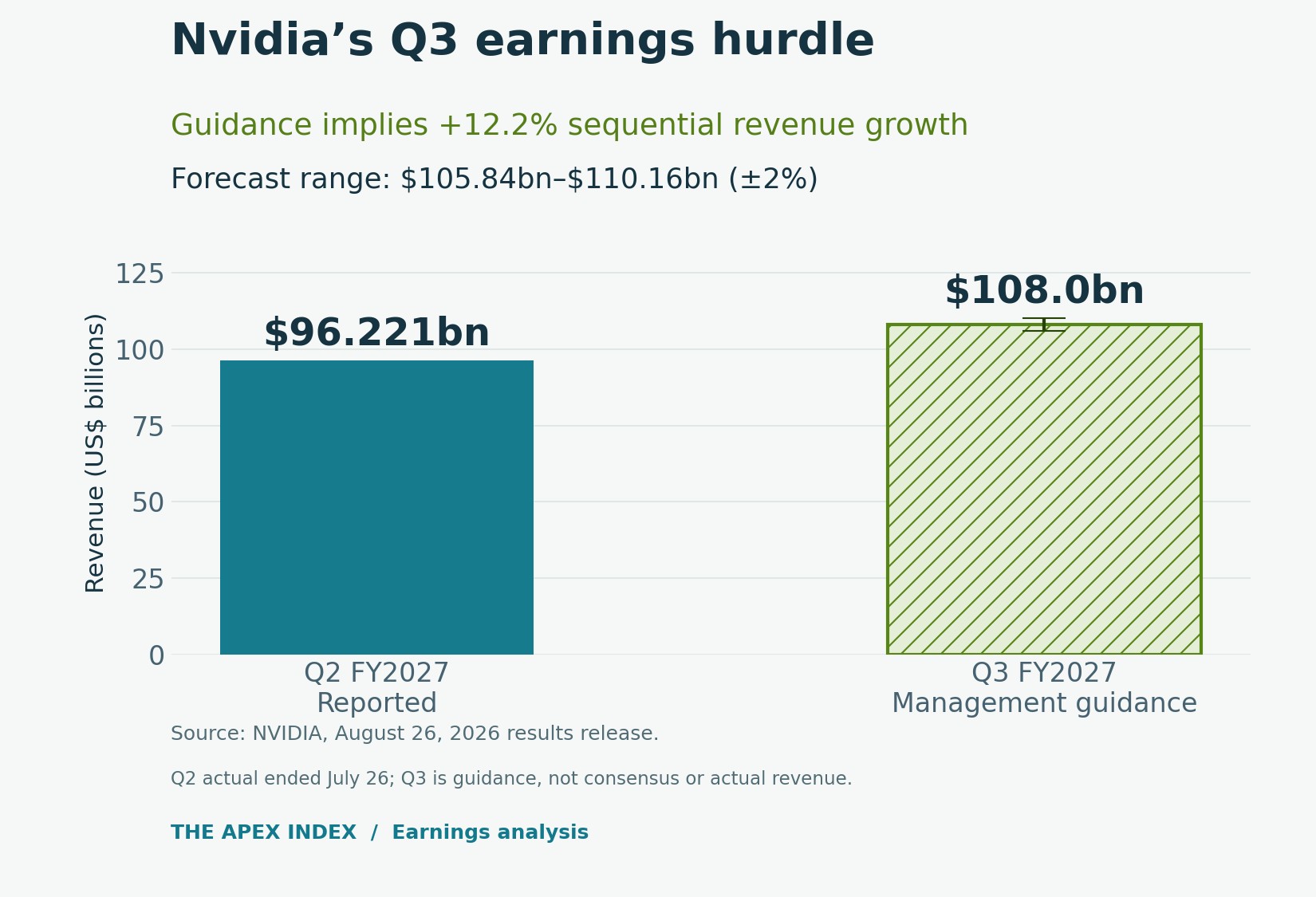
A result inside that range would meet the company’s stated revenue framework. A result above it would exceed that framework, but would not automatically beat the market’s prevailing expectations. Investors should compare any eventual release with both the prior company guidance and independently sourced consensus available immediately before the announcement.
Gross margin is the next checkpoint. Management’s Q3 outlook puts both GAAP and non-GAAP gross margins at 74%, plus or minus 50 basis points, versus 75% reported in Q2. That means a 73.5%–74.5% forecast band. Stronger sales accompanied by weaker margins could produce a different earnings outcome from equally strong sales with better profitability.
The outlook also assumes approximately $9.2 billion in GAAP operating expenses and $9 billion on a non-GAAP basis. Those distinctions matter when comparing earnings figures. Mixing GAAP profits with non-GAAP margins, or annualizing one unusually strong quarter, would distort the valuation assessment.
Data Center contributed $89 billion of Q2 revenue, underscoring where execution matters most. Investors should scrutinize the pace of Vera Rubin deployment, customer acceptance and revenue conversion. The Q3 guidance assumes no Data Center compute revenue from China; any change to that assumption needs explicit management confirmation, rather than being silently added to a bullish model.
What the stock’s structure says
The current technical snapshot is constructive, but it is not a clean earnings signal. Independently rechecked provider scans put the 20-day simple moving average at approximately $225.58, the 50-day at $220.58 and the 200-day at $201.68. At the observed price, NVDA trades above all three, with the shorter averages above the longer ones.
The 14-period RSI was approximately 64.3, while MACD was around 4.90 against a signal line near 3.63. Those readings indicate positive momentum without the conventional 70 RSI threshold being crossed. They cannot establish that the next report will exceed expectations, and a momentum indicator can remain elevated or weaken before price reverses.
For a constructive continuation scenario, investors would want resilient margins, credible subsequent guidance and sustained acceptance above the short-term trend. A break below the 20-day average would weaken that setup; a sustained break below the 50-day would raise the risk of a broader retracement. The 200-day average is a longer-term reference, not a promised downside target.
Average true range was about $5.61. That describes recent trading variability; it is neither an options-implied earnings move nor a ceiling on event risk. Earnings gaps can jump across moving averages before investors have an opportunity to react. Position sizing should account for that discontinuity, not assume an indicator supplies an exact exit price.
Fresh catalysts need a revenue bridge
In its October 7 announcement, Nvidia outlined Windows-focused AI systems with Microsoft, including RTX Spark preorders and a DGX Station preview. The development broadens the product narrative, but preorder availability is not recognized revenue or proof of a material Q3 contribution.
As previously reported by Apex, SpaceX is seeking substantial financing for Nvidia hardware. The related custom-chip analysis above addresses another side of that investment cycle. For NVDA, the decisive earnings question is how announced demand becomes delivered systems, cash generation and durable profitability. Bullish product headlines still need that operating bridge before they justify a stronger valuation thesis.