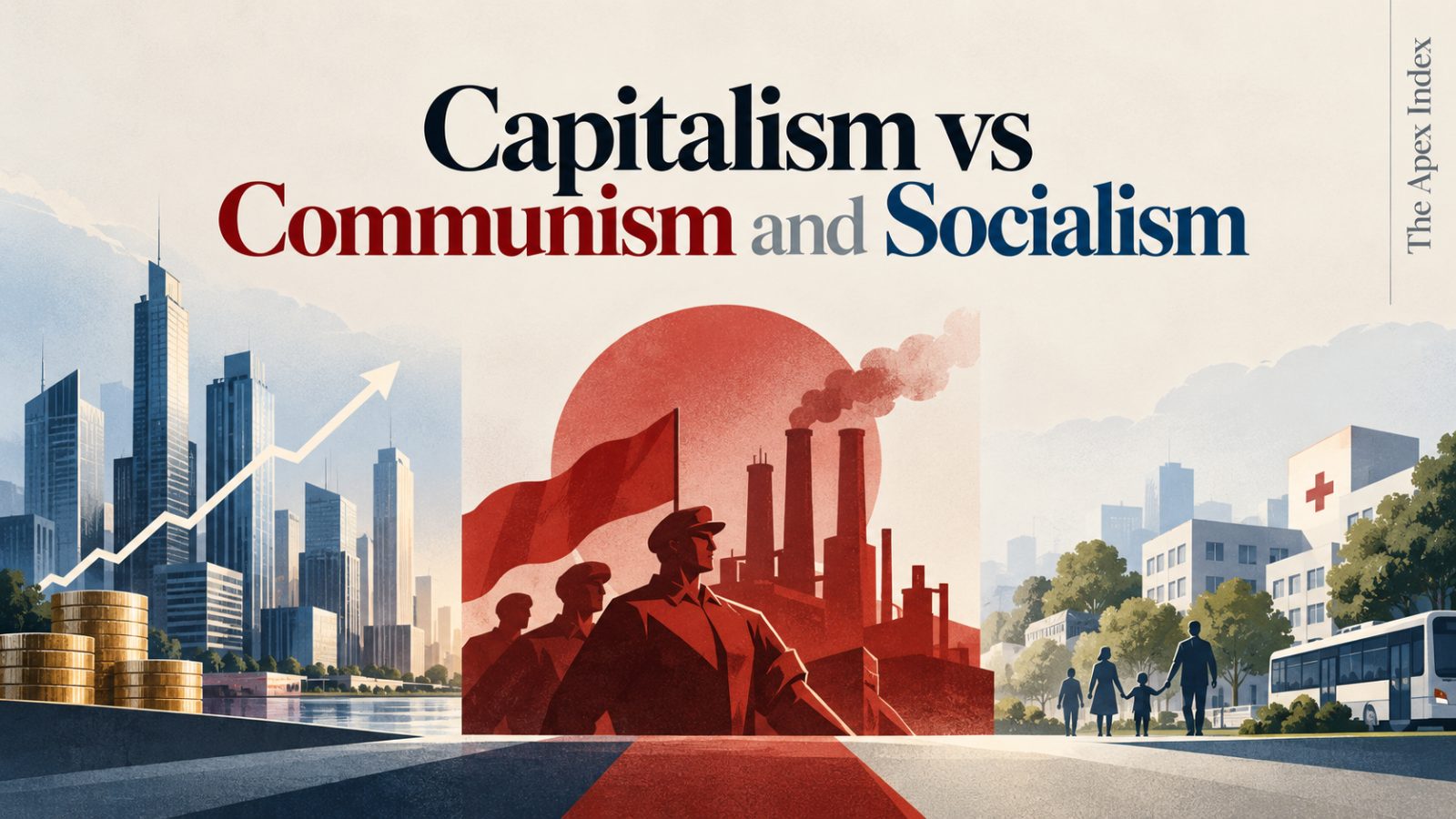
Economics becomes confusing very quickly when capitalism, socialism and communism are treated as political insults instead of economic ideas.
Someone proposes free healthcare and gets called a communist. A government owns an oil company and suddenly the whole country is described as socialist. A private company becomes extremely powerful and critics call it proof that capitalism has failed. None of those shortcuts tells us very much.
The three systems are better understood by asking a few basic questions. Who owns the resources used to produce goods and services? Who controls businesses? How are prices set? Who receives the profits? How much economic power should government or society have?
Those questions expose both the differences and the considerable gray area between the systems.
At the center of the debate is something economists call the means of production. That phrase sounds more complicated than it is. It basically means the productive assets used to create goods and services: factories, machinery, mines, commercial land, infrastructure and other forms of productive capital.
Capitalism, socialism and communism disagree most sharply over who should own and control those assets.
What capitalism, socialism and communism are really about
It is tempting to think the argument is simply about whether government should be “big” or “small.” It is not.
The deeper dispute concerns ownership and economic power.
Under capitalism, productive property is primarily allowed to remain in private hands. Individuals and companies can own businesses, invest capital, hire workers, compete with rivals and keep profits after paying their costs and taxes.
Under socialism, a larger share of productive resources is supposed to come under social ownership or democratic control. That ownership can take several forms. It may mean the national government, local authorities, public trusts, workers, cooperatives or other collective institutions.
Under classical communism, common ownership goes further. The ultimate goal described in Marxist theory is a society in which economic classes disappear and productive resources are held in common rather than controlled by a capitalist owning class.
That makes socialism particularly difficult to define in one sentence. Oxford's Research Encyclopedia of Politics describes socialism as a large and diverse tradition. Socialists generally favor some form of common or democratic control over much of the means of production, but they disagree over markets, planning, political strategy and how ownership should work.
What is capitalism?
Capitalism is an economic system in which productive assets are mainly privately owned and economic activity is largely organized through markets.
Imagine you save money and open a bakery.
You own the ovens, building or lease, equipment and business. You decide what bread to make. You hire workers. Customers decide whether your bread is worth buying. Another bakery can open nearby and compete with you.
If your revenue is greater than your expenses, you make a profit. If customers stop buying from you and your costs stay high, you can lose money or eventually close.
That simple example contains most of capitalism's core machinery.
The International Monetary Fund describes capitalism around features including private property, self-interest, competition, market pricing and freedom of economic choice. Capital and labor move between uses partly in response to prices and expected returns.
Private ownership matters
Capitalism allows people and companies to own productive assets.
This is broader than owning your shoes, phone or house. A person can own shares in a corporation, an apartment complex rented to other people, a factory, farmland, software businesses or machinery used to generate income.
Owners can generally sell those assets, invest more money in them and receive some of the financial gains they produce.
Markets do much of the coordination
A capitalist system typically relies heavily on supply and demand.
There is usually no national office deciding exactly how many sandwiches, laptops, shoes or televisions the entire population should receive next year.
Businesses make their own plans. Consumers make their own purchasing decisions. Prices move as supply, demand and competition change.
Markets therefore act as a huge decentralized information system.
If millions of people suddenly want a certain product, its price may rise. Higher prices and stronger demand can encourage existing producers to increase supply or attract competitors.
This process can be messy, but it allows countless economic decisions to happen without one institution directing all of them.
Profit creates an incentive
The profit motive is another defining feature.
People invest because they hope to receive more value in the future. Businesses have an incentive to lower costs, improve products, reach new customers or develop something their competitors do not have.
The same incentive can create problems. A company interested in profit may pollute, exploit market power, underpay workers or ignore costs imposed on people who are not part of the transaction unless laws, competition or other institutions restrain it.
Capitalism therefore does not necessarily mean zero government.
Even countries strongly associated with capitalism use courts, banking rules, competition law, labor standards, environmental regulation, taxes, central banks and public services.
The IMF notes that mixed capitalist economies, in which markets remain dominant but governments regulate them and provide public functions, are the predominant model today.
What is socialism?
Socialism begins from a different concern: if a small group owns most productive wealth, that group can accumulate enormous economic power over everyone who depends mainly on wages.
Socialists therefore argue, in different ways, that important productive resources should be owned or controlled more broadly.
The difficult part is that there is no single socialist blueprint.
One socialist may support national ownership of major industries. Another may want businesses owned directly by their workers. Another may favor publicly owned investment funds. Another may accept markets but insist that capital should be socially owned.
That diversity is why equating socialism with “the government controls everything” is inaccurate.
Social ownership can mean several things
Social ownership could include a state-owned railway, a worker-owned factory, a municipal utility or a cooperative whose members collectively control the enterprise.
Some forms of socialism allow significant market activity.
That concept is known as market socialism. Companies or productive assets can be socially owned while prices and transactions still operate through markets.
Other versions favor economic planning instead.
The Stanford Encyclopedia of Philosophy notes that socialist proposals range from central planning to participatory planning and market-based models. Socialists themselves disagree deeply over which institutions would work best.
Socialism is not simply welfare spending
This distinction causes endless political arguments.
Suppose a capitalist country taxes private companies and wealthy individuals, then uses some of that revenue for public schools, unemployment benefits and healthcare.
That is redistribution.
It does not by itself transfer ownership of most productive capital from private owners to society.
The country can therefore have a very large welfare state while remaining fundamentally capitalist.
OECD economies offer plenty of examples. Governments across the organization finance pensions, healthcare, family benefits, unemployment programs and other social support while their economies continue to contain extensive private ownership and markets.
What is communism?
Communism is related to socialism but is more specific.
In the Marxist tradition, capitalism is expected eventually to give way to a social order in which the means of production are commonly owned and economic classes disappear.
Karl Marx described a higher phase of communist society in which production had become sufficiently abundant for distribution to follow the principle “from each according to his ability, to each according to his needs.”
An important distinction gets lost in everyday political arguments: the theoretical communist end-state is supposed to be classless and ultimately stateless.
That is very different from saying that an enormous government permanently owns every object and controls everyone forever.
Oxford's definition makes the theory-versus-history problem particularly clear. Communist theory imagines common ownership and, ultimately, no state. Countries historically described as communist, however, usually developed extremely powerful states.
Communism does not mean abolishing every personal possession
Another common misconception is that Marx and Friedrich Engels wanted people to share toothbrushes, clothes and every household object.
The central Marxist attack was aimed at bourgeois private property: productive property that allows an owning class to control capital and employ wage labor.
In The Communist Manifesto, Marx and Engels explicitly distinguished the communist challenge to capitalist property relations from ordinary personal appropriation of goods used to sustain one's life.
The practical boundary between personal property and productive private property can still become complicated. A home used only as a residence is one thing. Twenty apartment buildings operated as income-producing assets raise a different economic question.
Capitalism vs socialism vs communism at a glance
| QUESTION | CAPITALISM | SOCIALISM | COMMUNISM |
|---|---|---|---|
| Who mainly owns productive assets? | Private individuals and companies | Society, workers, public bodies or a mixture depending on the model | Common ownership in the theoretical end-state |
| Are markets allowed? | Yes; usually central to the system | Sometimes; socialist models differ sharply | Classical higher-stage communism goes beyond ordinary capitalist market relations |
| Can private businesses exist? | Yes | Depends on the socialist model | Not in the conventional capitalist ownership form under full communism |
| What happens to profit? | Can accrue to private owners and investors | Usually redirected more toward workers or society depending on ownership | Private capitalist profit disappears with private ownership of productive capital |
| Is economic equality a central objective? | Not necessarily | Generally yes | Yes, alongside abolition of economic classes |
| Does the system require democracy? | No | No single answer; democratic and authoritarian versions have existed | Classical theory and historical communist states differ greatly |
| Does it require a large government? | Not necessarily, though modern capitalist states perform major functions | Depends heavily on the model | The theoretical end-state is stateless, although historical communist regimes built powerful states |
| Can people own personal possessions? | Yes | Yes in most socialist models | Yes; common ownership primarily concerns productive capital rather than every personal item |
Who owns businesses and property under each system?
Ownership is the cleanest place to see the differences.
In capitalism, a founder can create a company and own it. Investors can buy shares. That ownership gives them a legal claim on part of the business and, depending on the arrangement, its future profits.
Employees normally receive wages rather than automatically receiving ownership of the company.
Socialism questions that arrangement.
Why, socialists ask, should the people who supply capital receive lasting control over a company while the people performing its work receive wages but little authority over the enterprise?
Different socialist traditions answer that problem differently.
Some propose worker ownership. Some favor government ownership of strategically important sectors. Some want collective investment funds. Some support cooperatives operating in competitive markets.
Communism goes further by seeking to end the capitalist ownership class itself.
Who decides what gets produced and how much things cost?
This is the second huge dividing line.
Under market capitalism
Millions of consumers and businesses make independent decisions.
Prices transmit information.
If coffee harvests are poor while demand remains strong, coffee becomes scarcer. Prices may rise. Customers may buy less. Producers may seek additional supply.
Nobody needs to know every detail of the entire economy for that adjustment to happen.
Under centrally planned socialism
A planning authority instead attempts to determine how resources should be used, what should be produced and where goods should go.
Planning can theoretically direct resources toward social priorities without requiring every activity to be profitable.
Its central difficulty is information.
Modern economies contain millions of products, workers, factories, preferences, supply relationships and continuously changing conditions. Critics of central planning argue that gathering and processing enough information to make all those decisions efficiently is extraordinarily difficult.
The Stanford Encyclopedia of Philosophy identifies both information and incentive problems among the longstanding criticisms of centralized economic planning.
Socialist markets complicate the picture
Not every socialist wants prices abolished.
Market socialists argue that society can socialize ownership while still letting markets help determine prices and allocate many goods.
That is why markets and capitalism are not technically identical concepts.
Capitalism concerns ownership as well as markets. It is possible to imagine markets with socially owned enterprises, just as it is possible for a nominally capitalist country to place significant parts of production under state direction.
How money, profit and work differ under the three systems
Capitalism gives private profit an important coordinating role.
Someone who believes a new battery, restaurant or software product can succeed has a reason to risk capital building it. Success may create substantial wealth.
Workers meanwhile sell their labor in exchange for wages.
Socialist criticism focuses heavily on that relationship. Marxists argue that workers produce economic value while ownership allows capitalists to claim the surplus remaining after wages and other expenses.
Non-Marxist socialists may reject parts of Marx's economic analysis while still believing that workers should possess greater bargaining power, ownership or control.
A communist society in the fully developed Marxist sense would eventually move beyond the familiar division between private capital owners and wage workers.
Marx did not describe that transition as something that would happen instantly. In his Critique of the Gotha Programme, he distinguished an earlier phase emerging from capitalism from a more developed communist society.
Why most modern economies are mixed
Real economies are untidy.
The United States is capitalist, but its government operates schools, highways, pensions, courts and military services. It regulates banks, collects taxes and transfers money to households.
European capitalist economies often combine large private sectors with public healthcare, social insurance, labor protection and publicly owned enterprises.
Meanwhile, countries governed by communist parties have sometimes introduced extensive markets and private enterprise.
China is the clearest modern example.
China officially describes its system as a socialist market economy. Its constitutional framework protects socialist public property while also recognizing individual and private non-public sectors as major components of that economy.
China's market reforms also expanded the role of non-state firms, competition and private enterprise, producing a system that is difficult to squeeze into a simple capitalism-versus-socialism box. The World Bank has long described China's development in terms of the interaction between markets, state enterprises and an expanding private sector.
This is why asking whether a country is “capitalist or socialist” can sometimes produce a misleading answer.
A better question may be: Which parts of this economy are privately owned, which are publicly owned, how are prices determined, how much does government redistribute, and who ultimately controls investment?
Strengths and weaknesses of capitalism
Capitalism's strongest argument is decentralization.
Individuals do not need permission from one national planning authority before trying a new business model, producing a new product or investing in an idea.
Competition can reward companies that become more efficient or make products people prefer. The possibility of financial gain can motivate investment, risk-taking and innovation.
Markets can also react quickly to changing information because prices continuously move.
But the same system can produce large inequalities.
Ownership itself generates income, meaning people who already possess capital can accumulate additional wealth faster than those relying mainly on wages.
Markets can also fail.
A factory may make money while polluting a river. A monopoly may prevent real competition. Healthcare consumers may lack the information or bargaining power assumed in an ordinary market. Financial institutions can take risks that affect people far beyond their shareholders.
Capitalist countries therefore spend enormous political energy arguing about where markets should operate freely and where regulation, taxation or public provision should step in.
Strengths and weaknesses of socialism
Socialism's strongest case begins with economic power and distribution.
If productive resources are socially owned, supporters argue, society can direct more of the gains from production toward the population rather than allowing ownership income to become concentrated among relatively few people.
Public or cooperative ownership may also allow services to be provided because they are socially useful even when they are not highly profitable.
Socialists argue that economic democracy should matter alongside political democracy. A worker may have one vote in an election, for example, while having almost no say in a company where they spend most of their waking day.
The challenges depend heavily on the model.
Large centralized planning systems face questions about information, incentives, bureaucracy and innovation. State ownership can also concentrate enormous power in political institutions if strong democratic checks do not exist.
Worker cooperatives and market-socialist models avoid some central-planning problems, but they introduce different questions about investment, competition, entrepreneurship and how capital should be allocated.
There is therefore no single list of “results of socialism.” Different socialist institutions can produce very different outcomes.
Strengths and weaknesses associated with communist systems
Communist theory offers an extremely ambitious promise: eliminate economic classes and build a system in which no separate owning class can dominate people who must work for it.
Its appeal has historically been strongest where poverty, land concentration, dangerous working conditions or extreme inequality made existing economic arrangements appear deeply unjust.
But the historical experience of governments built by communist parties raises another set of problems.
Highly centralized ownership can combine political and economic power in the same hands.
If the state controls employment, investment, major industries, information and political institutions while opposition is weak or prohibited, citizens may have few independent centers of power through which to challenge decisions.
The Soviet system achieved rapid industrialization in important periods, but centralized socialist economies also struggled with shortages, consumer choice, incentives and innovation. The Stanford Encyclopedia's discussion of historical planning similarly distinguishes the aspirations of socialist theory from the political concentration and economic weaknesses found in the Soviet model.
Those historical outcomes do not settle every theoretical debate about communism. They do, however, form an unavoidable part of evaluating attempts to construct communist political economies.
Capitalism, socialism and democracy are different questions
Economic systems and political systems are connected, but they are not synonyms.
Capitalism is not another word for democracy.
Private ownership and markets can exist under democratic governments or authoritarian governments.
Likewise, socialism is not automatically dictatorship.
There are socialist traditions explicitly committed to multiparty democracy, elections, civil liberties and decentralized control.
And communist theory's ultimate stateless society should not be confused with the authoritarian structures built by several governments ruled by communist parties.
It is therefore useful to imagine two separate questions.
The first asks: Who owns and controls economic resources?
The second asks: Who holds political power, and how can citizens replace or restrain them?
Answering one does not automatically answer the other.
Real-world examples and why the labels get messy
A completely pure capitalist economy would allow private ownership and market exchange to dominate almost everything while government played only a very narrow role.
Major modern economies do not work that way.
A completely centrally planned socialist economy would put most productive assets under social or state ownership and replace a great deal of market allocation with planning.
That model has existed much more extensively in the past than it does among today's largest economies.
Full communism, in the classical Marxist meaning of a classless and stateless society based on common ownership, has not been achieved by a modern country.
Countries commonly called communist are more precisely countries governed by communist parties, often while describing their existing economic arrangements as socialist stages rather than the final communist society.
Modern economies instead occupy different points across several dimensions.
Some rely heavily on private ownership but tax and redistribute a great deal.
Some contain important state-owned industries alongside private corporations.
Some allow competitive markets while maintaining one-party political control.
Some governments own natural resources but otherwise operate strongly market-based economies.
This is also why ordinary political programs should be described carefully.
Raising the top income-tax rate is not the same thing as abolishing capitalism.
Creating one government-owned company is not the same thing as socialism controlling the whole economy.
Offering universal healthcare does not create communism.
Privatizing one government service does not suddenly produce laissez-faire capitalism.
The meaningful question is always how ownership, control, markets and economic power are organized across the system as a whole.