

Iran-based operators used ChatGPT and fabricated Western journalist identities to place nearly 100 articles in genuine news outlets, a newly disclosed influence campaign that turned editors and publication brands into distribution channels for messaging about the U.S.-Iran conflict.
The operators used seven fake bylines, usually posing as Americans. Their identity and any government connection remain unestablished. The activity appeared consistent with a commercial influence campaign run for hire, rather than an operation investigators could definitively attribute to Tehran.
OpenAI's October 8 report says it banned the associated accounts and shared information with authorities. Investigators identified almost 100 articles published or syndicated under those bylines across roughly a dozen outlets worldwide. The outlets were generally small or medium-sized, focused on international affairs and the Middle East. That count should not be read as 100 separate U.S. publications or 100 independently verified false factual claims.
Fake contributors passed through real editorial gates
The operation, dubbed “Bogus Bylines,” used the model to refine English-language drafts, assess whether they met individual outlets' submission requirements and prepare editorial pitches. Articles concentrated on geopolitics and the war, including criticism of U.S. policy and Israel.
Investigators traced publications from July 2025 through October 2026. The pace increased after the conflict began. The deception lay in the contributors' fabricated identities and concealed operation; an antiwar argument alone does not establish that an article is disinformation.
One persona, Ervin B. Hoskins, claimed to be an American freelance writer while account-transparency information placed associated social accounts in Iran. Another, Noah Lamington, claimed a New Zealand location. The operation also maintained profiles across several platforms to support its invented contributors.
The company's attribution assessment was explicit:
The overall activity appeared consistent with a commercial actor running a for-hire influence campaign, but we are unable to identify the particular actor involved. We have shared information on this case with the relevant authorities.
Once genuine outlets published the pieces, some promoted them through their own social accounts. That gave the operation access to audiences it might otherwise have struggled to reach. The report does not establish how many readers encountered the articles or changed their views.
A successful publishing route, weak comment engagement
The operators also generated batches of English and Persian comments, sometimes praising their own published articles. Other replies addressed missile strikes, ceasefires and diplomacy, portraying America as the aggressor and Iran as a resilient victim. Investigators found only a portion of those replies online.
Their assessment of visible engagement was considerably less dramatic:
The social media replies that we were able to identify generally enjoyed low numbers of likes, views, and comments (in the single or double digits).
Some likes came from accounts linked to the operation itself. The comments generally represented a minority of replies rather than dominating conversations. Automated posting was mentioned in internal reports, but investigators found no evidence that their models supplied that automation.
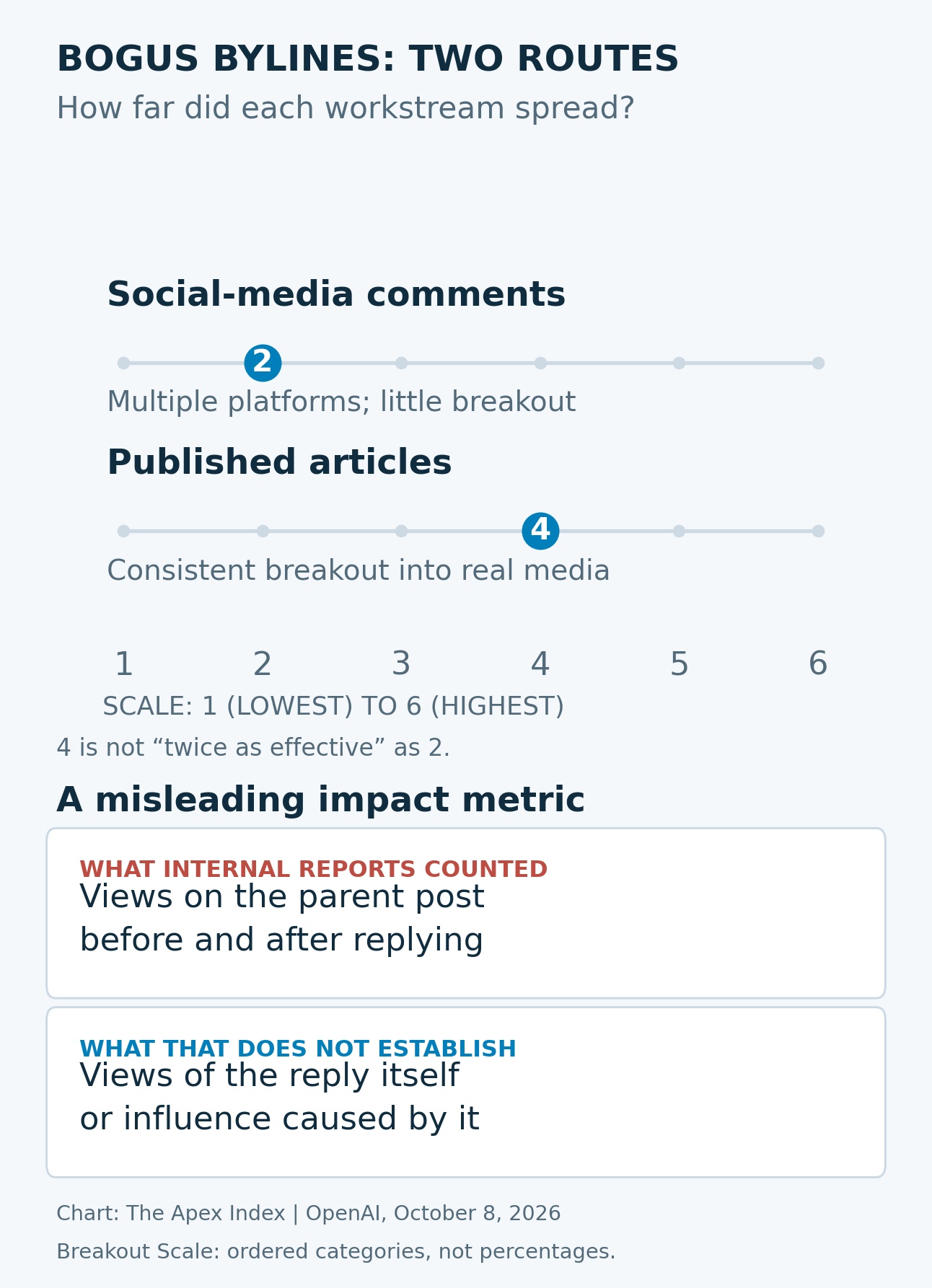
Using the Breakout Scale, the investigation rated commenting at Category 2 and the article operation at Category 4. These are ordered assessments of distribution, not percentages of success. The broader reach came from getting published, not from proving that manufactured applause persuaded an audience.
Internal presentations exaggerated that impact by counting views on the original posts before and after comments appeared, instead of views on the comments themselves. The calculation could not separate the operation's contribution from the posts' existing popularity or other activity.
Another same-day dispute over AI and journalism
Separately, USA Today Co. and affiliated publishers filed a New York federal complaint on October 8 seeking more than $250 million from OpenAI. They allege copyrighted reporting was copied for model training and reproduced or repackaged in outputs. Those are allegations, not a court finding, and the lawsuit is unrelated to the Iranian campaign.
For newsrooms, the influence operation exposes a different vulnerability: polished submissions and plausible biographies can conceal who is actually supplying a story. Editorial scrutiny has to extend beyond readable prose to a contributor's identity and provenance.