
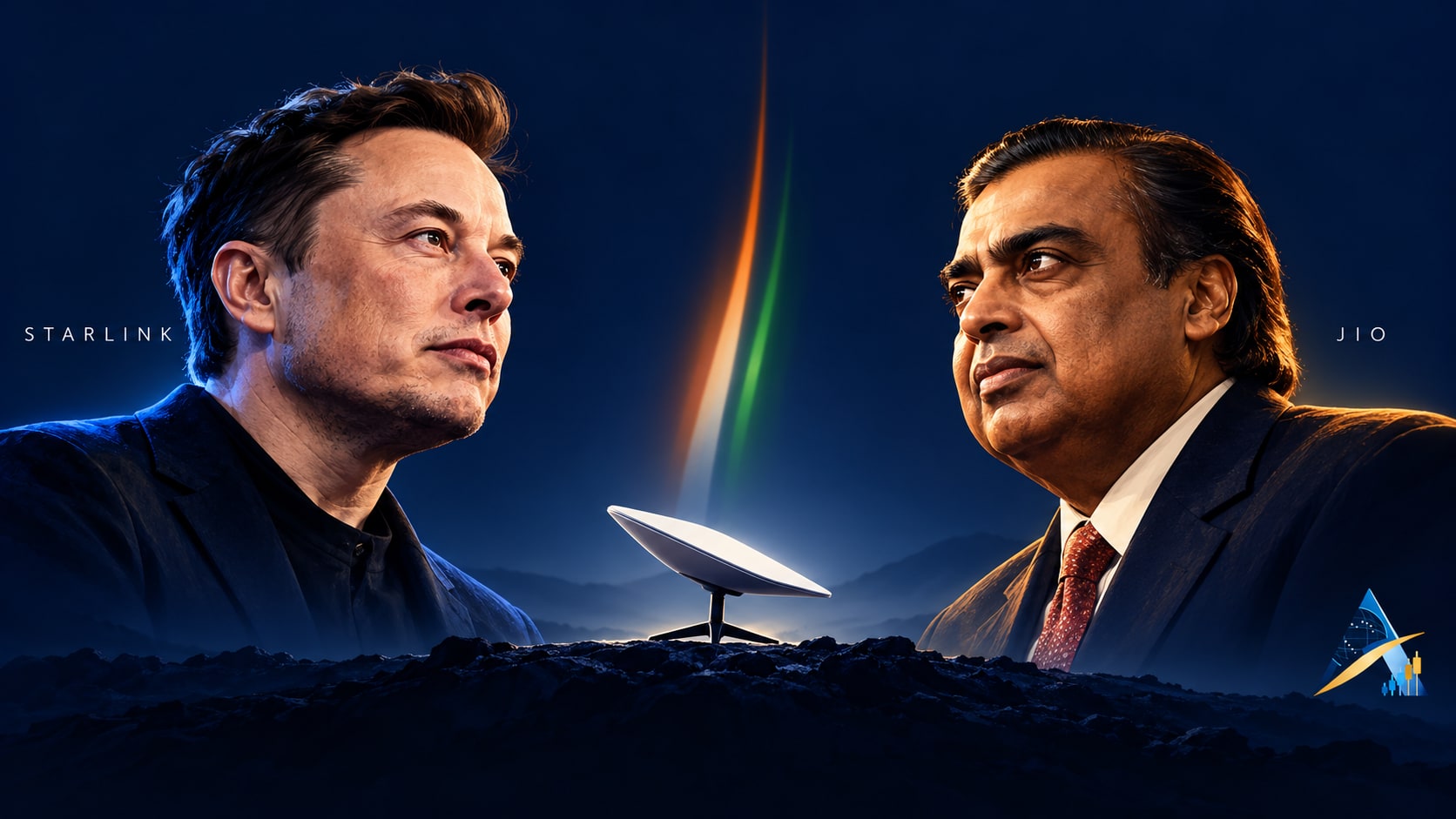
Elon Musk escalated his fight over Starlink’s stalled Indian launch on October 9 by calling Mukesh Ambani “Prime Minister Ambani” and accusing him of protecting his telecom business from competition. The awkward part: Ambani’s Jio has already signed an agreement to sell Starlink to Indian customers.
That makes this more than a clash between two wealthy men. SpaceX wants access to a huge connectivity market, Jio wants to protect the economics of its network, and India’s government says neither company can skip the remaining regulatory requirements. A distribution deal has aligned some of their interests without resolving their disagreement over who should pay for spectrum and on what terms.
Musk made his accusation directly in an October 9 post:
Dear Prime Minister Ambani, Please accept my humble apologies for not realizing that you are the real boss of India. Naturally, you would prefer to maintain your monopolistic exploitation of the great people of India, but would you nonetheless consider allowing Starlink to compete?
He tied the argument to people beyond the reach of existing networks, saying internet access could help children learn and small businesses sell internationally. A second post added an emergency-services argument:
Also, Starlink has proven to be essential for saving lives during natural disasters throughout the world, when all other communications systems have failed, so you would also be helping save men, women and children throughout India.
Musk accused Ambani of interfering without identifying a specific action by the businessman that stopped Starlink from launching. India’s government controls the approval process, which involves several regulatory decisions.
India says Starlink already has a licence
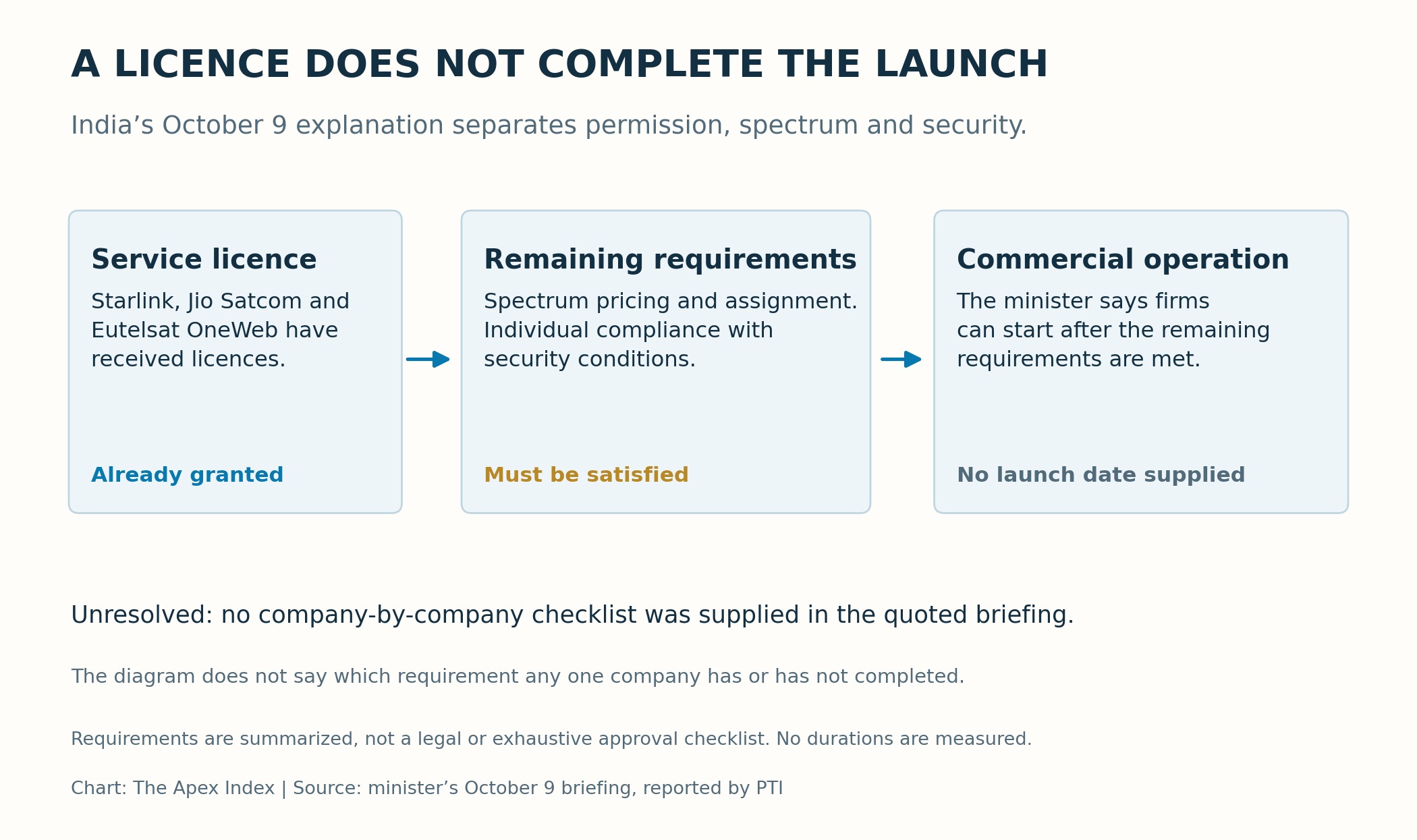
Communications Minister Jyotiraditya Scindia addressed the dispute at the India Mobile Congress in New Delhi on October 9. He said three satellite-service players had received licences: Starlink, Jio Satcom and the Bharti-backed Eutelsat OneWeb. Amazon’s Kuiper would need to follow the established process.
The minister’s explanation separates a service licence from the steps needed to turn it into an operating business. Spectrum charges still need to be settled and spectrum assigned, while each company must fulfil security conditions. As reported from the briefing by PTI, he said:
We are very clear on our stand. There are three parties that have got a licence; as and when the government decides the charge system on the revenue basis, that spectrum will be assigned to them, and as and when they individually fulfil the security conditions, they can start operations.
That does not identify which security requirement any individual company has yet to complete. Nor does it supply a commercial launch date. It does make the claim that Starlink has received no licence different from the government’s stated position that a licence exists but the full route to operation remains unfinished.
In an October 8 statement, the communications ministry said security assessments were underway for all three licensees and that they were at broadly the same regulatory stage. The government has rejected suggestions that its authorisation framework is selectively applied. Scindia said his department was technology agnostic and wanted customers to choose between services. His defence of the process is an official position, not an independent audit proving every applicant has experienced identical treatment.
The Jio deal that makes this fight stranger
On March 12, 2025, Jio Platforms announced an agreement with SpaceX to offer Starlink broadband in India. It was explicitly conditional on SpaceX receiving its own authorisations to sell the service.
Jio said it would offer equipment through retail outlets and online storefronts and establish support for installation and activation. The companies would explore how Starlink could extend Jio’s services and how Jio could complement SpaceX’s direct sales to households and businesses. The announcement did not describe an exclusive arrangement or transfer regulatory authority to Jio.
SpaceX president Gwynne Shotwell’s statement at the time was notably different in tone from Musk’s latest attack:
We are looking forward to working with Jio and receiving authorization from the Government of India to provide more people, organizations and businesses with access to Starlink’s high-speed internet services.
The release presented satellite broadband as a complement to JioFiber and JioAirFiber in locations that are harder to serve. That proposition can coexist with competition elsewhere. A retailer can earn money selling another company’s equipment while opposing regulatory terms it believes would put its own network at a disadvantage.
There is a second complication: Jio’s own satellite venture is among the licensed competitors. Ambani’s group is therefore positioned to participate through its own offering as well as through a distribution relationship with Starlink. That creates a reason to seek partnerships and a reason to contest the rules governing rival networks.
Jio and SpaceX have a commercial relationship as well as a policy disagreement. Musk’s attack has brought that tension into the open: Jio agreed to help sell Starlink while seeking rules that would protect its own network business.
The real argument is over spectrum and costs
The fight has a substantial policy record behind the insults. In October 2024, Starlink’s written submission sought shared access to satellite bands and charges focused on administrative cost recovery. That was before the distribution deal. In its May 13, 2026 submission on satellite-network authorisation, Reliance Jio Infocomm reiterated its demand for auctions and parity between terrestrial and satellite access services. Its position was that providing comparable services should bring comparable regulatory obligations.
Jio argued that lighter fees or security requirements for a separate satellite-network authorisation could produce regulatory arbitrage. It also warned that splitting the service layer from the network layer could leave providers dependent on another operator’s pricing, quality and investment decisions. These were the company’s arguments to the regulator, not findings that satellite providers had breached any rule.
The submission stated:
We reiterate our submission that spectrum assignment for both terrestrial and satellite-based access services should follow the principle of "Same Service, Same Rules." Therefore, ensuring parity in regulatory levies, including spectrum charges, is essential to prevent regulatory arbitrage and to ensure level playing field.
Starlink’s May 13 submission took a different approach. It opposed forcing network operators to hand partnering companies control over network resources through authorisation rules, preferring commercially negotiated arrangements. It also sought flexibility over which party could hold permissions for different satellite links and argued against duplicating existing authorisation obligations.
The technical issue behind spectrum allocation is that satellite and terrestrial networks are organised differently. A mobile operator uses spectrum across a network of ground-based cells. Satellite services involve moving or fixed orbital coverage, user links and gateway links, with interference and coordination rules shaping how frequencies can be reused. Charging models cannot be assessed sensibly without accounting for those differences.
Jio’s claim about fair treatment deserves scrutiny because it has invested in networks and carries continuing compliance costs. But historical investment alone cannot establish that every new technology must use the same allocation mechanism. Satellite frequency sharing still needs transparent charging rules and security oversight.
Why Ambani has so much influence
Ambani is chairman and managing director of Reliance Industries, a conglomerate whose businesses span energy, petrochemicals, retail and digital services. Its importance comes from infrastructure, customers, investment capacity and distribution, rather than from the title Musk assigned him.
Reliance’s July 17 financial release reported consolidated gross revenue of ₹340,257 crore for the quarter ended June 30, 2026. Jio reported a customer base of 533.3 million, roughly 285 million 5G subscribers and 28.6 million fixed-broadband subscribers. Those are dated company figures, not a live October count.
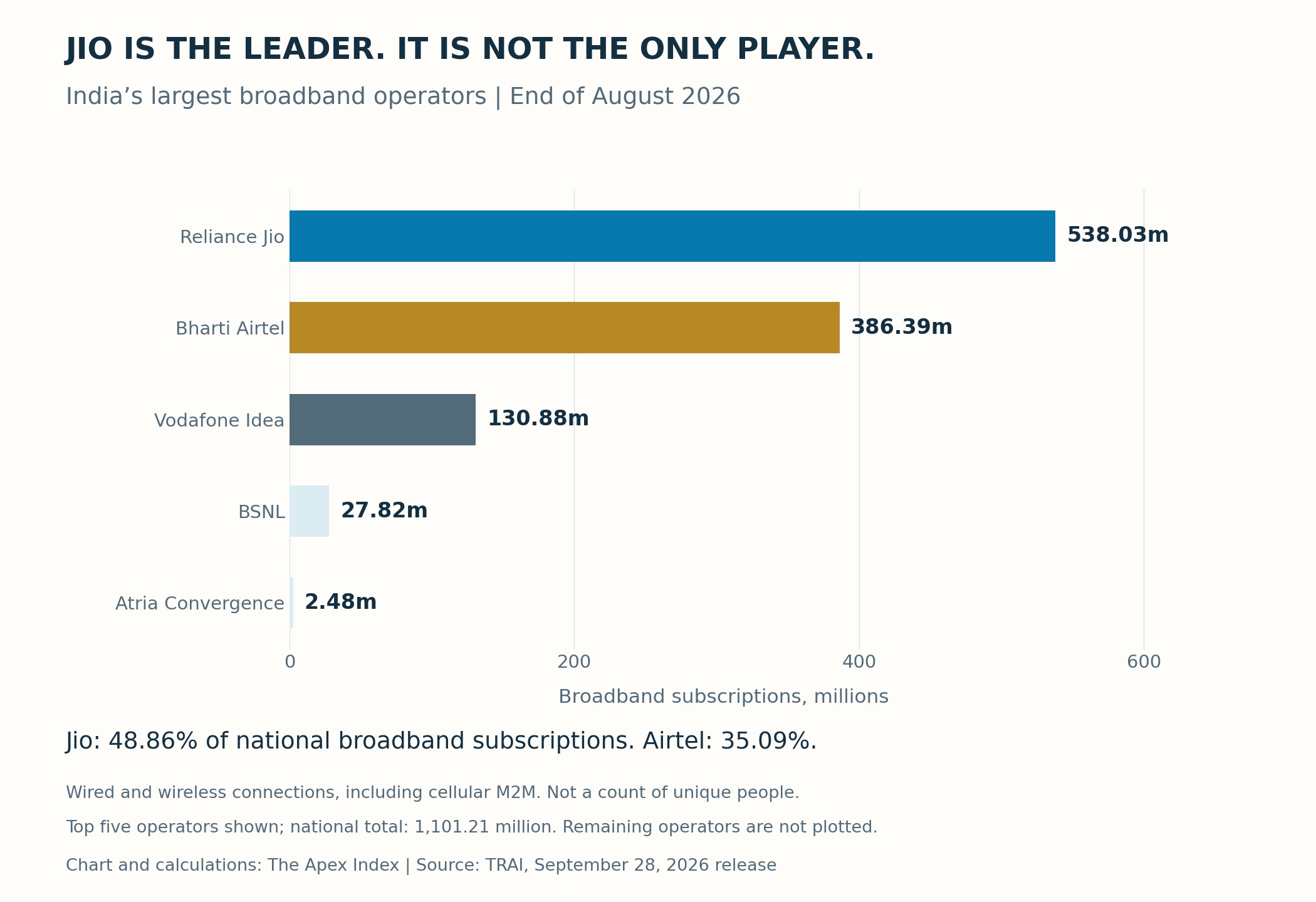
The latest monthly TRAI report, covering the end of August, places Jio first in broadband with 538.03 million subscriptions. Airtel had 386.39 million, Vodafone Idea 130.88 million and BSNL 27.82 million. Jio’s share of the national broadband subscription total works out to 48.86%.
That is an enormous position. It is also different from being the sole supplier. Subscription totals include machine-to-machine cellular connections and multiple connections held by the same person; they cannot be treated as hundreds of millions of unique household customers. The August regulator count also has a different date and scope from the June company customer figure.
Size gives Jio advantages an incoming provider would find expensive to recreate: relationships with customers, equipment distribution, installation capacity and an established national brand. It also gives policymakers a reason to listen when the company argues that a rule will affect investment or service continuity. Listening to a major employer and infrastructure operator is not itself proof that the government takes orders from its chairman.
For Starlink, Jio’s reach is potentially useful and potentially constraining. It can lower the friction of selling and supporting dishes across India. It also places a prospective partner at the centre of a policy debate affecting Starlink’s costs and ability to sell independently. That tension is the substance behind the billionaire feud.
Why Musk cares about India
India offers scale, but the opportunity is more specific than replacing every mobile subscription. Satellite broadband can reach premises where running fiber or providing reliable terrestrial wireless access is difficult. The addressable business includes remote households, businesses, institutions and backup connectivity, subject to service availability, affordability and local permissions.
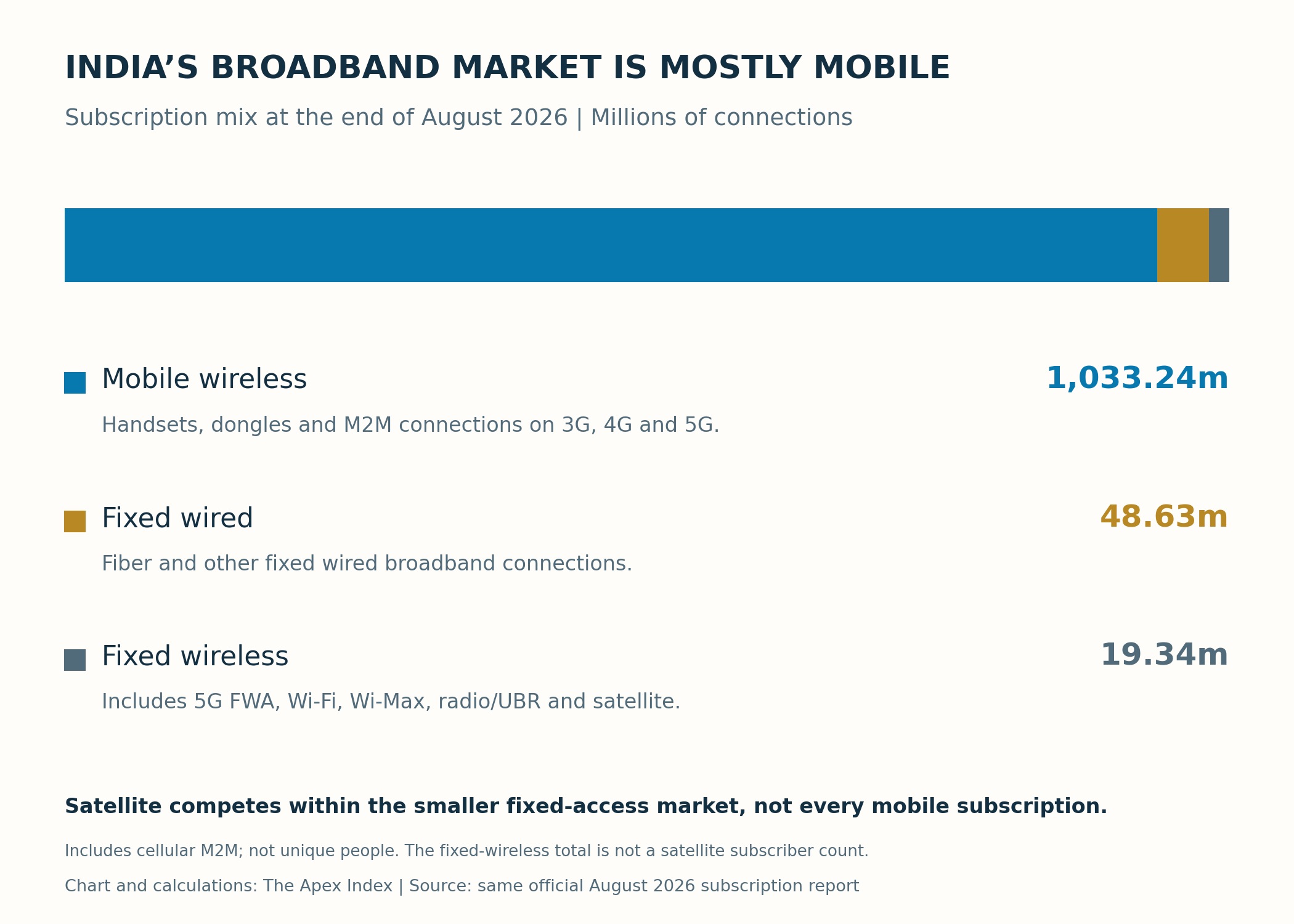
The official August figures show how different that opportunity is from India’s mass mobile market. Mobile wireless broadband accounted for 1,033.24 million subscriptions, compared with 48.63 million fixed-wired connections and 19.34 million fixed-wireless connections. The latter category includes satellite, but also 5G fixed wireless, Wi-Fi, Wi-Max and other radio-based services. It is not a count of Starlink customers.
A satellite dish serving a remote business and a low-cost mobile plan used on a handset are not interchangeable products. Jio’s reported monthly average revenue per subscriber was ₹215.6 in the June quarter. That is a company-wide revenue metric, not the price of a particular retail plan, but it illustrates the economics of selling connectivity at Indian scale.
A reliable Starlink connection could be valuable to a customer whose alternative is poor service or none. It still requires equipment, power, suitable installation and enough capacity. Musk’s appeal to education and small businesses identifies plausible uses; it does not establish that every unconnected family could afford the eventual offer. Affordability will depend on the Indian subscription price and equipment charge.
The commercial stakes extend beyond dish-based broadband. Starlink’s May submission urged permission for direct-to-device satellite services using mobile spectrum, while Jio’s submission raised questions about timing, standards and auction rules for that technology. Those positions concern a potential expansion of the competitive relationship, not proof that satellite-to-phone service is already authorised for Indian consumers.
As previously reported by Apex, Musk’s October 8 U.S. announcement paired a proposed ground-spectrum acquisition with permission for a new mobile-satellite constellation. That American plan helps explain the ambitions behind Starlink’s broader push. It does not automatically confer Indian permissions, and the U.S. spectrum transfer itself still requires final approval.
What the feud means for customers
For readers in India, the useful question is whether the dispute produces another reliable, affordable option where existing service falls short. A school, clinic or small business in a difficult location could benefit from an alternative connection. A customer with dependable, inexpensive fiber may have far less reason to switch.
Emergency resilience is another genuine engineering use, with an important limit. A satellite route can reduce dependence on the local terrestrial connection that has failed. It cannot make a terminal work without power or guarantee a clear signal under every obstruction. Redundancy depends on the complete setup, not just a satellite being overhead.
Competition also depends on the terms of entry. If newcomers face transparent obligations and can sell independently, consumers gain another choice. If a distribution relationship becomes the only practical way to reach customers, an incumbent could retain considerable influence even while selling a rival’s product. The 2025 agreement explicitly contemplated both Jio’s offerings and SpaceX’s direct offerings, which makes that distinction worth watching.
For readers outside India, the dispute shows the limits of a global constellation’s business model. Orbital coverage does not remove national authority over market access, radio use or security. A company can operate its spacecraft internationally and still need country-specific permission to serve customers on the ground.
Is Musk right, or is Ambani?
Musk has a credible argument that an additional technology can extend connectivity and create competitive pressure. The government’s account of unresolved spectrum pricing confirms that there is a policy obstacle still to be settled. A published, verifiable checklist and clear timetable would make delays easier to judge.
His accusation that Ambani personally blocked Starlink remains unsubstantiated. Jio’s lobbying shows it wants particular rules. Its large market share shows economic power. Neither, alone or together, proves Ambani personally blocked Starlink or that Jio is exploiting consumers in the way Musk alleges. Competitors making self-interested submissions is part of a regulatory process; misconduct requires additional evidence.
Jio has a legitimate case that security, levies and competitive conditions should not be designed to privilege one operator. Its existing network scale and investment are relevant. They do not automatically justify applying terrestrial auction economics to every satellite service or postponing entry indefinitely. Its claim that auctions are the only legally tenable method is a corporate legal position, not a judicial ruling resolving this dispute.
Neither side is disinterested. Jio wants to defend its network business and participate in satellite connectivity. Musk wants to expand Starlink on terms that support its economics. As previously reported by Apex, financing for SpaceX’s other ambitions already involves proposed tens of billions of dollars in borrowing. That separate AI-chip plan is not a disclosed budget for India, but it puts the search for additional large markets in a wider commercial context.
The next meaningful developments are a settled spectrum-charge regime, company-specific completion of the remaining conditions, and an actual service offer with prices and availability. Until those arrive, Musk’s accusation is a pressure campaign, the government’s explanation is a process defence, and Jio remains both a formidable competitor and a company that agreed to help sell Starlink.