
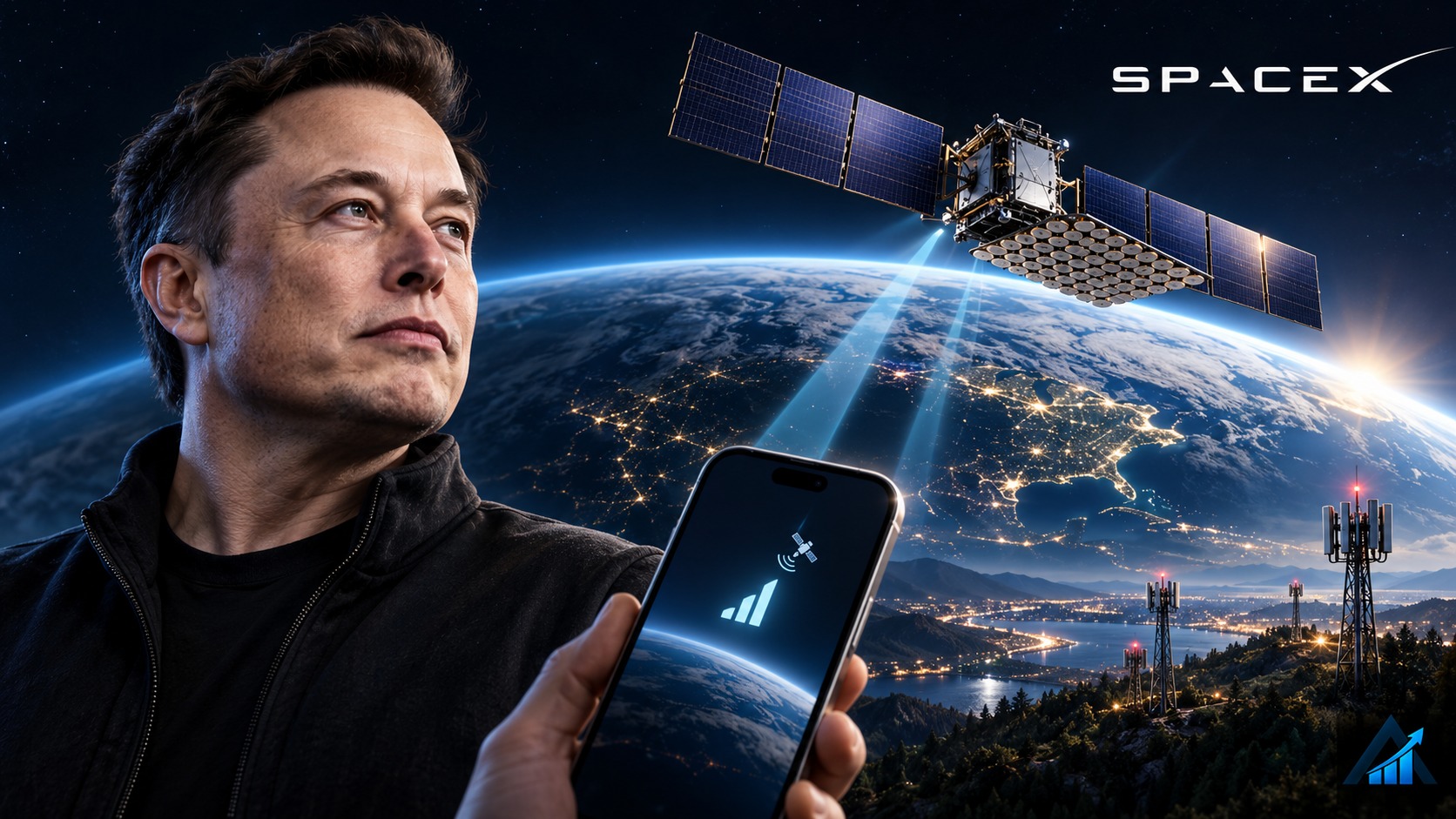
Elon Musk is pushing Starlink toward becoming a full U.S. mobile carrier, with a new spectrum agreement designed to address one of satellite connectivity's hardest problems: getting a reliable signal indoors. The plan moves SpaceX beyond filling cellular dead zones and toward competing for customers who already have a wireless subscription.
The October 8 announcement pairs a nationwide low-band spectrum purchase agreement with authorization for a new satellite-to-phone constellation. The satellite approval is in place, according to the company. The spectrum transfer still requires final approval from the Federal Communications Commission before the proposed hybrid network can proceed on those licenses.
Musk called the deal decisive in an October 8 post:
This is the last critical piece of the spectrum puzzle needed for SpaceX to provide complete phone coverage in America
That is his ambition for the network, rather than a demonstration that every American phone can already receive the service. Competing with AT&T, Verizon and T-Mobile will require more than orbital coverage: indoor reception, capacity, device compatibility and dependable day-to-day service all matter.
The missing piece is on the ground
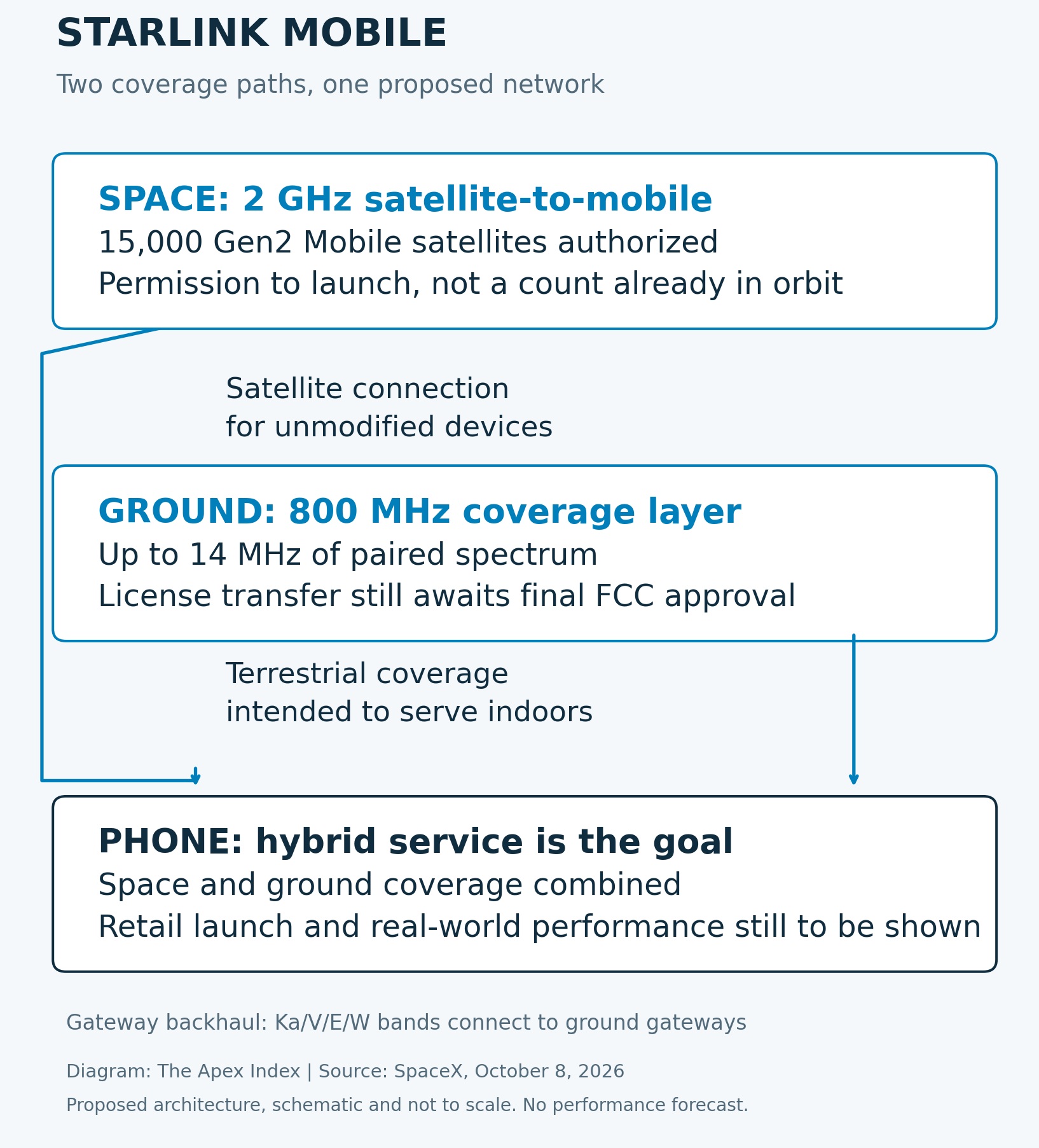
The original announcement describes an agreement for up to 14 megahertz of paired spectrum in the 800 MHz band. The distinction matters: 800 MHz identifies the radio-frequency band, while 14 MHz describes the amount of paired bandwidth in the portfolio.
Lower-frequency spectrum is being added as a terrestrial coverage layer. The existing plan for global 2 GHz mid-band spectrum supplies satellite-to-mobile capacity. Combining those roles is the proposed answer to a service that must work both outside and through obstacles such as walls.
The company describes the architecture this way:
Once we receive final FCC approval, Starlink Mobile will deploy a flexible architecture combining our satellite-to-mobile constellation in space with an advanced terrestrial deployment that can seamlessly connect devices everywhere.
Its October 8 transfer filing identifies NewLevel IV, controlled by an affiliate of Grain Management, as the seller controlling the license-holding Prism entities. It requests permission to transfer control to the SpaceX subsidiary. The announcement does not disclose a purchase price.
Fifteen thousand satellites change the scale
The approval announced this week covers 15,000 Starlink Mobile Gen2 satellites optimized for 2 GHz service globally. It authorizes launches; it does not mean that those satellites are already operational. SpaceX says the V2 mobile satellites will offer more than 100 times the bandwidth of the current generation.
That comparison is a company claim about bandwidth, not evidence that an individual customer's download speed will increase a hundredfold. The approved backhaul bands, Ka, V, E and W, are intended to let the system use the existing Starlink gateway network.
The carrier challenge is now explicit
A satellite layer could help a new operator reach locations where terrestrial coverage falls short. A ground layer is intended to make the same proposition useful inside buildings. Neither layer removes the need to demonstrate dependable service, especially where many customers want capacity at once.
For the incumbents, the competitive question is whether Musk can turn that combination into a primary subscription rather than a supplementary connection. This announcement does not provide a retail launch date, subscription price or independently measured indoor performance. Those are the milestones that would turn a spectrum strategy into a direct consumer challenge. Supporting an existing radio band also does not establish that every device will work with every feature of the proposed service.
There is also a financing backdrop. As previously reported by Apex, SpaceX has been seeking $40 billion for Nvidia chips while lenders reassess its credit risk. That earlier reporting concerns proposed AI financing, not an announced budget for this mobile buildout. The new network adds another undertaking whose execution will matter as much as its technical ambition.