
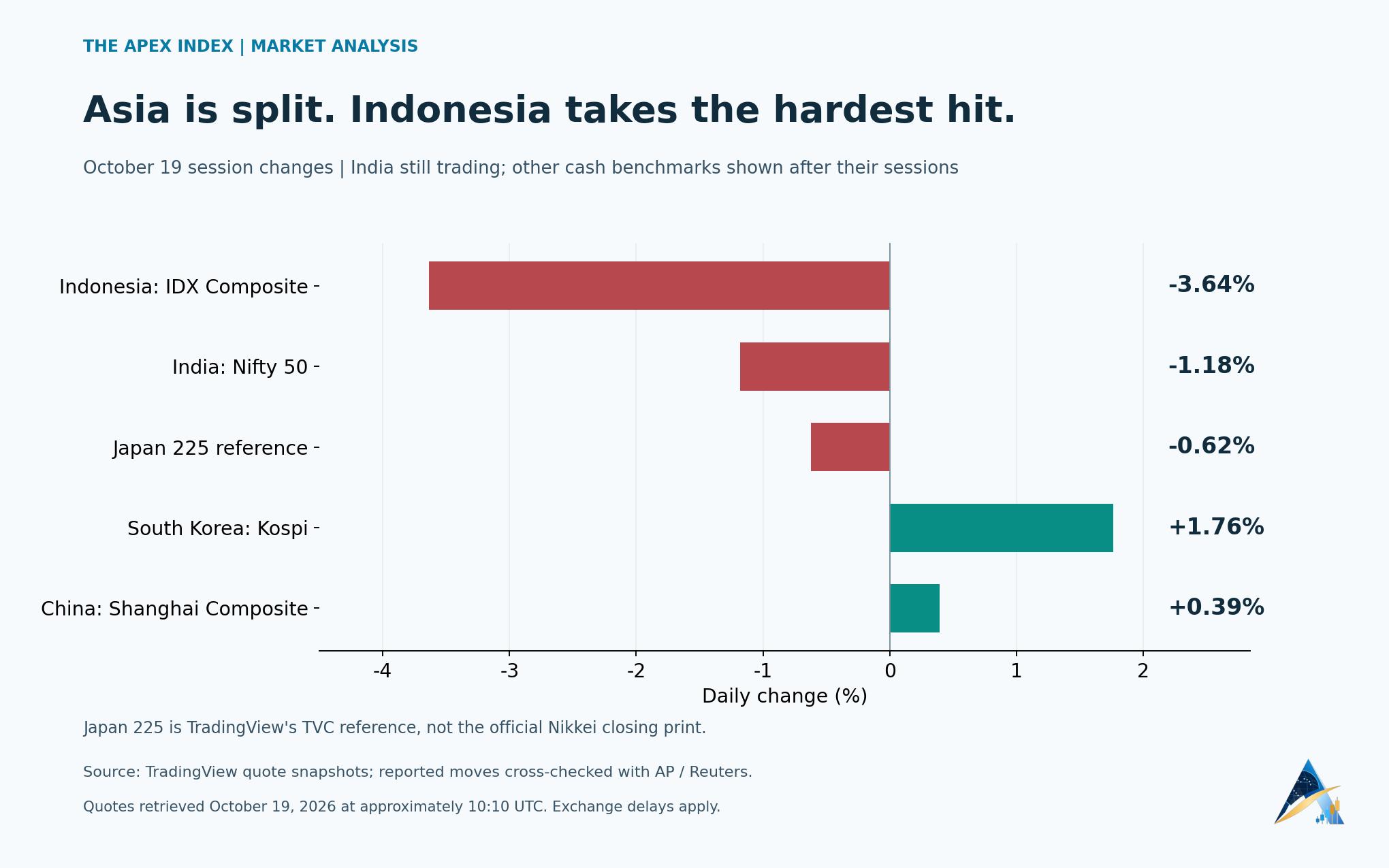
Indonesia is taking another heavy hit, Japan's technology stocks are under pressure and European shares have opened lower. But the first thing to get straight about October 19 is that this is not a synchronized crash everywhere. South Korea, Shanghai and Australia have gained, while U.S. cash trading has not yet opened at this article's market snapshot.
Several problems are arriving together: Indonesia faces possible removal from major global stock indexes, investors are questioning AI valuations, and France has its own political shock. Expensive oil and high borrowing costs make the backdrop less forgiving. The reasons for selling overlap, but they are not identical from one country to the next.
Where the losses actually are
At approximately 10:10 UTC, TradingView's delayed quote put Indonesia's Jakarta Composite at 4,996.61, down 3.64% after a much deeper intraday slide. India's Nifty 50 was down about 1.18% at 22,873.55 while its session was still underway.
Japan's Nikkei finished around 0.6% lower at 64,916.70, according to the Associated Press. Taiwan's Taiex also lost about 0.6%. The cover chart uses TradingView's separately labeled Japan 225 reference, whose quote differs slightly from the official Nikkei closing print.
In early European trading, AP reported France's CAC 40 down 1.3%, Germany's DAX down 1% and Britain's FTSE 100 down 0.8%. Those were intraday observations, not closing results.
The gains elsewhere matter. South Korea's Kospi rose approximately 1.76% to 5,768.01 and the Shanghai Composite added about 0.39% to 3,730.92 in the quote snapshot. Australia's S&P/ASX 200 gained about 0.4%, according to AP. Hong Kong was closed for a holiday, so there was no fresh Hang Seng selloff to include.
Indonesia has a specific problem, and it is serious
MSCI's original announcement proposes moving Indonesia from Emerging Market to Standalone Market status. That is more severe than the previously discussed move to Frontier Markets.
The index provider cited opaque ownership structures, suspected coordinated trading and insufficient evidence that promised reforms had improved how the market works. It said:
Despite the announced reforms, significant concerns remain around market dysfunction, including continued suspected coordinated trading behavior and lack of evidence of meaningful enforcement.
This is still a consultation, with feedback accepted until April 30, 2027 and a decision due by June 30. Yet investors do not have to wait for a final removal to reduce exposure. Funds tracking emerging-market benchmarks could eventually have to sell excluded Indonesian shares, which makes the prospect consequential right now.
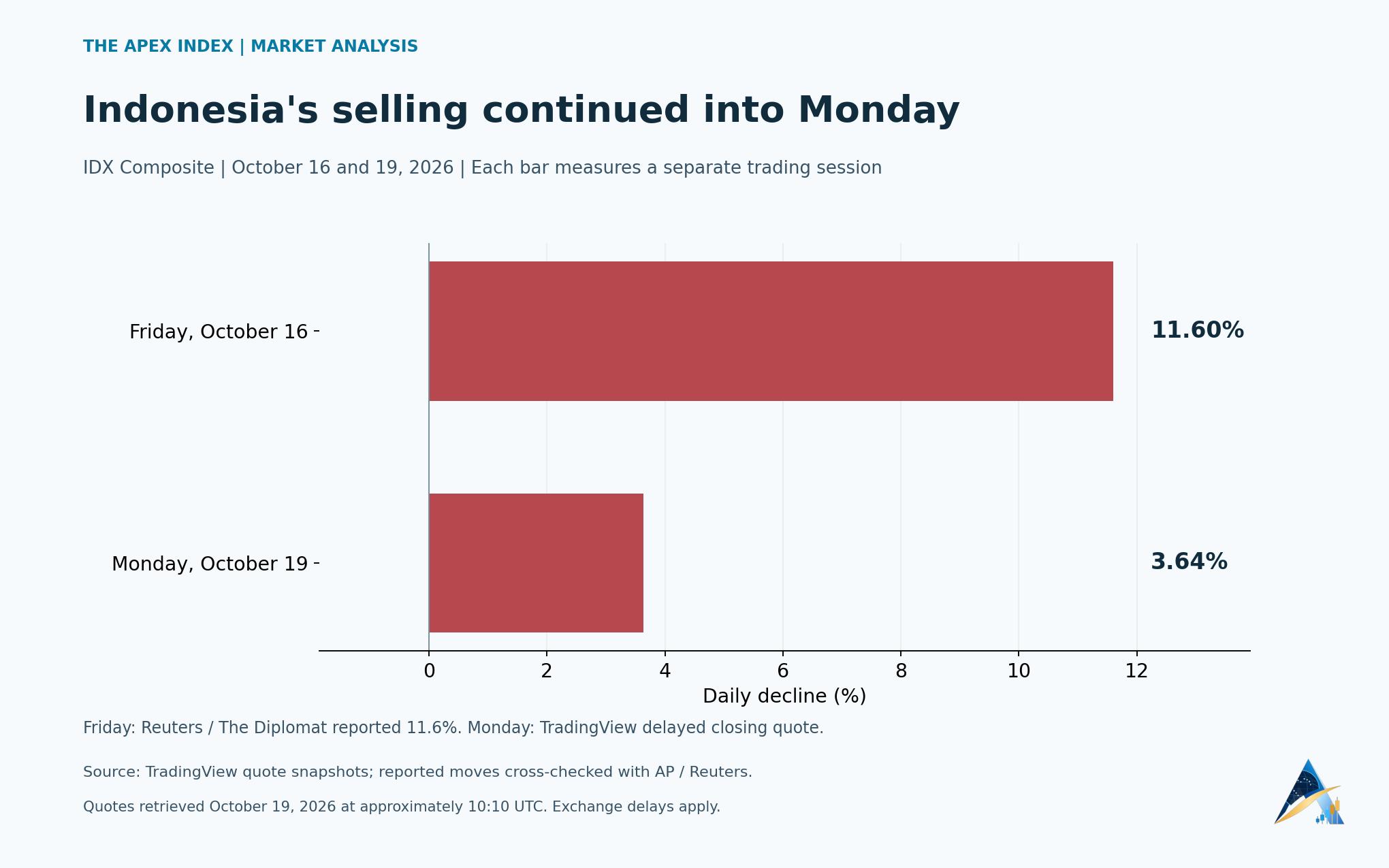
Reuters reported an 11.6% Jakarta decline on Friday, followed by losses exceeding 5% during Monday's session before the later quote showed a smaller decline. The exchange reduced its individual-stock downward price limit to 7%; that should not be confused with a 7% guaranteed floor for the whole index.
The exchange acknowledged the shock in a statement reported by Reuters:
The MSCI announcement was unexpected to us, causing a market panic.
Goldman Sachs estimated that full removal could prompt $5.6 billion in passive outflows, Reuters reported. That is a scenario estimate, not money already withdrawn. The same report put foreign net selling of Indonesian stocks this year at $4.88 billion.
The pressure spread beyond shares. Reuters reported the rupiah at 18,040 per dollar and Indonesia's 10-year government yield at 7.4%, compared with 7.169% on Friday. A weaker currency and rising yields suggest concern about Indonesian assets more broadly, rather than just one bad day for a few stocks.
Japan's losses are tied more closely to the AI trade
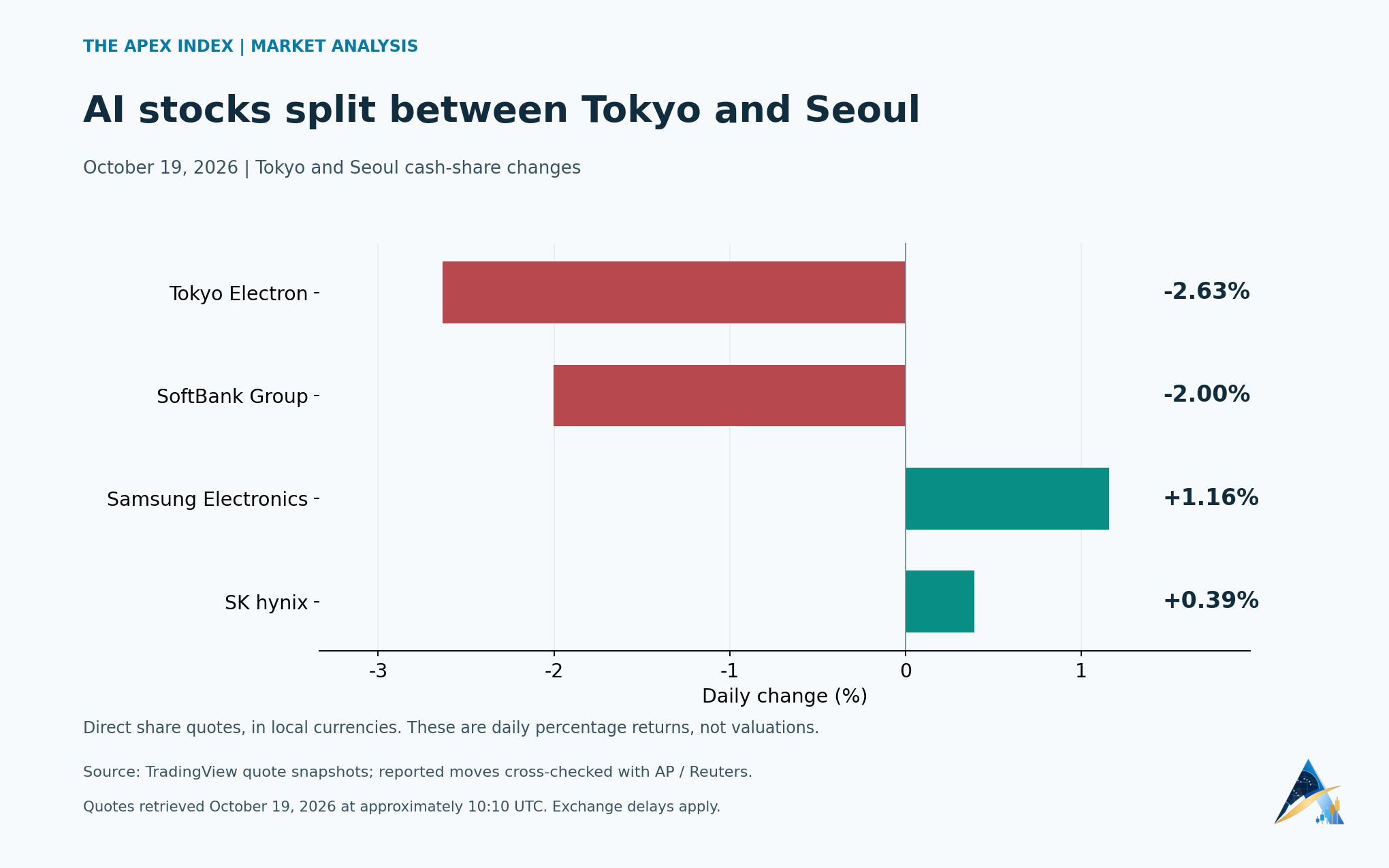
Tokyo Electron fell about 2.63% and SoftBank Group about 2% in TradingView's Tokyo share quotes. They provide different routes into the AI investment story: chipmaking equipment in the first case and major AI investment exposure in the second.
When investors question whether the spending boom will produce enough profit, those exposures can become vulnerabilities. AP identified concern about the sustainability of the AI boom as a driver of recent technology-stock volatility.
But the trade was not moving uniformly lower. Samsung Electronics gained roughly 1.16% and SK hynix about 0.39% in Seoul. That is why an index-level headline needs a closer look underneath it: some AI-linked shares were recovering while others were still being sold.
China also had a fresh economic support. As previously reported by Apex, third-quarter GDP grew 4.5% from a year earlier, beating forecasts. The result helps explain why mainland shares could rise even as neighboring markets struggled.
Europe adds politics to an already difficult backdrop
France's losses followed violent weekend protests over living costs and school conditions, AP reported. The unrest gave investors a country-specific reason to demand a larger cushion for political risk, alongside the broader concerns about energy prices and earnings.
Oil actually fell early Monday. AP reported Brent down about 2.1% to $107.55 a barrel after Trump's waiver of new Russian sanctions raised the prospect of additional fuel supplies. Falling on the day does not make oil cheap: a price above $100 still leaves businesses and households facing expensive energy.
The Treasury 10-year yield eased toward 5.08%, from roughly 5.13% Friday, according to AP. That contrasts with rising Indonesian yields. There is no single global bond-market signal here; local risk and demand for safer assets are pulling in different directions.
Wall Street's Friday drop is not Monday's result
Friday's Nasdaq Composite fell 2.14%, the S&P 500 lost 1.09% and the Dow dropped 0.34%, according to the quote data. AP reported U.S. equity futures edging higher Monday morning.
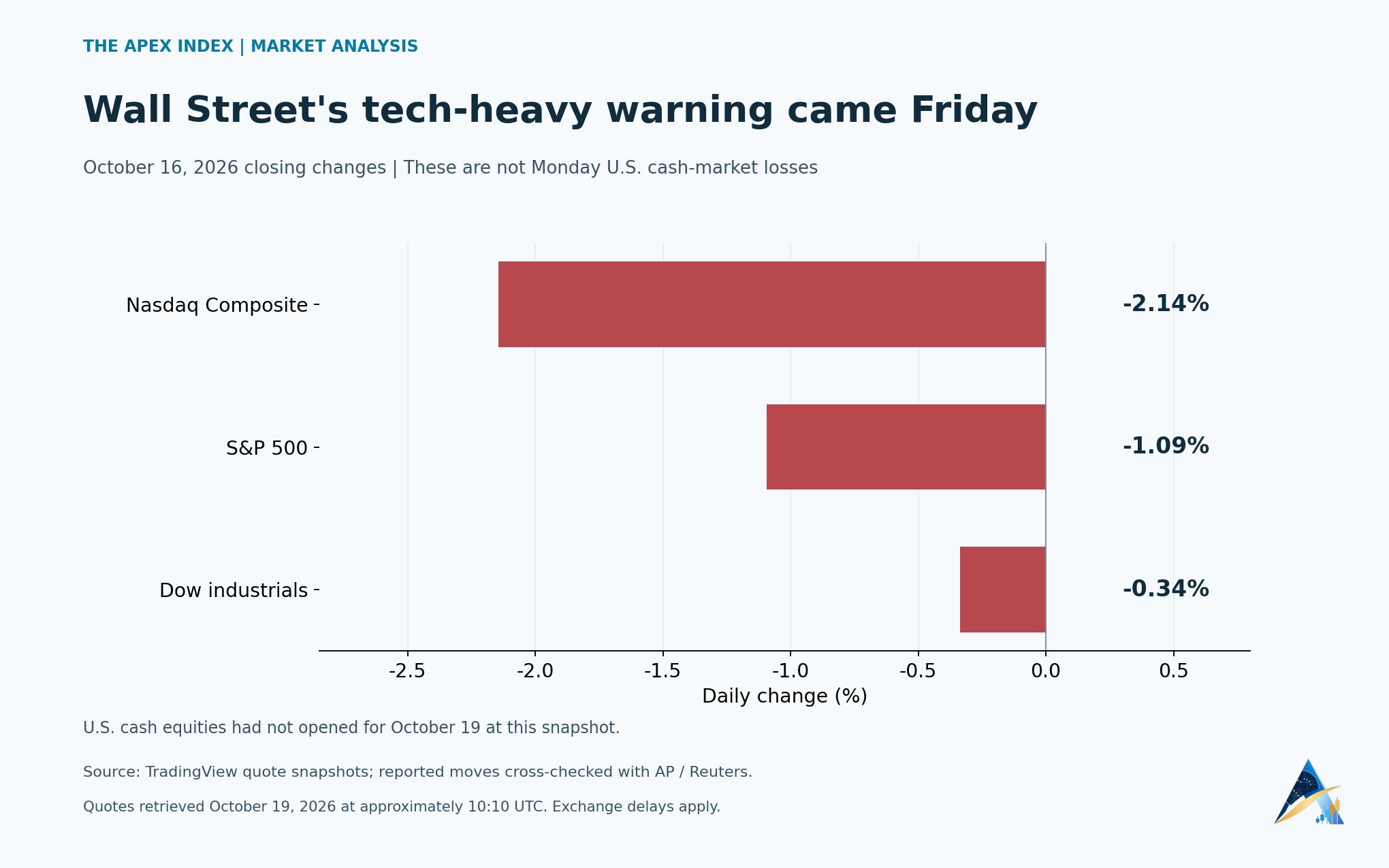
Calling those Friday losses a fresh Monday U.S. crash would mix two different sessions. As discussed in Apex's earlier Black Monday analysis, a frightening setup still needs to be tested against what markets actually do when trading begins.
The levels worth watching next
For Indonesia, 5,000 is an immediate psychological reference because the latest quote is just below it. A sustained recovery above that round number would be an initial sign of stabilization, but it would leave MSCI's governance concerns unresolved. Further selling alongside a weaker rupiah and higher local yields would be more troubling than a stock-only decline.
In Japan, the Nikkei's proximity to 65,000 gives traders a simple round-number marker. For the Nifty, 23,000 serves the same purpose. These are reference points, not statistically tested support levels or promises of a bounce.
The stronger test is breadth. Do losses spread to markets that were gaining, and do technology shares stabilize as earnings arrive? Indonesia's index-access crisis, Japan's AI repricing and France's political shock require different fixes. Treating them as one indiscriminate global crash hides the information investors most need.