

China's economy picked up speed in the third quarter, growing 4.5% from a year earlier as overseas orders helped make up for weak spending at home. A roughly $938 billion goods trade surplus over the first nine months shows just how much the country is leaning on the rest of the world to keep buying.
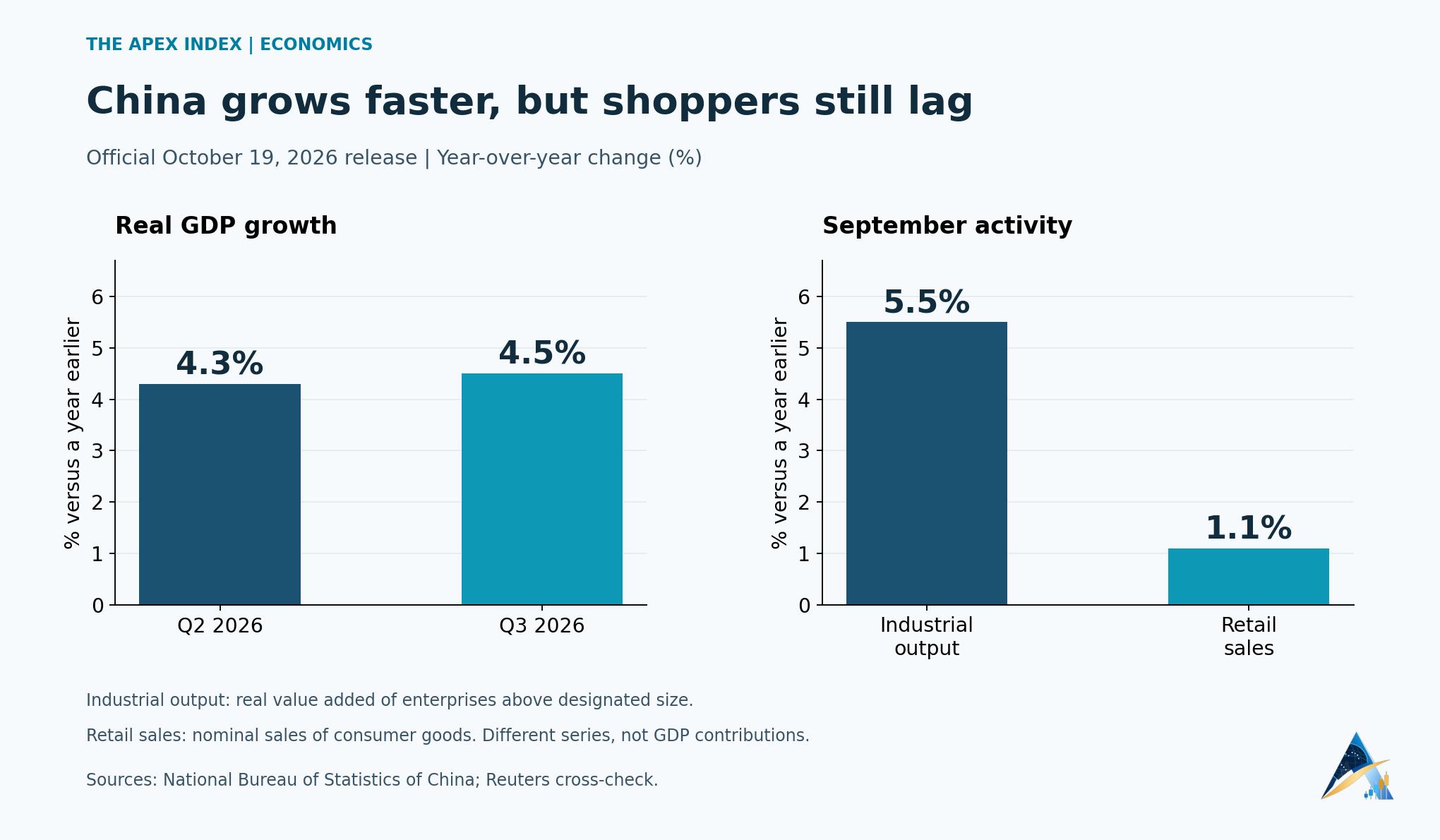
The October 19 GDP release gives Beijing some breathing room. Growth beat the 4.4% forecast in a Reuters poll and improved from 4.3% in the second quarter. But the better headline comes with familiar problems: shoppers remain cautious, investment is falling and the property downturn is still deepening.
A better quarter, with an uneven recovery underneath
China's National Bureau of Statistics said in its official release that GDP rose 1.2% from the previous quarter. Across January-September, the economy expanded 4.6% from a year earlier, keeping it within the government's full-year target range of 4.5%-5%.
The monthly figures show where the momentum is coming from. Industrial output rose 5.5% in September from a year earlier, up from 5.2% in August. Retail sales of consumer goods grew just 1.1%, although that was an improvement on August's 0.4% and stronger than the 0.6% economists had expected.
Factories are finding orders. Households are proving harder to persuade.
Ho Woei Chen, an economist at UOB in Singapore, described the policy trade-off in comments carried by Reuters:
External demand is still keeping the economy afloat, and I think that is also why the government is not really very aggressive in the stimulus.
The trade cushion is enormous
The roughly $938 billion surplus covers goods traded during January-September, not just the latest quarter. It was reported with the October 14 customs figures, ahead of Monday's GDP release.
As previously reported by Apex, September alone produced a $133.5 billion surplus as exports grew faster than imports in dollar terms. Both sides of the trade ledger expanded, so the widening gap came alongside rising purchases from abroad.
The government's first-three-quarter trade report points to the industries doing the heavy lifting. Exports of integrated circuits, electric vehicles and industrial equipment increased strongly. Demand tied to the global AI investment boom has supported overseas orders for Chinese technology products and components.
That helps explain why growth has held up despite the trouble elsewhere. Exporters can keep production moving even when consumers and property developers are spending carefully.
The goods surplus is not itself a calculation of how much trade added to real GDP. It is a dollar-value balance over nine months, while the 4.5% figure measures inflation-adjusted economic growth in one quarter against the same period last year. The two figures tell related parts of the story without being interchangeable.
Property still weighs on the outlook
The sharpest weakness remains in investment. Fixed-asset investment fell 7.2% in the first nine months from a year earlier. Property investment dropped 20.6%, a steeper decline than the 19.9% recorded for January-August.
That leaves a lot of work for exporters and manufacturers. A stronger September retail reading is welcome, but 1.1% nominal growth offers little evidence of a household spending boom.
Zhiwei Zhang, chief economist at Pinpoint Asset Management, told Reuters:
The economic momentum remained subdued in September. The retail sales growth rebounded slightly. After adjusting for inflation, real retail sales barely grew compared to a year ago.
His assessment captures why the GDP beat may do more to reduce the urgency for sweeping stimulus than to settle concerns about the economy. Beijing remains near its annual growth goal, even as the weakness underneath gives policymakers reasons to keep supporting demand.
For trading partners, China's resilience also brings pressure. Strong shipments help Chinese factories, but they intensify competition abroad. If global AI spending cools or trade barriers tighten, the export cushion could become less reliable.
For now, China has delivered a better quarter than expected. The harder task is getting people at home to spend enough that keeping the recovery going does not depend so heavily on buyers elsewhere.