

Friday gave investors plenty to worry about. Technology stocks were sliding, volatility jumped and oil stayed expensive. By Sunday, talk of a "Black Monday" was spreading online. The temptation is to connect those dots and assume Monday, October 19, has already been decided.
My view: a rough opening is a credible risk. A crash is a much bigger claim, and the evidence does not justify treating it as inevitable. Even the market commentator whose post helped frame this debate is arguing that investors have become too gloomy.
The post is pushing back on the panic
The Kobeissi Letter wrote on October 18:
Calls for a "Black Monday" are spreading rapidly across social media right now. If history is any guide, this means the S&P 500 should hit 8,000 soon.
That is a bullish opinion, including an index target. Its linked October 15 analysis argues that expensive energy and borrowing costs have already suppressed valuations, leaving room for a rally if those pressures ease. Neither that argument nor the bearish posts provide a reliable timetable for Monday.
The date adds drama. October 19 was also the date of the 1987 Black Monday crash, when the Dow fell 22.6% in one session, according to Federal Reserve History. The anniversary is memorable. It gives us no information about tomorrow's orders, liquidity or news.
Friday's damage was real
The S&P 500 closed at 7,659.44 on October 16, down 1.1%. The Nasdaq Composite lost 2.1%, while the Dow slipped 0.3%. Small companies were hit too: the Russell 2000 fell 1.7%.
The Associated Press closing table puts the calendar-week losses at 1.9% for the S&P 500 and 4.5% for the Nasdaq. Both had their worst week since June. Yet the Dow gained 0.7% for the week. Selling was painful and spread beyond technology, but some parts of the market were holding up better than others.
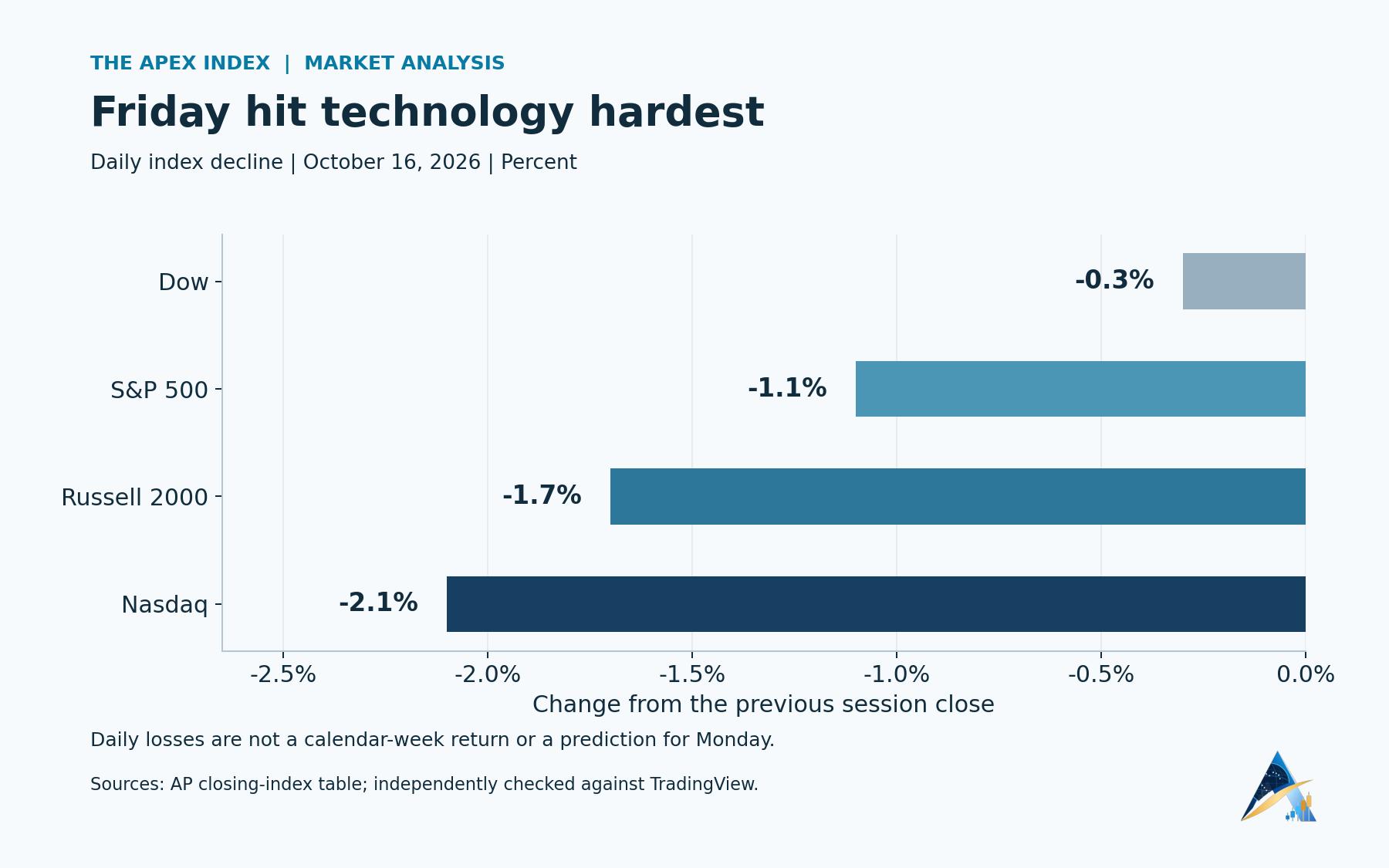
That unevenness matters. If the argument is that every corner of Wall Street is already signaling disaster, the Dow's weekly gain is an awkward fact. It also offers no protection if selling broadens when trading resumes.
The AI trade deserves particular attention. Schaeffer's Friday recap described continued rotation out of AI stocks, with energy shares among the bright spots. Investors can lose confidence in the price they paid for future growth long before the underlying technology stops growing.
Volatility is flashing a warning
The VIX closed at 19.99, up from 16.46 on Thursday. That is a 21.4% jump, calculated from the official daily closes. It had finished the previous Friday at 14.84, making the calendar-week increase 34.7%.
Cboe's definition describes the index as a measure of expected near-term volatility derived from S&P 500 option prices. It tells us how much uncertainty investors are pricing. It does not give the probability of a crash or say which direction the next session must take.
I would take that rise seriously. Options prices were signaling more uncertainty as stocks fell, which is a reason to expect a nervous reopening. But putting a precise crash probability on those readings would require a model and assumptions that this analysis does not have.
The weekend has supplied risk in both directions
Energy is the clearest route from geopolitics into household costs, corporate margins and inflation expectations. As previously reported by Apex, the Saudi-led coalition reported fresh missile interceptions as fighting with the Houthis continued. That leaves investors watching for further disruption across the region.
There are also efforts to bring more fuel into circulation. Apex had earlier reported Trump's waiver of new Russia-related tariffs and sanctions following his diesel agreement with Putin. Whether those decisions deliver meaningful price relief is a separate question from announcing them.
The bullish argument in the linked research is conditional:
Therefore, if there were to be any indication of the Iran War ending and the global energy crisis subsiding, this would lead to a domino effect in the bullish direction.
That explains why a market under pressure can still rally on better news. It also explains why buying solely because pessimism is loud would be a gamble: the favorable development still has to happen.
What would make Monday more dangerous?
This assessment is being published before Sunday's stock-index futures reopening. Friday is the latest completed U.S. cash session. There is no Monday opening price to analyze yet.
I would watch whether selling spreads across sectors, whether volatility keeps rising and whether credit markets show fresh funding stress. A falling stock index alongside orderly credit trading is a different situation from investors struggling to finance positions and selling whatever they can to raise cash.
For the S&P 500, Friday's 7,659.44 close is a useful reference for the next session, not a proven floor. An opening drop that attracts buyers would weaken the immediate crash argument. Sustained selling across large and small companies, accompanied by worsening funding conditions, would strengthen it.
The NYSE has specific market-wide circuit breakers: declines of 7%, 13% and 20% from the S&P 500's previous close. The first two trigger minimum 15-minute halts during their eligible window; a 20% decline ends trading for the day.
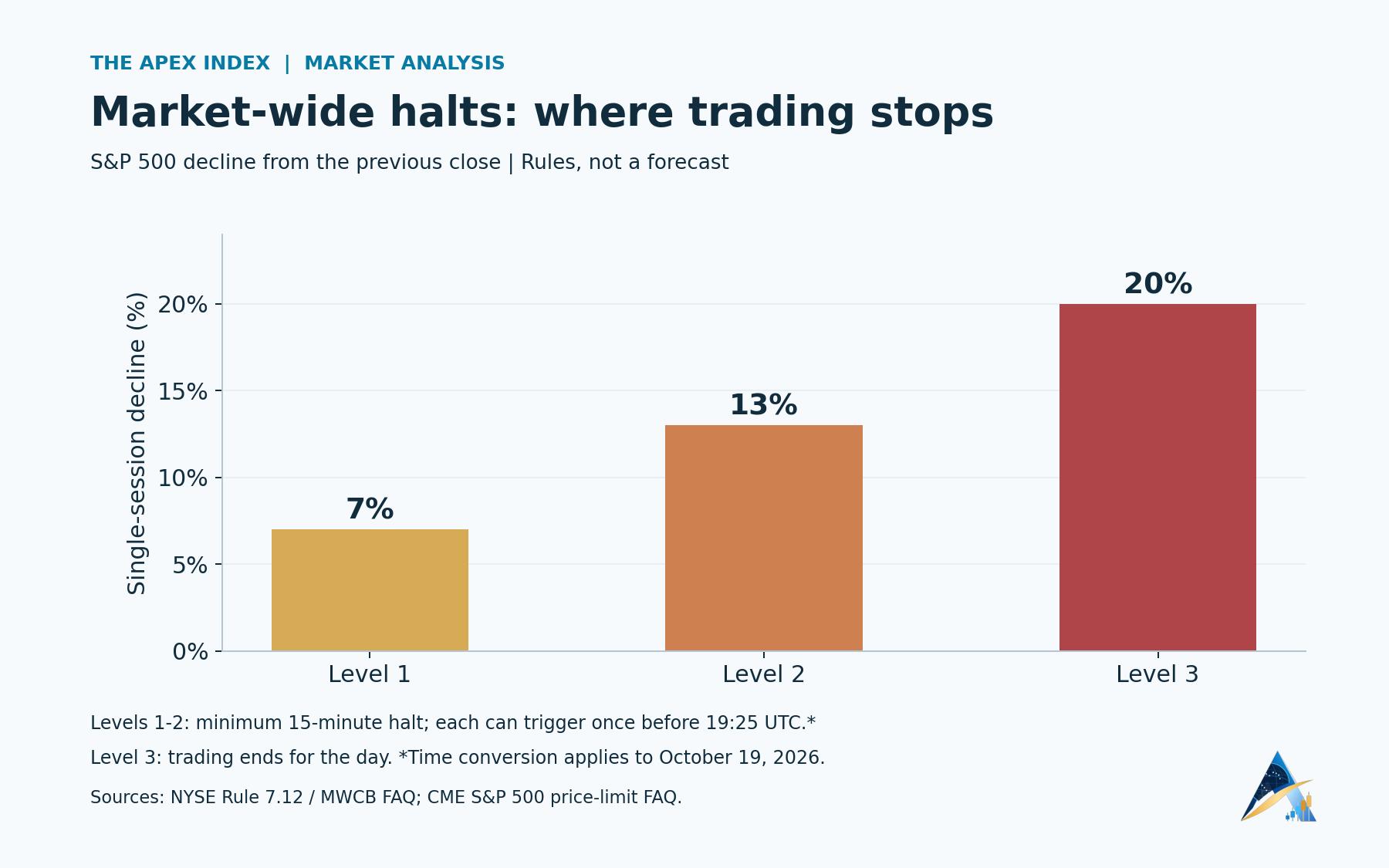
Those mechanisms can pause trading. They cannot remove the economic reason people want to sell. A halt would be evidence that an extreme move had occurred, rather than evidence that social media predicted its cause correctly.
My call
The risk of another ugly session is real enough to take seriously. The claim that "all signs" point to a Black Monday goes further than the data support. Technology weakness, higher volatility and dangerous geopolitics sit alongside a Dow that rose for the week and the possibility of better energy news.
I would change that assessment if broad selling and funding stress started reinforcing each other. Until then, a crash is a scenario to prepare for, rather than a conclusion to announce before the market opens.