
Gold is falling because today's inflation report has put higher U.S. interest rates back in focus. The dollar is gaining for much the same reason. For investors holding bullion, that combination is painful: a stronger currency makes gold more expensive overseas, while higher bond yields increase the income buyers give up by owning a metal that pays none.
At 17:14 UTC on October 14, gold traded around $4,080 a troy ounce, down 1.94%, in Apex market data. The dollar index stood at 102.793, up 0.57%. Those are intraday observations, not closing prices. Gold had already fallen through $4,100.
The inflation number traders cannot ignore
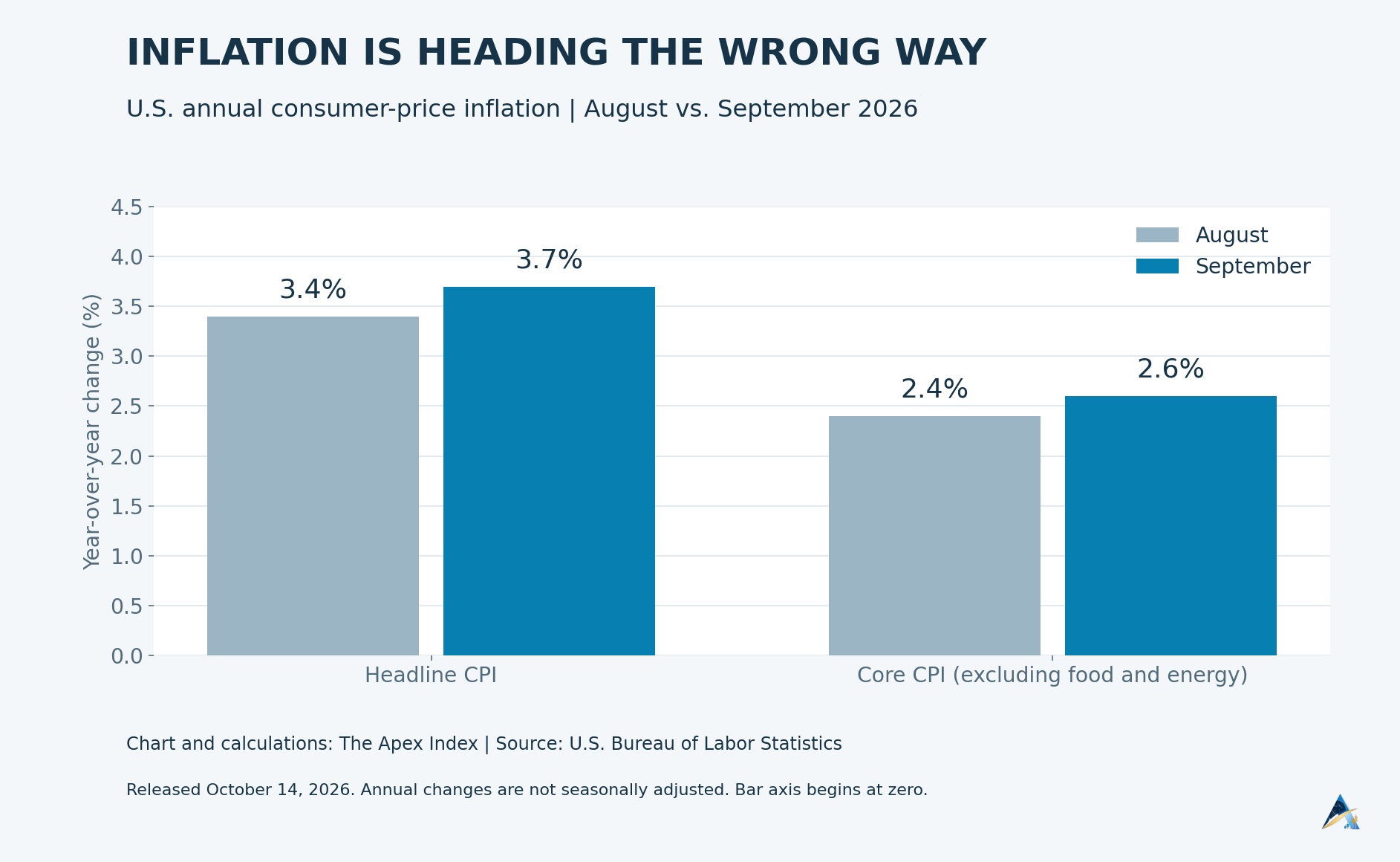
September's inflation report, released Wednesday by the Bureau of Labor Statistics, showed consumer prices climbing 0.6% from August. Annual inflation accelerated to 3.7% from 3.4%. Core inflation, which excludes food and energy, increased 0.3% for the month and 2.6% over the year, up from August's 2.4% annual rate.
Gasoline was the biggest culprit. The agency explained:
The index for gasoline rose 9.1 percent in September, accounting for over half of the monthly all items increase. The energy index increased 5.2 percent over the month following a 2.1-percent increase in August.
For gold, the problem is the potential policy response. If inflation makes another rate increase more likely, the appeal of interest-bearing dollar assets can improve. That can outweigh demand for gold as an inflation hedge, especially over a single trading session. Today's price moves fit that mechanism; they do not establish that every seller acted for the same reason.
The Fed was already warning about another hike
As previously reported by Apex, New York Fed President John Williams considered one more increase appropriate this year in his October 13 comments. Boston Fed President Susan Collins also supported further tightening before year-end. Today's inflation figures arrive against that backdrop.
Williams distinguished particular price shocks from an economy overheating everywhere:
My view is this is not an economy that is overheating overall. This is not an economy where it's adding inflationary pressures beyond these particular shocks that we're experiencing.
His expectation that further increases would not be needed in 2027 remains a forecast, not a committee commitment. An inflation report can change the discussion without settling the next decision.
Gold has recovery levels to clear
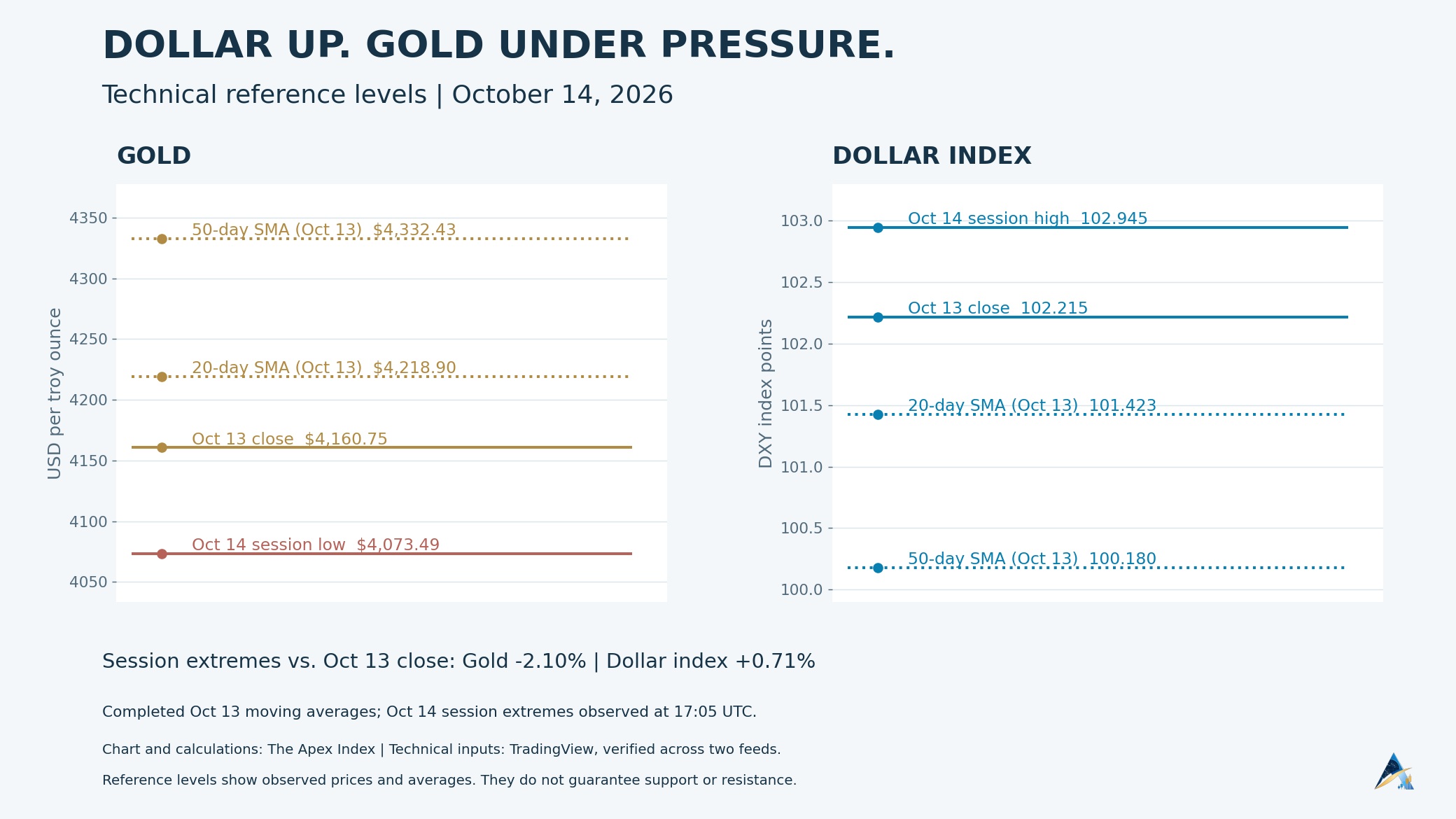
The featured chart separates completed-session moving averages from today's price extremes. Gold reached $4,073.49 by the 17:05 UTC observation, 2.10% below Tuesday's $4,160.75 close. That makes the observed low the first downside reference, rather than a guaranteed floor.
For buyers, recovering $4,100 would be an initial improvement. Reclaiming $4,160.75 would erase the decline from Tuesday's close. A sustained recovery toward the completed October 13 20-day simple moving average at $4,218.90 would offer stronger evidence of repair. The corresponding 50-day average, $4,332.43, sits farther away.
The bearish scenario is a closing break below $4,073.49 followed by unsuccessful attempts to recover it. That would keep $4,000 in view as a psychological reference. It is a round-number scenario, not an independently established historical support level. Holding the low and recovering Tuesday's close would weaken that bearish case.
Can the dollar keep climbing?
The dollar index reached 102.945 by 17:05 UTC, 0.71% above Tuesday's 102.215 close. It was also above its completed October 13 20-day average of 101.423 and 50-day average of 100.180. That gives the dollar a stronger short-term technical position than gold.
A sustained break above 102.945 would bring the round-number 103 threshold into focus. A move back below 102.215 would instead surrender Wednesday's advance and weaken the immediate bullish case. The 20-day average would then become a lower reference to watch, rather than an automatic destination.
The base case is continued pressure on gold while the dollar holds its gain, with inflation and Fed expectations driving the next test. Buyers need more than a cheaper entry price: gold has to recover lost levels. Today's inflation report gives them a reason to demand that evidence.