

A safe-haven asset is an investment people expect to preserve value, remain usable or provide protection when other assets are under pressure. The phrase describes a role in a particular crisis. It does not promise that the asset can never lose money, that its price will always rise during a panic, or that it is suitable for every investor.
Investors seek havens because a crisis can threaten several things at once: portfolio value, access to cash, the reliability of borrowers and the purchasing power of a currency. An asset that protects against one threat can be exposed to another. Choosing a haven starts by identifying what needs protection, for how long and in which currency.
Safe from which risk?
A government security can offer strong credit quality but substantial interest-rate risk. Cash can provide immediate spending power while losing real value to inflation. Gold does not depend on a company's earnings, but its market price can fall sharply. The useful question is therefore more specific than whether an asset has a reputation for safety.
A safe haven also differs from a low-volatility asset. Prices reported infrequently can look stable even when the asset is difficult to sell. A private investment may avoid daily fluctuations on an account statement without protecting its owner during a crisis. Liquidity, credit quality, inflation sensitivity and market risk all deserve separate consideration.
A hedge offsets a particular exposure, while a diversifier responds differently from other holdings across some conditions. A haven is expected to help especially when stress intensifies. These roles can overlap, but they are not identical. An investment that diversifies normal daily movements may still decline alongside the rest of the portfolio during a severe shock.
Why money moves toward havens
A loss of confidence changes what investors are willing to own. When uncertain future profits or debt repayments become harder to evaluate, people may prefer more liquid claims, more reliable issuers or assets with fewer dependencies. The price of that preference appears in market prices, yields and the cost of funding riskier investments.
Institutions may also need acceptable collateral or cash to meet obligations. Their decisions are not always about finding the asset with the best long-term return. A bank, fund or leveraged trader can prioritize something that can be pledged, sold or transferred immediately. This helps explain why highly traded government securities often matter during financial stress.
A crisis can nevertheless force investors to sell assets they would otherwise prefer to keep. If a fund must meet withdrawals or a trader faces a margin call, even gold or government bonds can be sold to raise cash. A temporary price decline does not prove that an asset has no defensive role, but it does demonstrate that the role is conditional.
The investor's own circumstances determine the relevant standard. Someone paying a bill next month needs dependable access to the required currency. A pension portfolio concerned about decades of purchasing power has a different problem. A single asset cannot solve both objectives perfectly without trade-offs in return, liquidity or market exposure.
Government securities: credit safety is only one dimension
A highly rated government can have substantial taxing capacity and access to financing in its own currency. Its securities may therefore be widely used as collateral and as a destination during a flight from weaker credit. That does not make every government's debt equally reliable or remove the possibility of inflation, default or currency losses.
Treasury bills and longer government bonds also behave differently. A short instrument nearing repayment usually has less sensitivity to a change in market yields than a bond whose payments extend many years into the future. The issuer may be identical while the market-price risk is not. Maturity is part of the safety decision.
The SEC's bond guidance distinguishes credit, interest-rate and liquidity risks. An investor holding a conventional bond to maturity still depends on the issuer honoring its obligations. An investor selling beforehand also depends on the price another buyer will pay at that moment.
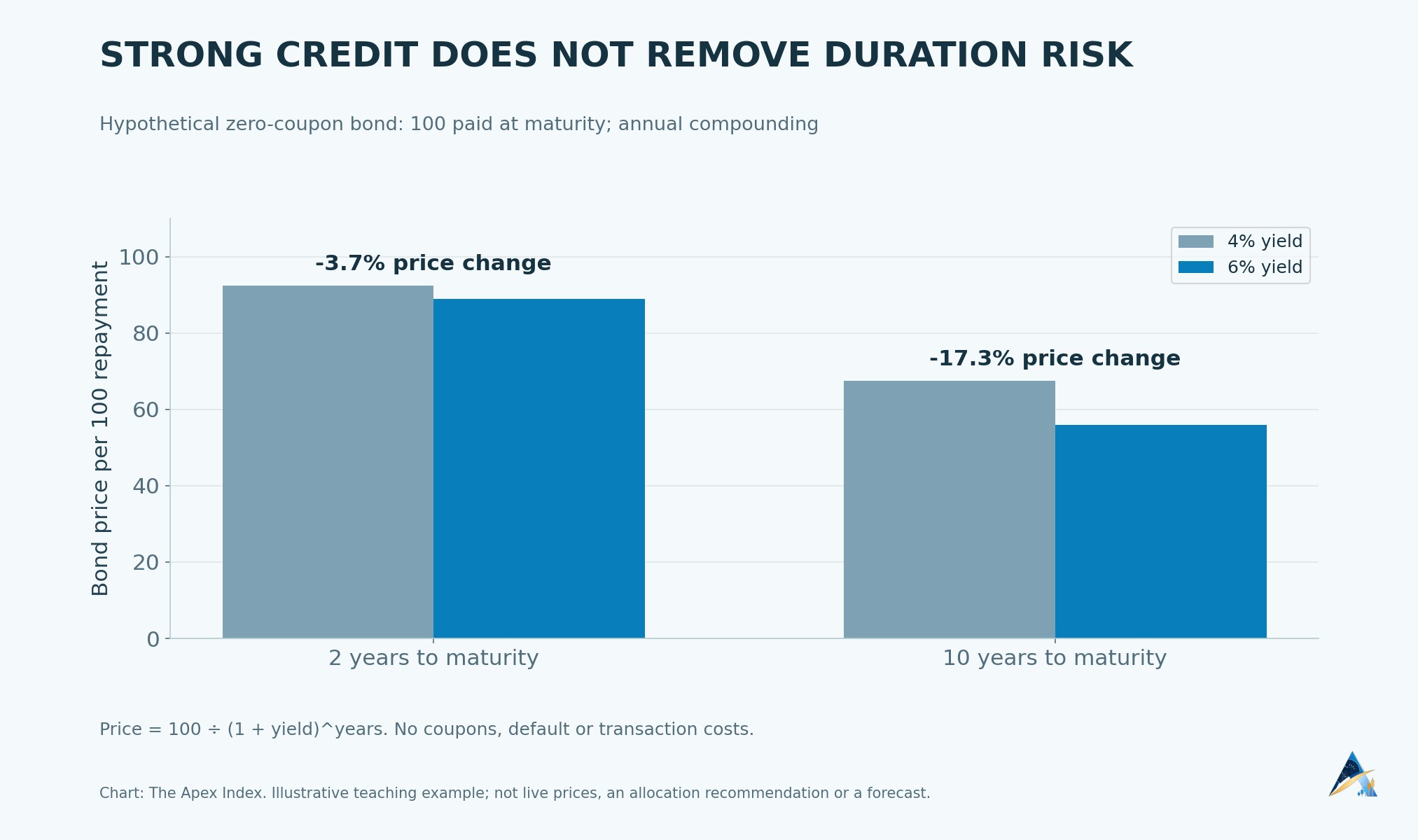
The first illustration isolates interest-rate sensitivity using hypothetical zero-coupon bonds. Both promise the same payment at maturity, and both are repriced when their required annual yield rises from 4% to 6%. The longer bond loses more market value because its payment is further away. These are teaching assumptions, not actual current government yields.
A bond fund generally holds a changing portfolio rather than a single security that reaches one repayment date for every shareholder. Its price and distributions reflect that ongoing portfolio. Holding the fund for a long time is therefore different from holding an individual bond to a specified maturity. Check which structure matches the obligation the money is meant to meet.
Inflation-linked debt protects a defined measure
Inflation-linked government bonds adjust specified payments using an official price index. The protection depends on the issuer's rules, the reference index and the timing of adjustments. An investor's own expenses may move differently from the index. These securities reduce a particular inflation mismatch rather than remove every possible investment risk.
U.S. TIPS, for example, adjust principal with consumer prices and pay interest on that adjusted amount. At maturity, the holder receives at least the original principal under the Treasury's rules. That is a U.S.-specific product feature, not a general guarantee applying to all inflation-linked securities issued around the world.
The maturity protection does not establish the price an investor can obtain before maturity, or guarantee recovery of a premium paid when buying the security. Inflation-linked bond prices also respond to changes in real yields. A security can offer contractual inflation adjustment and still produce a negative market return over a shorter holding period.
The distinction matters when a crisis is driven by inflation rather than weak demand. Conventional bonds may lose value as required yields rise. Inflation-linked debt responds to different forces, but is still a traded investment. Understanding its real-yield exposure is more useful than assuming anything with inflation in its name must rise with the next price release.
Gold offers independence with a fluctuating price
Gold has long been used as a reserve asset and a store of value. A directly owned bar is not a promise by a corporate borrower to pay interest. That independence can be attractive when confidence in financial claims or currencies weakens. It does not mean the bar has a fixed market value.
The World Gold Council's 2026 research describes gold's diversification and crisis-related role. The organization represents the gold industry, which is relevant when assessing its investment arguments. Its research can inform an analysis without making an allocation automatically appropriate for every household or every economic scenario.
Gold pays no contractual income. Its return depends on the price eventually obtained and the costs of holding and trading it. Storage, insurance and the difference between purchase and resale prices can matter for physical holdings. A fund adds its own legal structure and expenses, while mining shares introduce operating costs, management decisions and company financing risk.
Demand for gold can reflect real yields, currency movements, reserve purchases and investor positioning, alongside jewelry and industrial use. Those forces do not all move together. A gold rally during one crisis is evidence about that episode, not proof that the asset will protect against every future inflation surprise or equity-market decline.
Cash protects flexibility, not necessarily purchasing power
Cash in the currency of an upcoming expense can avoid a forced sale of a volatile investment. It also provides a way to respond when opportunities appear or ordinary income is interrupted. That practical value can be more important than maximizing the return on every part of the portfolio during every market cycle.
The word cash still needs a product definition. Bank deposits, money-market funds and brokerage balances have different protection and access arrangements. Deposit insurance depends on the jurisdiction, institution and account ownership. A fund is an investment product, not automatically an insured bank deposit. Review the actual terms rather than infer safety from a familiar account label.
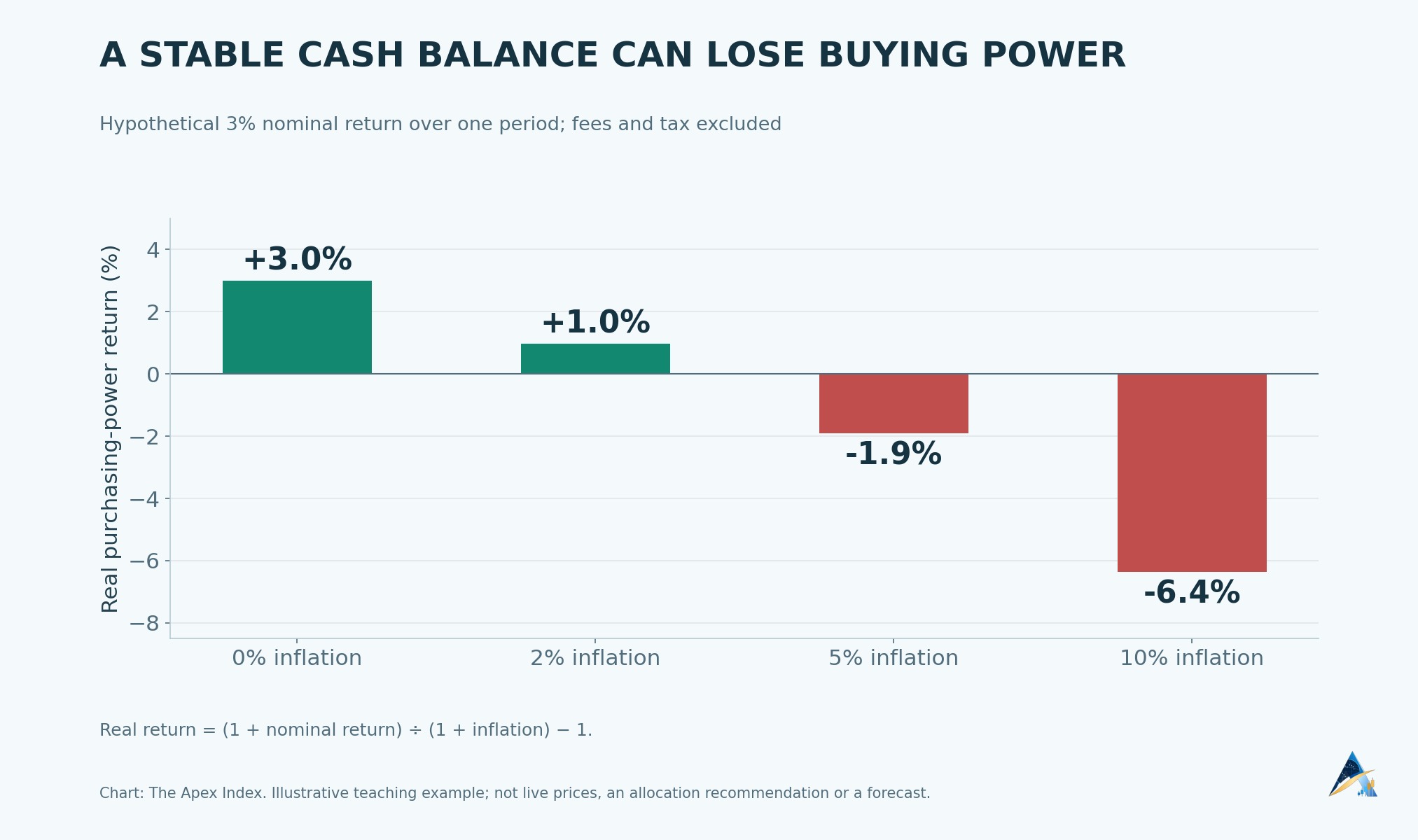
Inflation can erode purchasing power even when the nominal balance is stable. A cash reserve earning less than the rate at which relevant expenses rise can buy fewer goods over time. The second illustration shows the arithmetic of a hypothetical 3% nominal return alongside different inflation assumptions. It is not a forecast of deposit rates or consumer prices.
Foreign-currency cash introduces a different risk. It may protect against depreciation of the investor's home currency while exposing them to exchange-rate movements before a local bill is paid. A currency described as a haven in global trading can still fall against a particular counterpart. Match the protection to the actual spending obligation.
Crypto's scarcity claims are not a guarantee
Bitcoin is sometimes described as digital gold because its issuance rules limit supply. Supply scarcity is one feature of an investment, but does not establish how its market price will respond during an economic crisis. Investor demand, leverage, regulation and access to trading can dominate its shorter-term behavior.
Crypto assets can be sold alongside other risky investments when financing conditions tighten or investors need cash. They also introduce custody and operational considerations absent from a simple government-bond claim. An investor who values resistance to a particular form of interference may be addressing a different objective from an investor seeking stable purchasing power over the next month.
Stablecoins require a separate analysis. A token targeting a currency value may rely on reserve assets, banking access, legal redemption rights and the issuer's ability to meet requests. An apparently stable quotation does not remove those dependencies. Algorithmic arrangements introduce different mechanisms again and should not be treated as equivalent to a protected deposit.
The same caution applies to commodities marketed as inflation protection. Oil and industrial metals have physical demand and supply cycles. They may rise during a supply disruption and fall during a demand collapse. A broad commodity allocation, a single futures contract and a producer's shares can therefore respond differently to the same crisis.
Ownership and access can matter as much as the asset
Two investors can hold exposure to the same market and have different practical protection. One may own a security directly, while another owns a claim through a broker or fund. A physical holding may avoid an issuer promise but introduce storage and authentication questions. Identify the chain of obligations between the investment and the investor before relying on its defensive reputation.
A plan also needs realistic access. Selling an asset, receiving settled proceeds and moving that money into a spending account are separate steps. A system interruption or restriction can matter even if the investment's price is stable. Maintain records of ownership and understand the process for using the asset under the conditions against which it is supposed to protect.
The objective is not to eliminate every intermediary at any cost. Different structures can offer useful convenience, liquidity and administration. The point is to compare the protections actually provided, including their limitations, with the investor's intended use. Market performance and reliable access are complementary parts of a crisis plan, and either can become the weak link if it is ignored.
Choose the protection that matches the shock
In a growth or credit shock, high-quality government debt and liquid reserves may serve a defensive role. In an inflation shock, duration and purchasing-power risks become more important. In a currency or institutional crisis, the denomination, location and legal ownership of assets can matter as much as their price behavior. These are scenarios to examine, not universal forecasts.
A sensible assessment asks several concrete questions. Can the asset be sold or accessed when needed? Who must fulfill a promise for it to work? What happens if yields rise or the currency moves? Does it match the timing and denomination of the investor's liabilities? Those answers reveal more than the asset's reputation during a celebrated historical panic.
Avoid paying any price for perceived safety. Demand for a haven can push its price higher or its yield lower, reducing the return available to a new buyer. Buying a long bond after yields have fallen sharply is a different decision from buying it before a growth scare. A protective asset can become expensive without ceasing to be useful.
Diversification among different forms of protection can reduce dependence on one scenario. The mix should also sit within a broader allocation that reflects the investor's goals. A portfolio intended to fund immediate expenses needs a different balance from one built for long-term growth. Safe-haven holdings should perform a defined job rather than become an excuse to avoid planning.
The strongest use of a haven is usually practical: keeping commitments manageable and preserving choices when conditions deteriorate. It can help an investor avoid selling everything under pressure or betting the portfolio on one favorable outcome. The word safe is useful only when followed by an explanation of the risk being reduced and the risks that remain.