


Nearly nine in ten retail investors would consider digital gold if the products cleared the obstacles keeping them away, according to the World Gold Council. That's a lot of interest for a market still worth only a fraction of the money held in physical investment gold.
The council puts the long-term opportunity at up to $700 billion in additional demand. That number has no target date. Its nearer-term base case is smaller: a digital gold market worth $160-$170 billion by 2031, up from an estimated $45-$55 billion today.
The WGC's October 19 report draws on a survey of 12,365 people across 12 markets and interviews with 20 industry experts. It covers both vaulted digital gold, bought and managed through digital platforms, and tokenized gold. The opportunity extends beyond the crypto tokens already trading on exchanges.
“Nearly 9 in 10 retail investors signal a willingness to invest in digital gold under the right conditions,” the council said. Its opening verdict was blunt: “Appeal is strong but is not (yet) converting at scale.”
People want the gold. They need to trust the seller
Nearly four in five investors say trusting the provider is a priority before investing. The most frequently cited thing that would make them more open to digital gold is evidence that a product is safe and legitimate.
That means knowing the gold is there, understanding who holds it and having a workable route to redeem it. The report says redemption can come with restrictive terms, including large minimum quantities or a single location where the metal can be collected.
Access matters, too. Where digital gold sits inside familiar banking apps, payment platforms and super-apps, penetration is up to seven times higher than in markets without that distribution. India, China and Indonesia show what happens when investors can buy through services they already use.
Then there's price. The council ranks uncompetitive costs as the second most common barrier to entry. A convenient app still has to compete with bars, coins and gold-backed ETFs.
The $700 billion opportunity has a smaller five-year forecast
The WGC's scenarios show how much depends on providers fixing those problems. Its base case implies annual growth of roughly 27% through 2031. Faster progress would lift the market to $270-$280 billion; limited progress would leave it at $70-$80 billion.
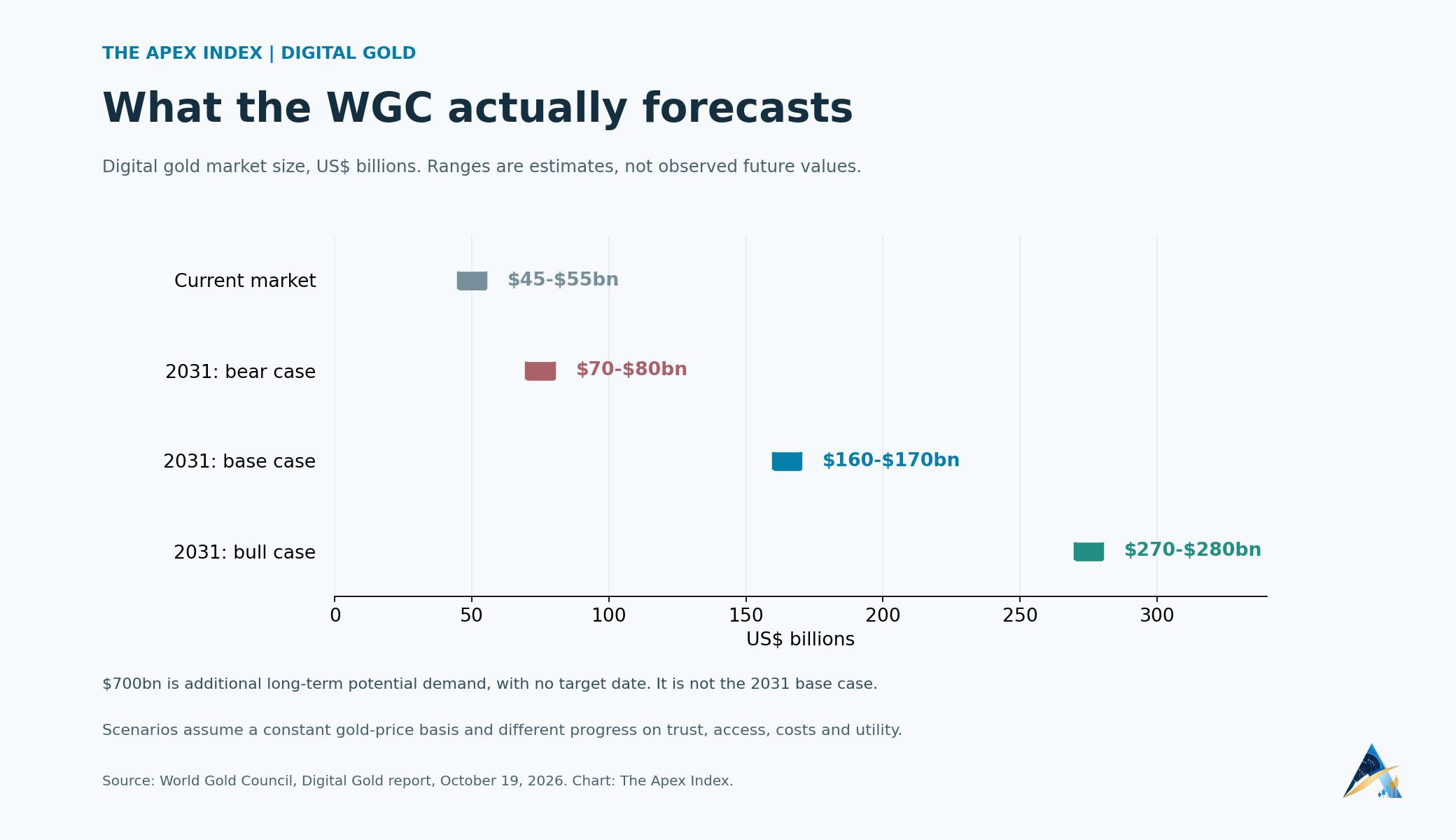
Those are different paths for the industry, rather than a prediction that the biggest number will arrive on schedule. The council's model holds the gold-price assumption constant, so a major bullion-price move could change the outcome.
For context on that separate price risk, Apex previously examined why the dollar rallied while gold fell. Easier access to gold doesn't remove its exposure to market swings.
Younger investors could bring fresh money
The WGC estimates that about 65% of latent demand comes from people who haven't invested in gold before. Among existing gold investors, about 53% would fund digital purchases with money from outside their gold holdings or cash not currently invested.
That makes this more than a fight over who gets the existing gold customer. Awareness reaches 50% among people aged 25-34, compared with 23% among those 55 and older. Younger investors are also more willing to buy when the barriers fall.
Yield is another draw. Investors ranked earning income through activities such as lending or using holdings as collateral ahead of payments as a distinctive attraction. Those uses bring lending and platform risks alongside the gold exposure.
The methodology spells out a gap investors shouldn't overlook: the scenarios exclude a major hack, custody failure or fraud. Some 44% of respondents said a major security breach would most undermine their confidence; 41% pointed to a significant custody failure or fraud.
“While the products are ready, the ecosystem around them needs to catch up,” the council said, calling for stronger standards, regulation and transparency around backing and investor safeguards.
That's the work behind the $700 billion opportunity. Interest gets people looking. Reliable custody, sensible fees and an easy way out are what could get them to commit.