
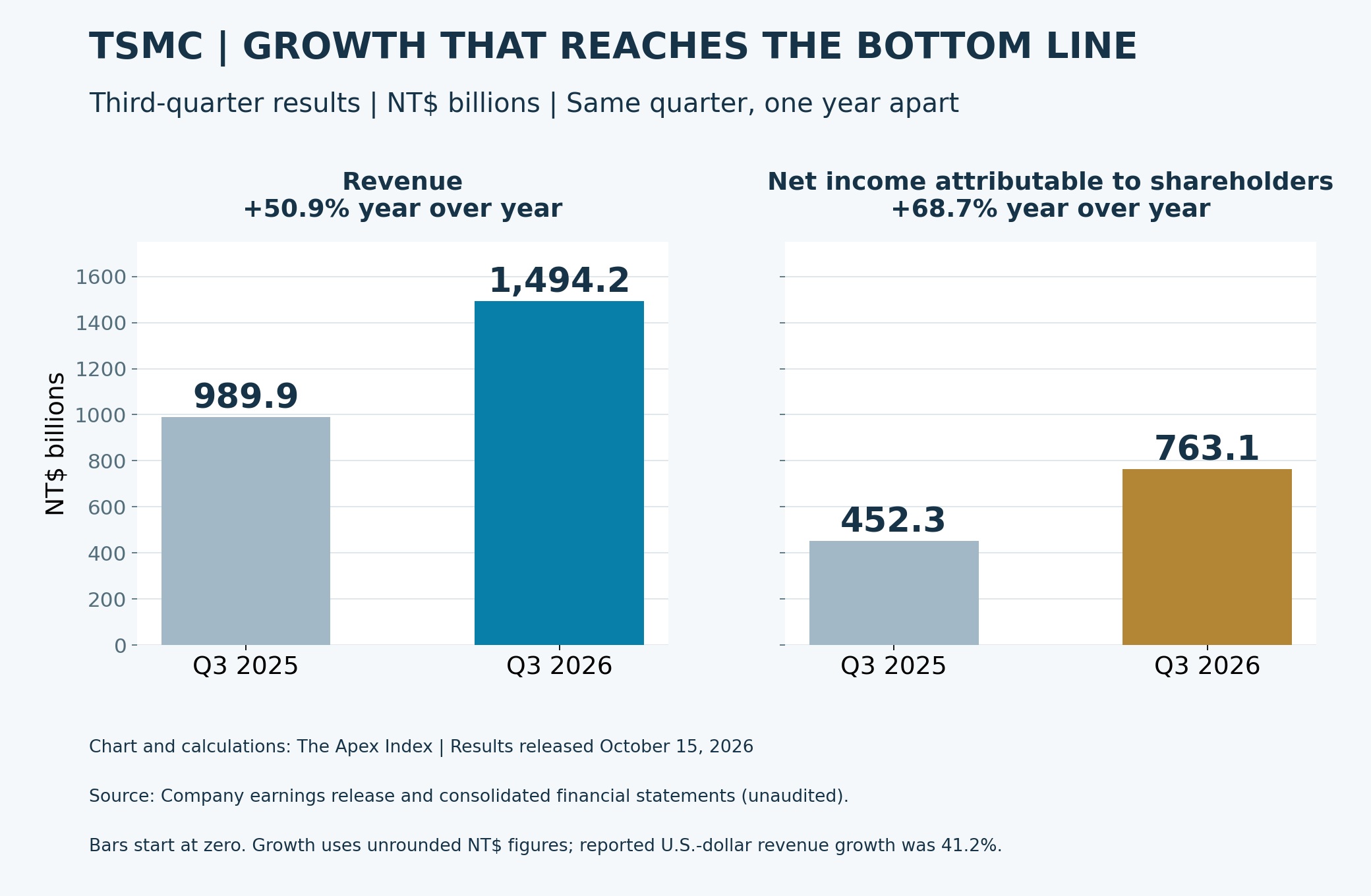
The AI chip rush is showing up where it counts for TSMC: sales and profit. The Taiwanese manufacturer reported a 50.9% jump in third-quarter revenue on October 15, as demand for its most advanced production technologies kept growing.
Revenue reached NT$1.494 trillion, or $46.72 billion. Net income attributable to shareholders climbed 68.7% to NT$763.06 billion, giving the company a net profit margin of 51.1%. The revenue increase was 41.2% when measured in U.S. dollars; the roughly 51% headline figure is the New Taiwan dollar comparison.
Its earnings release points to more growth ahead. Chief Financial Officer Wendell Huang said:
Moving into fourth quarter 2026, we expect our business to be supported by continued strong demand for our leading-edge process technologies, including the steep ramp-up of our 2-nanometer technology.
Revenue also rose 17.6% from the previous quarter in local currency. This was not simply a favorable comparison with last year: sales were also well above the April-June quarter.
The competition leads back to the factory
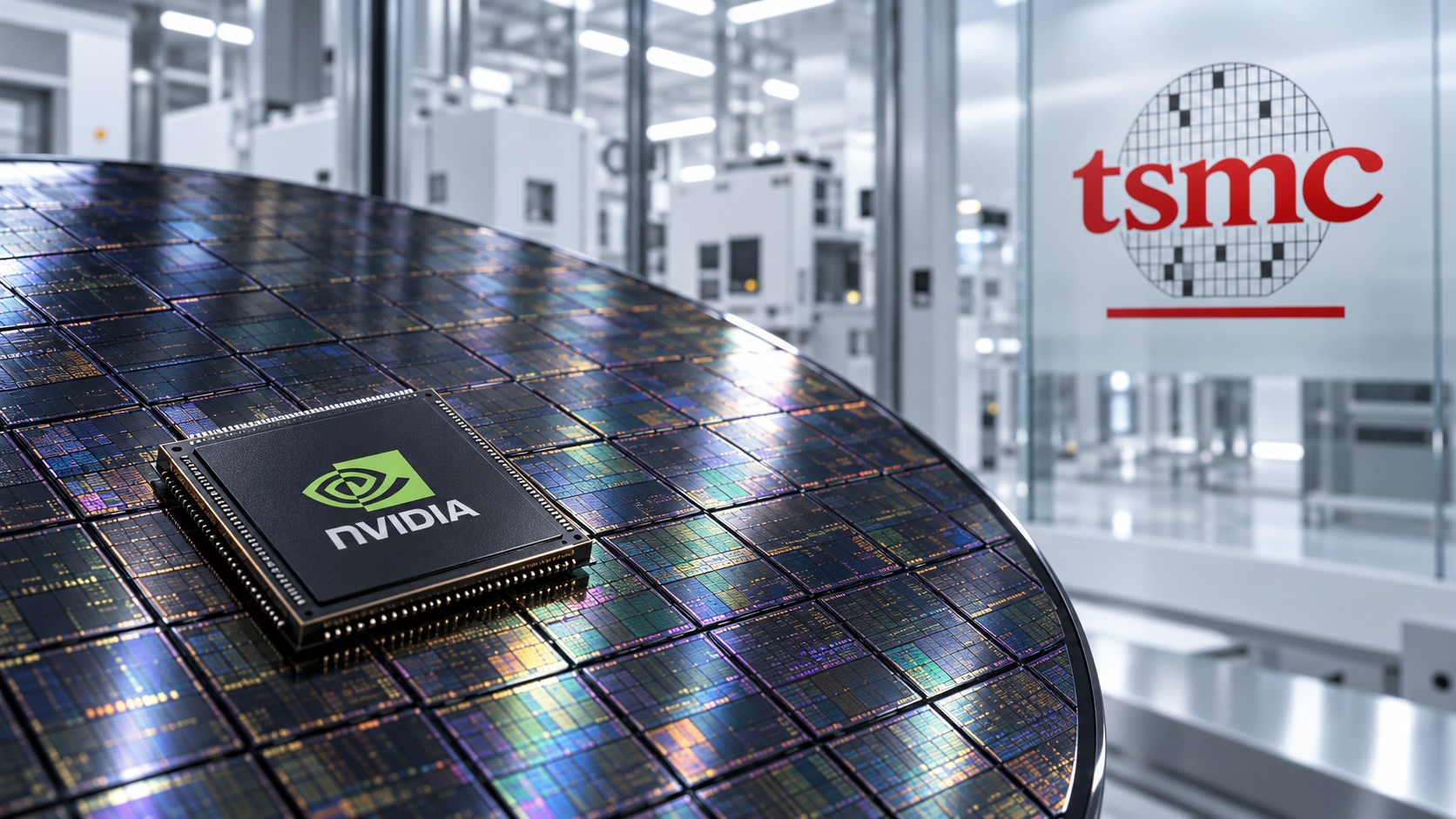
Nvidia identifies TSMC among the foundries that manufacture its semiconductor wafers. Its annual filing also describes its use of CoWoS packaging, the technology that connects advanced processors and memory. Designing a powerful accelerator is only part of getting one into a data center.
The latest manufacturing mix shows where spending is going. Two-nanometer production generated 8% of wafer revenue, up from 3% in the previous quarter. Three-nanometer chips contributed 33%. Technologies at seven nanometers and below together accounted for 79% of wafer revenue.
High-performance computing, a broader category than AI alone, supplied 68% of total revenue, compared with 57% a year earlier. Smartphone products supplied 21%. The two sets of percentages measure different things: manufacturing technology for wafer sales, and applications for overall sales.
The customer race extends beyond Nvidia. As previously reported by Apex, Broadcom has been seeking more than $50 billion in financing for OpenAI's custom-chip program. Those plans illustrate how AI companies are pursuing their own hardware alongside purchases from established suppliers.
Strong demand still comes with expensive trade-offs
Management raised its expected full-year U.S.-dollar revenue growth to around 44%. For the fourth quarter, it forecast sales of $52.3 billion-$54.3 billion.
The spending required to keep up is substantial. The annual capital budget remains $60 billion-$64 billion, while the company expects its two-nanometer family's annual capacity to more than double in 2027. Third-quarter gross margin was 66.4%, down from 67.7% in the previous quarter as the new process ramped up.
Construction of its second Arizona fab is complete, with volume production scheduled for the third quarter of 2027. In Taiwan, it has decided to add another three-nanometer fab in Tainan, targeting production in the first half of 2028. That leaves customers facing a gap between today's demand and factories still being built.
Chief Executive C.C. Wei also sounded a warning on the earnings call:
Looking ahead, we continue to observe consumer and price-sensitive end market segment are being challenged due to the impact of rising component prices and macroeconomic uncertainties. As such, we are being prudent in our business planning going into 2027 while focusing on the fundamentals of our business to further strengthen our competitive position.
Meanwhile, AI is moving inside chip factories as well as out of them. In an October 14 announcement, Nvidia described tools for semiconductor simulation, inspection and manufacturing workflows, with equipment and design companies among the adopters.
Expansion is also taking the manufacturer beyond its existing U.S. footprint. Wei said teams were evaluating Texas and discussing possible cooperation with Terafab, the Musk-backed project Apex had earlier reported on. Talks remain unfinished. His condition was direct: any such fab would have to be run by TSMC.