

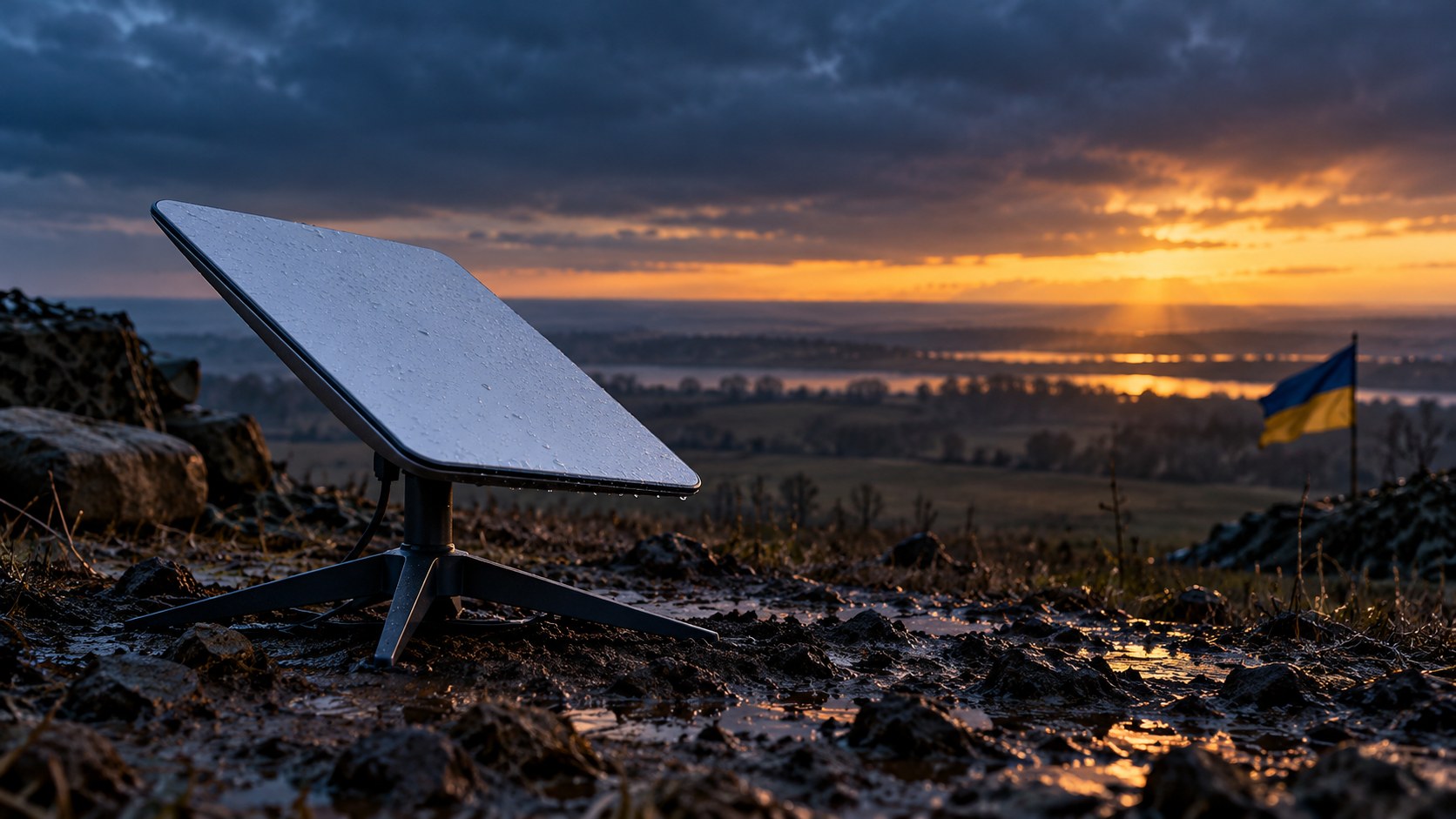
Donald Trump says Elon Musk has restored Ukraine's satellite internet access. Kyiv's account is much less reassuring: drones still face restrictions, improvements have been uneven, and the capabilities Ukraine needs to intercept fast-moving Russian weapons have not fully returned.
The sequence matters. President Volodymyr Zelenskyy described the remaining limits earlier on October 22, before Trump's announcement later that day. Subsequent reporting still pointed to an incomplete restoration, rather than a clean end to a dispute that has disrupted Ukrainian military operations.
Asked whether he had called Musk to get the restrictions lifted, Trump declined to give a straight answer. Reuters reported his response:
I don't want to comment on it, whether I called or whether somebody else called, doesn't make any difference, I guess. The bottom line - he put it back.
The Wall Street Journal reported that Trump had contacted Musk and expressed frustration that the service remained capped. It cited U.S. and Ukrainian officials saying the system was working more normally afterward, although some Ukrainian officials said full functionality had not returned.
A connection that drops when the drone gets faster
Zelenskyy's complaint concerns the speed at which aircraft carrying the terminals can operate while maintaining service. This is a limit on motion, measured in miles per hour, rather than an ordinary broadband download-speed complaint.
In his October 22 interview with CNN's Christiane Amanpour, he said Ukraine had previously been able to use the system for interceptor drones pursuing Russian jet-powered Shaheds. He described incoming weapons traveling at roughly 450-500 kilometers per hour, while Ukraine's available operating speed had fallen to a maximum of about 100 mph.
He acknowledged that speeds had increased somewhat after the initial restrictions, but said limits remained. He also said he did not know whether the decision originated with SpaceX or government institutions, even though he believed the company could technically implement it.
That distinction leaves two questions open: who ordered the restrictions, and whether the service now supports the missions it supported before. A connection that works for some units can still fall short for a fast-moving interceptor.
The reports from Ukraine remain mixed
CNN subsequently reported that some Ukrainian military units had experienced higher speeds, but a source familiar with the situation said the improvement was not universal and speed limits remained. Ukraine was still awaiting clarification from the U.S. side.
A Ukrainian official gave the Kyiv Independent an even bleaker account. In its October 22 report, updated October 23, the official said the cap of 161 kilometers per hour, roughly 100 mph, remained:
Overall, nothing has changed anywhere.
Zelenskyy also told reporters on October 22 that he was waiting to hear back from Rubio, who had promised information within about 48 hours. The official who spoke with the newspaper said there were still no explanations for what had happened to a system Ukraine considers a top priority.
Washington and Musk have also offered different explanations of who controls the service. As previously reported by Apex, Musk said military-grade Starshield systems were owned and controlled by the U.S. government, with usage limits ultimately decided by the military and president.
Secretary of State Marco Rubio, meanwhile, has said decisions about commercial Starlink rest with SpaceX and Musk. Starlink and Starshield are related services, but the commercial network and its military-grade counterpart should not be treated as interchangeable when assigning responsibility.
One important service has come back
Zelenskyy did report progress on a separate problem: U.S. intelligence warnings about incoming Russian ballistic missiles were working again after his discussions with Rubio. He said the missing alerts had put civilians at risk by denying them time to reach shelters.
That restoration brings back a warning, not the means to shoot down the missile. Zelenskyy said Ukraine still needed more Patriot interceptors and that supplies from European partners were insufficient. For Ukrainian air defenses, reliable satellite connections, timely intelligence and enough interceptor missiles remain separate requirements. Getting one back leaves the others to be resolved.