
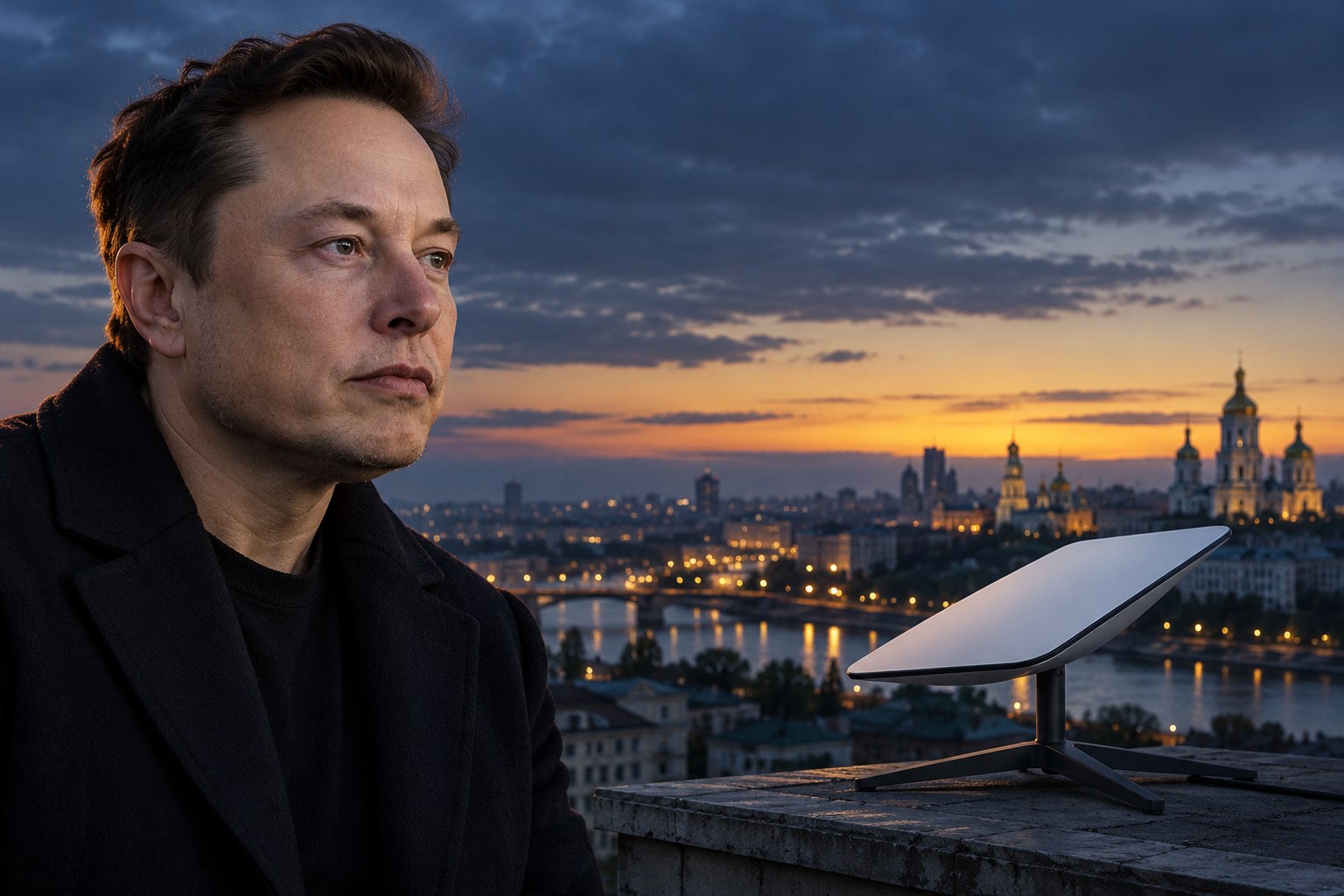
Elon Musk allegedly helped sell Donald Trump on restricting Ukraine's satellite communications, then distanced himself from the decision because he feared a backlash from European customers. That is the account in a new Telegraph report, which puts his business interests at the center of a dispute with immediate consequences for Ukrainian air defenses.
The October 16 report cites four unnamed sources who said Musk approached Trump about imposing speed limits on the service and the president agreed. The allegation about Musk's role and concern for his European business remains unconfirmed publicly. Trump denied responsibility the same day, while Ukraine said its access still had not fully recovered.
A different account of who wanted the limits
The Telegraph reported that Musk proposed the restrictions, paving the way for the Pentagon to execute a slowdown on Starshield, SpaceX's military-grade satellite service. Accounts of the exclusive published by The New Republic and RBC-Ukraine describe the same sequence: Musk made the suggestion and Trump accepted it.
The European money angle comes from an unnamed source who said Musk feared a consumer backlash after a devastating Russian attack on Kyiv. In that account, his public explanation shifted responsibility toward Washington after he had already helped initiate the change.
That goes further than his public statement. As previously reported by Apex, Musk said the U.S. government controlled Starshield restrictions. His October 14 post read:
Starshield systems are owned and controlled by the US government. Any limits on speed or usage are decided by the US military and ultimately POTUS.
The post also distinguished the system from commercial Starlink, which SpaceX owns and controls. Government authority over Starshield and Musk proposing a restriction could both be true. The new allegation concerns his involvement before the order, which that statement did not address.
The cutoff hit drones, not just internet browsing
The restrictions affected terminals mounted on moving aircraft. Ukrainian officials told Reuters that the equipment stopped working on fast-moving objects, interfering with drone guidance. A Ukrainian Defense Ministry source said on October 15 that connections worked again in motion, but only up to about 100 mph.
That matters for interceptor drones sent after incoming Russian Shaheds. Ukrainian officials said the limits also complicated strike missions against Russian forces and logistics in occupied territory. A drone losing its connection during flight is a much bigger problem than a slow video call.
An independent Reuters investigation, published October 15, traced the instruction to inside the White House. Two U.S. officials and a Western official said Pentagon leaders received a message that Ukraine's Starshield service needed to be slowed. They did not identify who made the decision or who implemented it.
SpaceX did not respond to that investigation's request for comment. A senior U.S. official said the president had made no such request, and the White House did not answer whether another administration official had done so.
Trump denies it, Kyiv says the problem continues
Asked on October 16 whether he or Musk was responsible, Trump told reporters:
Well, I don't know if it was anybody, because it wasn't me, and I don't think it was Elon, and from what I understand, it's the same as it's always been.
Zelensky's account was different. Speaking after meeting European leaders in Brussels, he said restoration was underway but incomplete. The Guardian reported his description of the remaining limits:
Have they returned to the previous speed limits? No. But is it coming back now? Yes.
The dispute arrives during a broader fight over Ukraine's attacks on Russian oil refineries. Trump has pressed Kyiv to stop, while Zelensky has defended strikes on infrastructure supporting Russia's war. As Apex had earlier reported in its intelligence-access coverage, Ukraine also said Washington had threatened to withhold missile-warning intelligence over those attacks.
For Kyiv, the immediate priority is restoring the capabilities its military was using before the restrictions. For Musk, the report opens a question his post left unanswered: what part did he play in getting those limits imposed?