
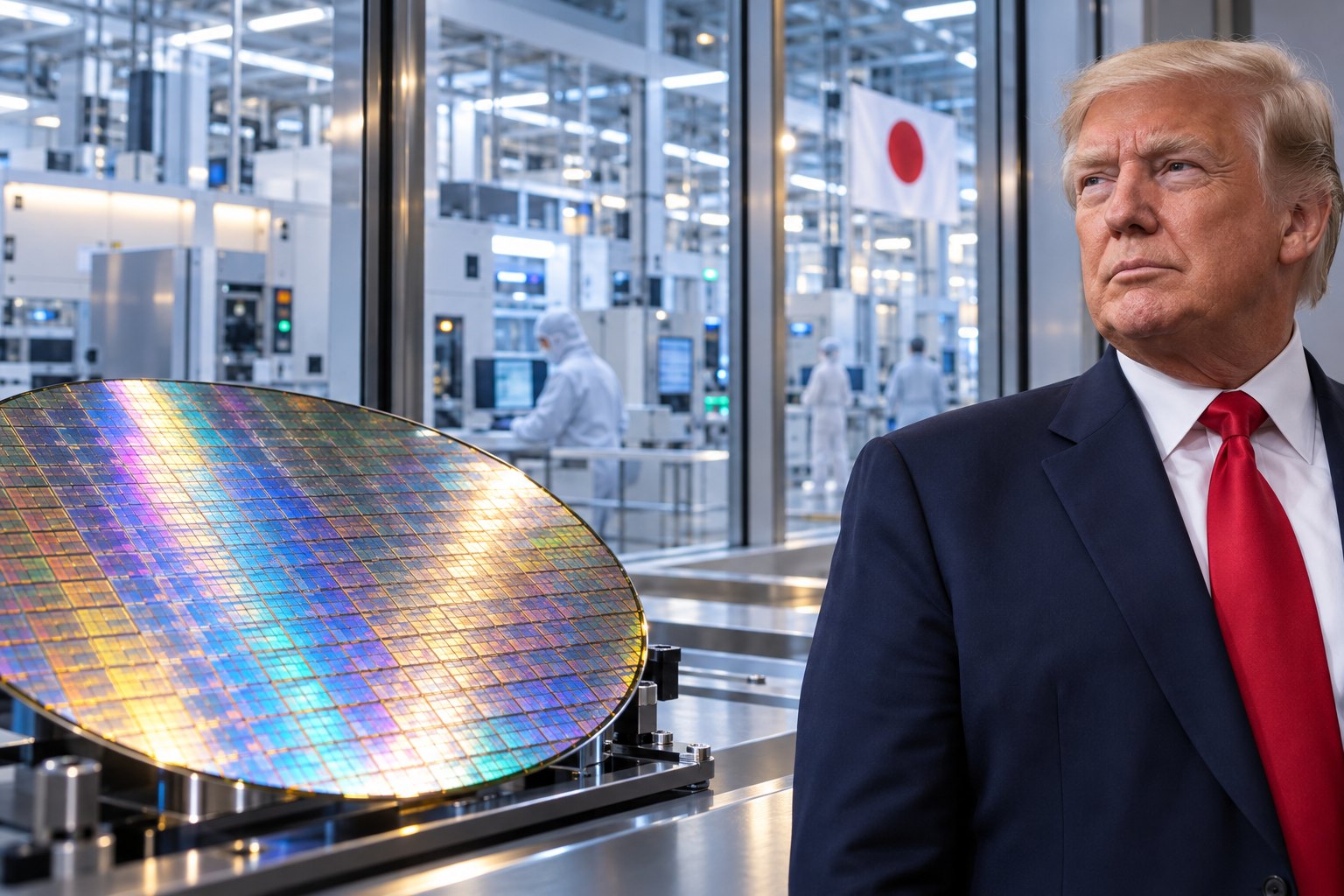
Donald Trump has announced a chip-factory expansion worth up to $21 billion in New York, with Japan supplying the investment and GlobalFoundries running the plants. America gets more domestic manufacturing capacity. The capital for the two new facilities comes from its Japanese partner.
The announcement covers two semiconductor factories in Malta, New York. The first is expected to start operating in 2029, with construction due to begin later this year. The second would follow through an additional investment, making this a phased expansion rather than two factories ready to start producing chips.
In his October 14 announcement, Trump put Japan's role front and centre:
Under my direction, JAPAN WILL PROVIDE THE CAPITAL for the 21 Billion Dollar Investment. This DEAL is a result of my HISTORIC TRADE DEALS to REVITALIZE the American Industrial Base, create HUNDREDS OF THOUSANDS OF GREAT AMERICAN JOBS, and strengthen our National and Economic Security.
Japan funds the factories. The U.S. shares ownership
The company's October 14 release confirms that Japan will provide the investment. The chipmaker's role is to supply the technology, manufacturing expertise and operating capabilities.
The Semiconductor Industry Association, or SIA, says both factories will be completely funded by Japan and jointly owned by the United States and Japan. That puts financing, ownership and operations in different hands. The announcements do not give the countries' ownership percentages for the facilities.
An initial investment of about $10 billion would accelerate the first factory's construction. Another investment of about $10 billion would fund the second. Those approximate phase figures sit within the announced funding envelope of up to $21 billion; the releases do not provide a detailed breakdown of every dollar.
CEO Tim Breen said running the plants would require more than money:
GF was selected because fabs of this scale require more than capital. They require differentiated technology, operational excellence and a proven ability to execute. That combination is what positions GF to make this first-of-its-kind initiative a success.
American taxpayers are getting a company stake
There is a separate U.S. arrangement alongside the Japanese-funded factories. The company has agreed with the Commerce Department to amend its existing CHIPS and Science Act award, reallocating $955 million to accelerate investment in silicon photonics, silicon-germanium and advanced packaging in New York and Vermont.
Those technologies support communications infrastructure and data centres, where the company says demand is growing. The amendment reallocates an existing award; it is not described as Japan's contribution to the two factories.
Commerce will also receive approximately 4% equity in the company under a separate agreement. That is a stake in the business, distinct from the countries' joint ownership of the new facilities.
Trump said total U.S. investments were reaching $1.63 billion and valued the government's stake at more than $2 billion. Those are the president's figures. A shareholding's stated value is not cash returned to taxpayers.
More capacity, but it takes time
The first factory is expected to add about 900,000 300mm wafers of annual production capacity when fully operational. The second would add roughly the same amount. Both are planned additions, not current output.
The project is expected to create about 27,000 construction and ecosystem jobs and more than 1,000 highly skilled manufacturing roles. The larger number includes work around building and supporting the factories, rather than 27,000 factory-floor positions.
As previously reported by Apex, U.S. semiconductor import spending rose 84% in January-August compared with the same period a year earlier. Today's deal adds a domestic-capacity plan against that backdrop, although the first plant's expected 2029 opening leaves a long construction period ahead.
The company says the new factories will serve automotive, industrial and connected-infrastructure markets. Its customers also see a role in the AI build-out: Renesas CEO Hidetoshi Shibata said demand for electrification, connectivity, AI and data-centre applications was accelerating worldwide.