

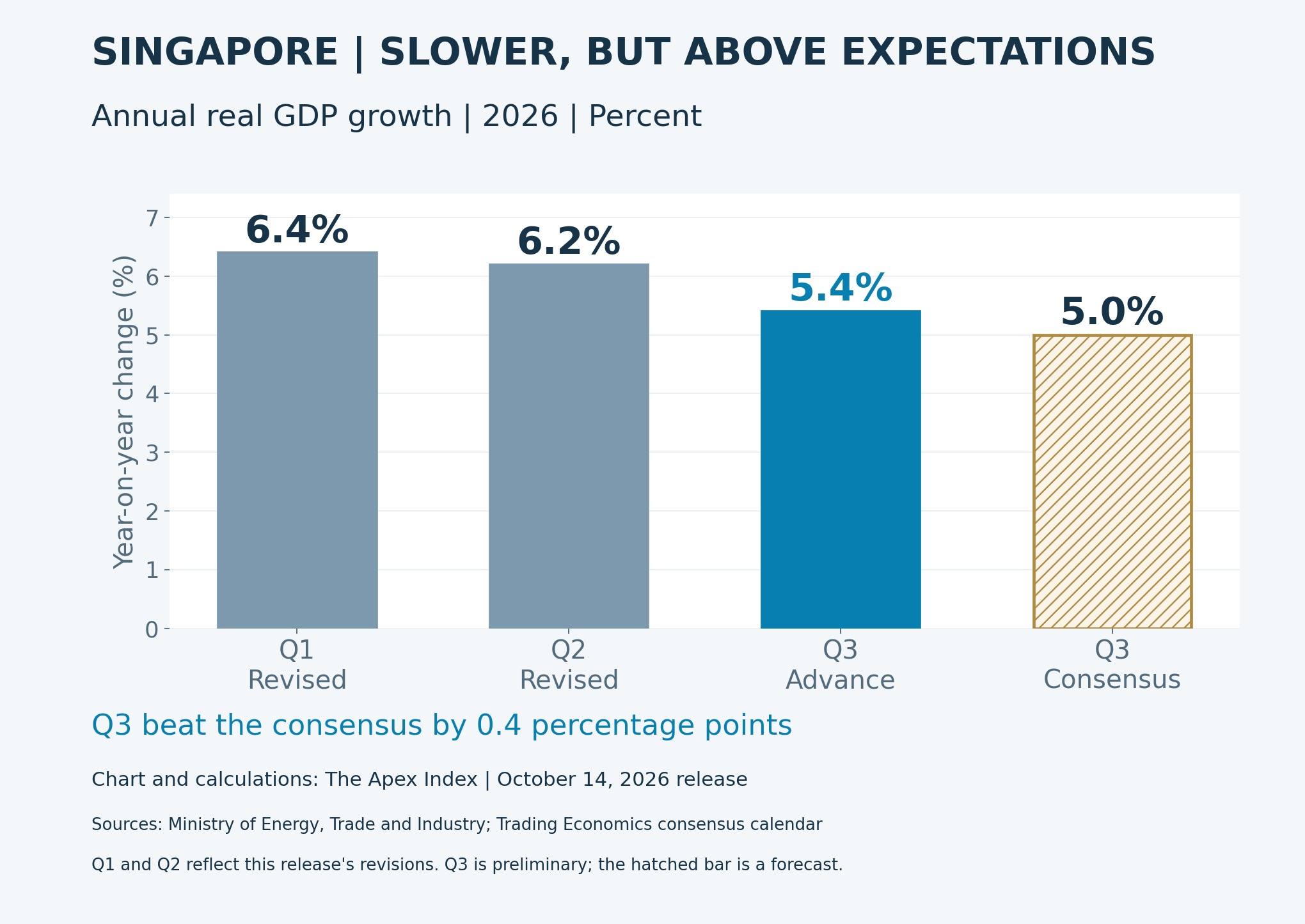
Singapore's economy slowed in the third quarter, but the slowdown was smaller than forecasters expected. Output rose 5.4% from a year earlier, beating a 5.0% consensus forecast and giving investors a stronger growth reading than they had pencilled in.
The October 14 advance estimate follows revised annual growth of 6.2% in the second quarter and 6.4% in the first. Singapore is losing some of its early-year speed, with factories doing much less of the heavy lifting. Construction and trade-related services helped keep the economy expanding.
A slower economy still beats the forecast
The Ministry of Energy, Trade and Industry's release puts the annual slowdown at 0.8 percentage points from the second quarter. Against the consensus listed on Trading Economics' calendar, the third-quarter result was 0.4 points stronger than expected.
The ministry also revised second-quarter annual growth upward from 5.9% to 6.2%.
The quarterly comparison was less flattering. After seasonal adjustment, GDP increased 1.1%, down from 1.5% in the previous quarter and below a separate 1.2% consensus. That is continued expansion, with less momentum, rather than an outright contraction.
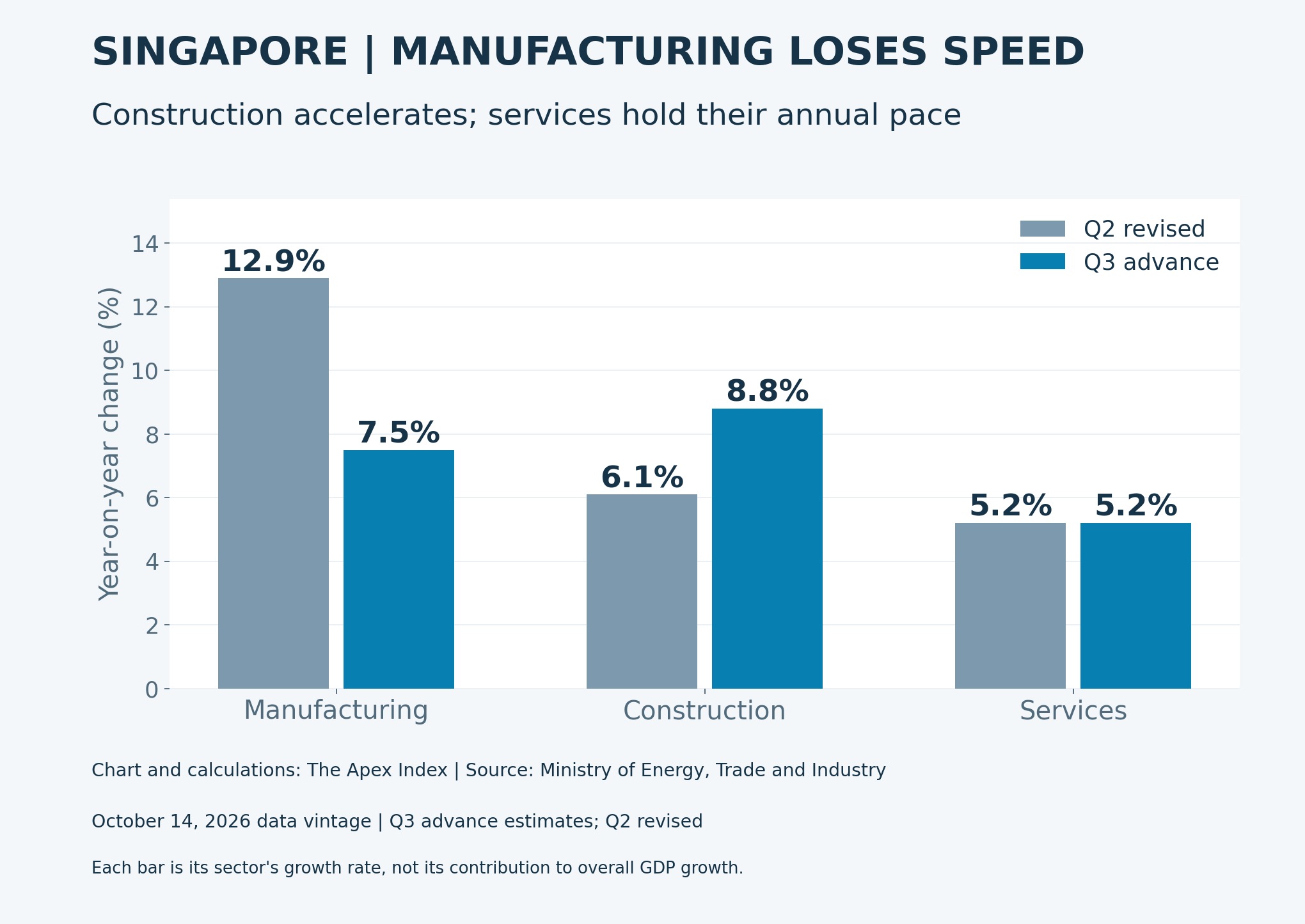
Manufacturing shows why the headline growth rate eased. Factory output grew 7.5% from a year earlier, compared with 12.9% in the second quarter. Measured against the preceding quarter, it fell 0.9%, reversing a 6.3% increase.
The ministry said:
Growth during the quarter was supported by output expansions in the electronics, precision engineering, transport engineering and general manufacturing clusters, which outweighed output declines in the chemicals and biomedical manufacturing clusters.
The electronics connection matters beyond Singapore. As previously reported by Apex, U.S. semiconductor imports rose 84% in the first eight months of 2026. Singapore's August economic review identified global AI-related investment as a support for its electronics production and machinery trade.
Other sectors pick up some of the slack
Construction accelerated to 8.8% annual growth from 6.1%, helped by increases in both public and private building activity. Its quarterly rise of 3.4% reversed the previous quarter's 2.7% contraction.
Services held their annual growth rate at 5.2%. Within that total, wholesale and retail trade, transportation and storage collectively expanded 8.0%, up from 6.9%. Machinery and equipment trading benefited from stronger electronics exports, while water and air transport supported logistics activity. Retail trade was the exception within that group, recording a decline.
The improvement was uneven elsewhere. Information and communications, finance and insurance, and professional services collectively grew 4.3%, down from 5.1%. The remaining services group slowed to 2.1% from 2.4%, with food and beverage services contracting. Stronger national output has not meant stronger business for every shop or restaurant.
The central bank holds its course
The Monetary Authority of Singapore also kept its exchange-rate policy settings unchanged on October 14, after tightening in April and July. All 10 analysts in a Reuters poll had expected another tightening. The authority retained the policy band's appreciation rate, width and centre.
In its statement, quoted by Reuters, it said:
The current appreciating policy band will allow the S$NEER to continue to strengthen and lean against the anticipated near-term rise in imported inflation, ensuring the gradual easing of inflationary pressures in 2027.
Singapore uses the exchange rate as its main monetary-policy tool. The S$NEER tracks its currency against a trade-weighted basket, and the unchanged appreciating band keeps that strengthening path in place. MAS expects core inflation to average 1.5%-2.0% in 2026 and ease more noticeably from the middle of 2027. Both core and overall inflation are forecast to average 1.5%-2.5% next year, with risks still tilted upward.
The GDP figures remain provisional. They rely largely on July and August data, with the fuller economic survey due in November. For investors assessing Singapore's outlook, the new numbers offer a stronger result than expected, alongside a manufacturing pullback and a central bank still guarding against imported price increases.