

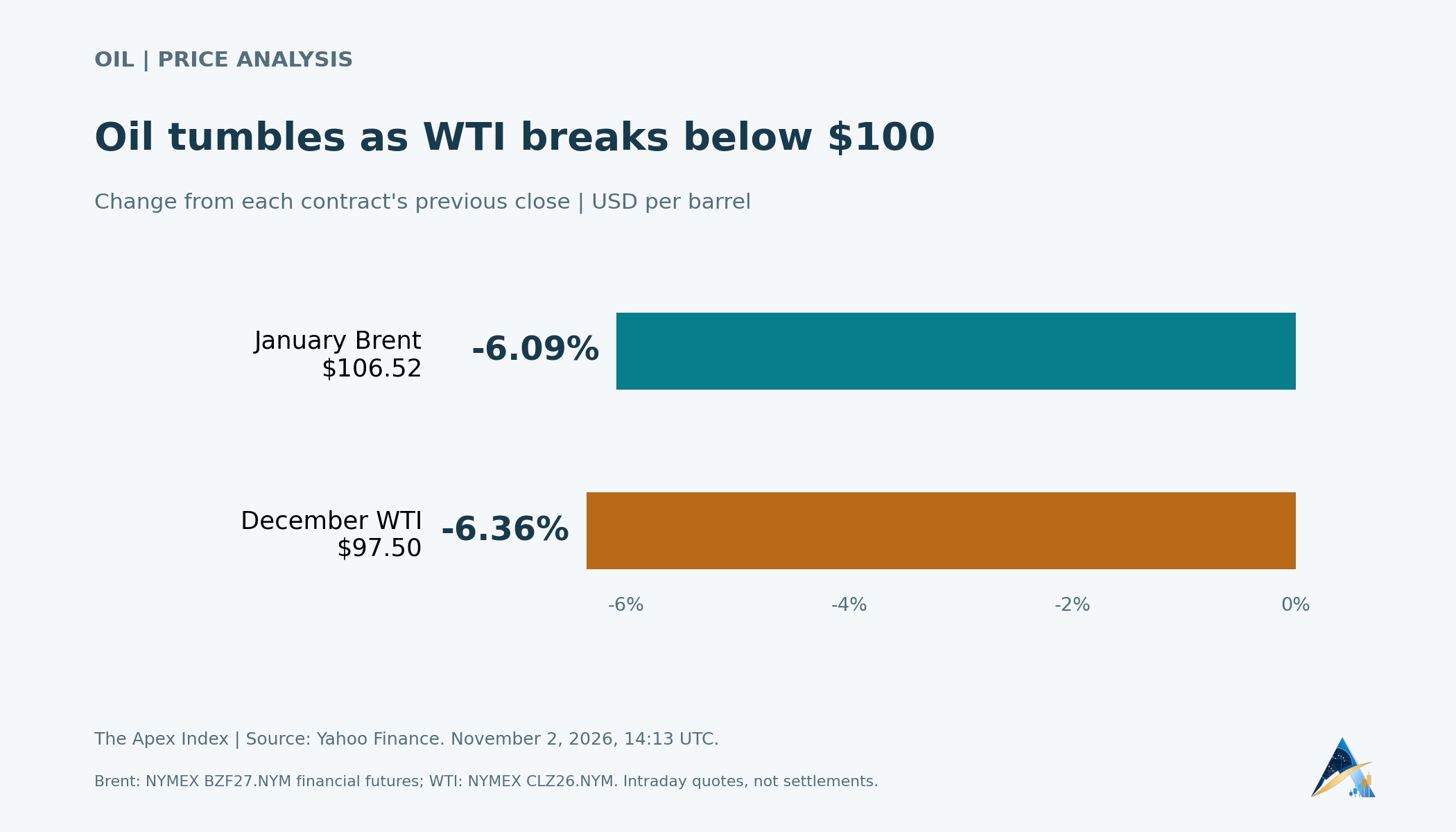
Oil prices tumbled roughly 6% on Monday as hopes for a US-Iran deal pulled some of the fear out of the market. American crude fell below $100 a barrel, putting traders who bought October's rally in a much less comfortable position.
At 14:13 UTC on November 2, January Brent futures were $106.52 a barrel, down $6.91, or 6.09%, from the previous close. December West Texas Intermediate, the US benchmark, traded at $97.50, down $6.62, or 6.36%. Those were intraday readings, with the session still underway.
The quotes and historical prices used here track the same contracts throughout: January Brent financial futures on NYMEX and December WTI. That matters when contracts change at month-end, because switching between delivery months can make a price drop look larger than the move in an individual contract.
Talks are keeping the prospect of a deal alive
Iran's Foreign Ministry said contacts with Washington were continuing after discussions with Qatari mediators ended without a breakthrough. Spokesperson Esmaeil Baghaei told Reuters:
I can tell you that the dialogues are continuing. However, the issue is complex.
He said the two sides were exchanging messages through mediators. An official briefed on the discussions said a draft proposal was circulating after Iranian negotiators left Qatar on Sunday.
Baghaei also described a shorter version of Iran's existing peace proposal:
The basis of dialogue and talks between Iran and the US via mediators is still Iran’s seven-steps proposal, which is now condensed, making it possible to implement it within two days.
That two-day period describes how Iran says its plan could be carried out if accepted. It is not an agreed deadline for reopening the Strait of Hormuz.
The proposal calls for Washington to end its blockade of Iranian ports, Iran to reopen the waterway, and the US to grant an Iranian oil-sales waiver and cancel new sanctions before further talks. Trump rejected the earlier version in September.
Apex had previously reported that Netanyahu wanted strikes after the November 3 US midterms, while Trump favored giving diplomacy more time. Monday's price reaction shows how much the market has riding on that choice.
WTI has lost $100, but the next test is close
For WTI, $100 is now the first round-number hurdle for a recovery. A move back above it would weaken the immediate bearish case. Further up, Monday's session high of $102.75 and the previous close of $104.12 provide additional reference points.
Below the market, the session low was $97.12. The provisional 20-day simple moving average stood nearby at $96.88. That puts the next test in a fairly tight area: can buyers hold prices around $97, or does selling continue through the recent average?
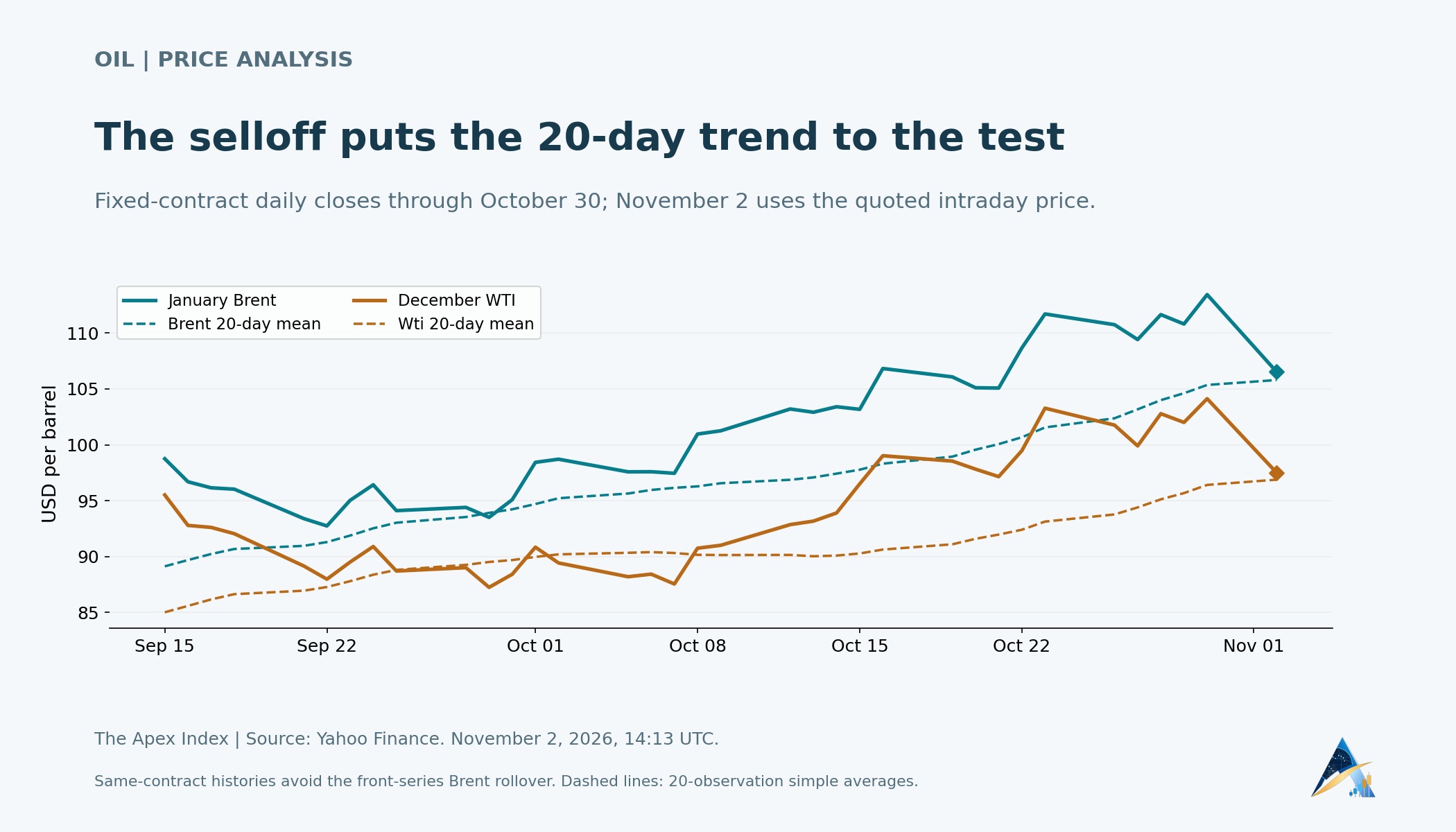
Brent has a similar setup. Its session low of $105.88 was just above its provisional 20-day average of $105.79. A sustained break below that area would weaken the recent upward trend. On a rebound, $110 is a round-number level to watch before the session high of $112.38.
These are chart reference points, not guaranteed floors or targets. Both contracts were still above their 20-day averages at the quoted prices. The sell-off has brought them close to a trend test without yet producing a break below that measure.
Momentum has cooled sharply
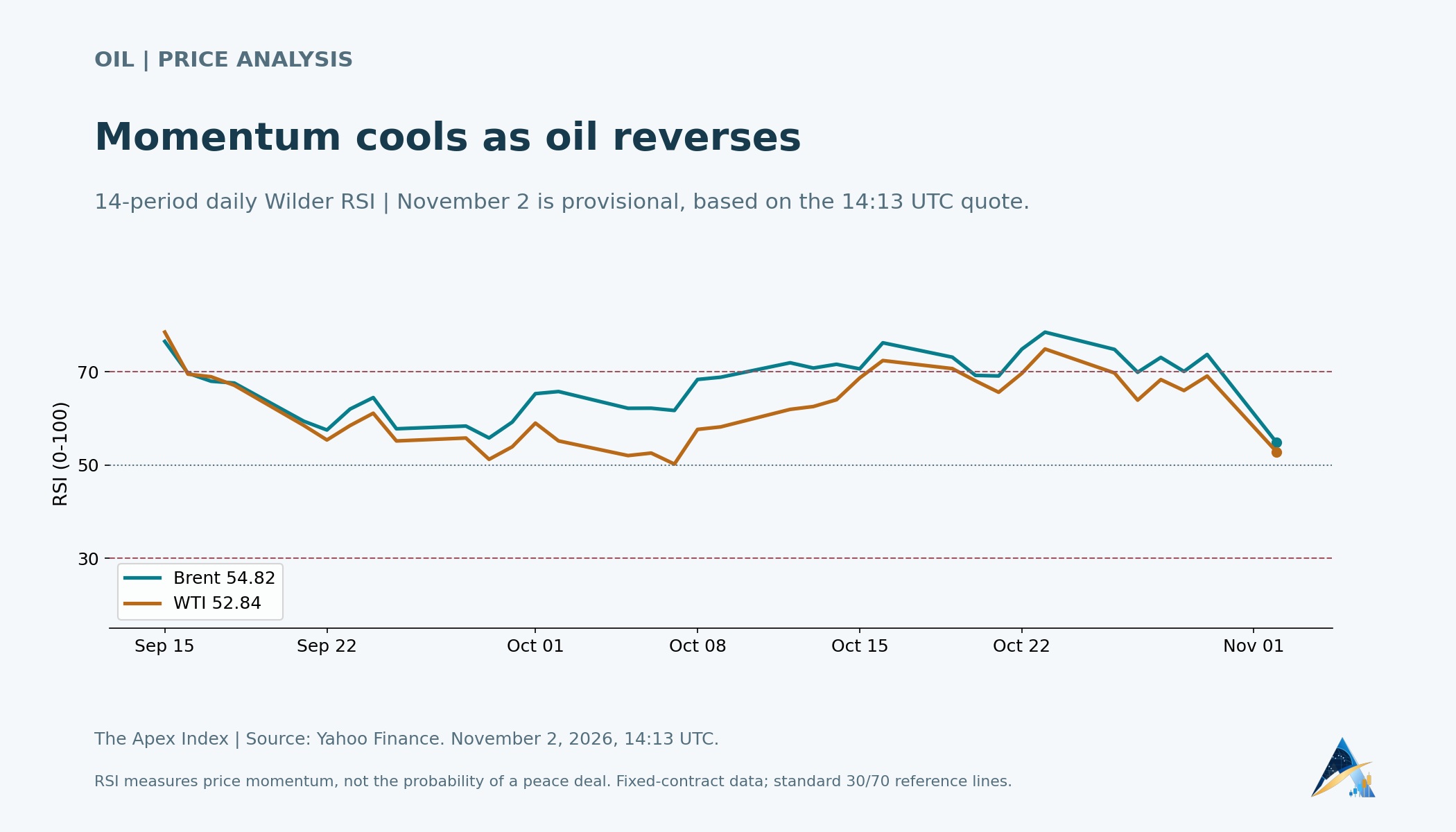
The 14-period daily relative strength index, calculated with Wilder's smoothing, fell to a provisional 54.82 for Brent and 52.84 for WTI. The previous completed session's readings were 73.74 and 69.11, respectively.
RSI measures the balance of recent price gains and losses. Readings above 70 are commonly described as overbought, while those below 30 are called oversold. Monday's readings were near the middle of that range, offering little support for calling the market oversold after one sharp drop.
The wider supply risk also hasn't disappeared. Goldman Sachs raised its December Brent forecast to $105 from $90 and its WTI forecast to $94 from $81, according to a Monday report by Investing.com. Strategists led by Daan Struyven cited the continuing risk of disruption to Middle Eastern supply.
Those are forecasts for December, rather than technical support levels. Their timing shows the tension in this market: oil can fall hard on progress toward talks while banks still allow for substantial disruption ahead.
For the decline to hold, traders will need more than another encouraging statement. Agreement on the blockade, sanctions and shipping would give the market a firmer reason to remove the extra cost of war from crude. Renewed strikes or another threat to tankers could send prices back the other way before any of those conditions are met.