

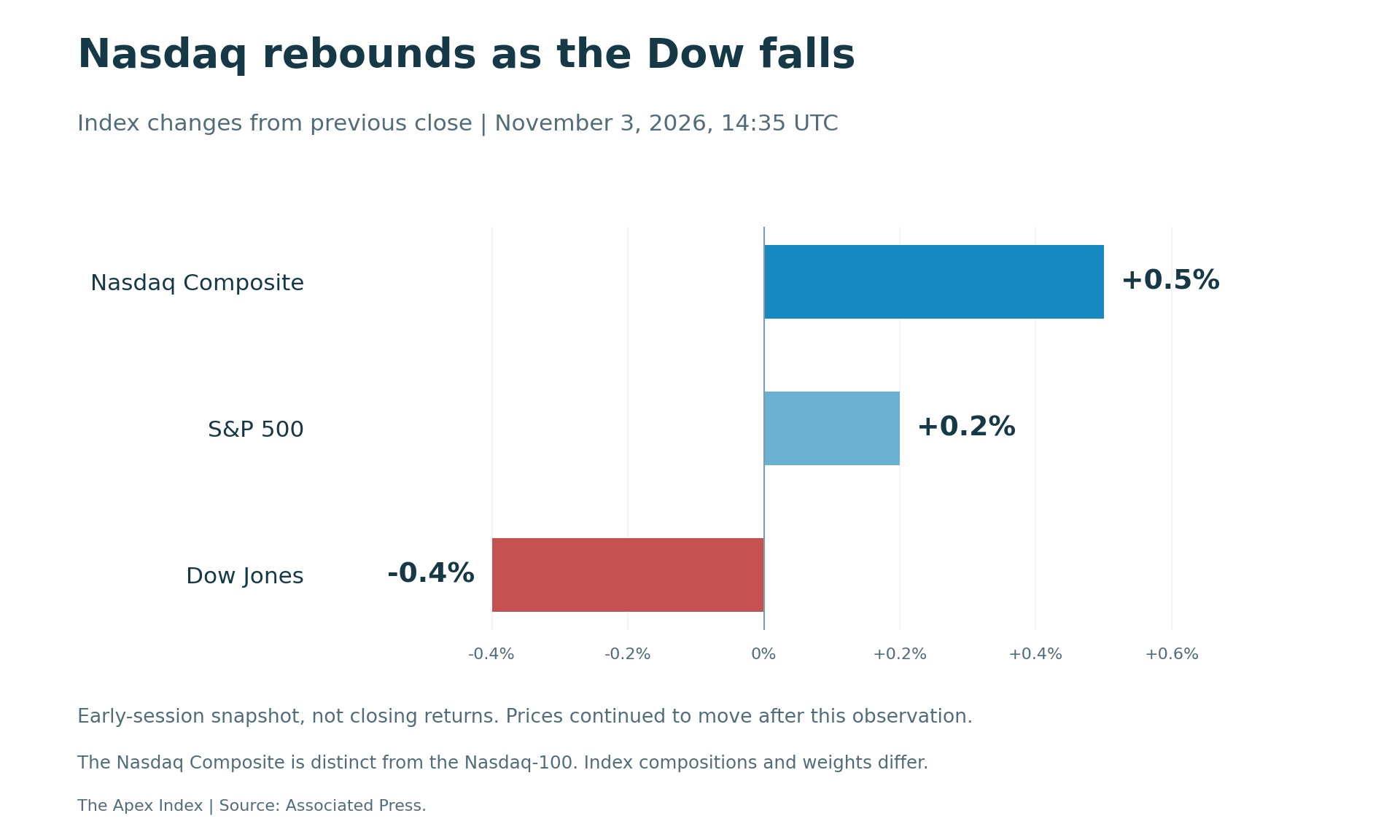
The Nasdaq Composite rose 0.5% in early U.S. trading on November 3 as major artificial intelligence stocks recovered, while the Dow fell 0.4% with Apple down 3.4%. The split showed two sides of the AI spending boom: support for companies supplying computing power and rising component costs for a major consumer-device maker.
Those figures describe the early session, not closing returns. Subsequent quote snapshots around 15:16 UTC put the Nasdaq up about 0.8% and the Dow down roughly 0.54%, while Apple was quoted at $332.23, down 1.8%. Apple's loss had narrowed, but the gap between the two indexes remained.
Nvidia leads the rebound, but the market is uneven
In the early snapshot reported by The Associated Press, the Dow was down 232 points at 14:35 UTC. The S&P 500 gained 0.2%, although more of its stocks were falling than rising. Gains in a few influential companies were enough to support the headline index.
Nvidia climbed 3.1% and was the biggest upward force on the S&P 500 in that report. CoreWeave, which buys AI chips and rents computing capacity to customers, rose 2.6%. Both moves followed a turbulent Monday, when some leading AI stocks had given up morning gains and finished lower.
The recovery was selective. Palantir fell 4.2% in the same early-session report despite beating profit expectations. As Apex previously reported, its latest quarter delivered about $2.3 billion in revenue, including a record $984 million from U.S. commercial customers. Strong reported growth didn't secure a positive share-price reaction.
Apple beats estimates, then warns about margins
Apple's results presented a similar divide between the quarter just finished and the period ahead. As Apex previously reported, September-quarter revenue reached $114.48 billion and diluted earnings were $2.10 per share. iPhone sales rose to $57.58 billion, helping both revenue and earnings beat the consensus cited in that coverage.
The December-quarter outlook brought the pressure. Apple forecast gross margin of 45%-46%, below the 47.9% reported for the September quarter, according to separate AP reporting. Higher memory costs and expenses tied to the Siri AI rollout were the main reasons cited.
Demand from AI data centers has made memory chips more expensive. That creates a different problem for Apple than for a company selling the hardware used to build those facilities: the component becomes a bigger expense in the products Apple sells.
Emarketer analyst Jacob Bourne put the results in the context of the wider technology selloff:
"Apple's strong earnings come in the wake of a recent tech sell-off, as investors question the enormous cost and uncertain returns of the AI boom driven by Apple's Big Tech counterparts."
Bourne also argued that Apple's more restrained approach to AI infrastructure spending helps preserve cash flow. The margin forecast shows that it still faces costs from the expansion of AI, even without matching rivals' spending on large computing facilities.
Prices keep moving as earnings and elections share the stage
The later Apple quote came from Nasdaq and was stamped 15:16 UTC. The index snapshots were recorded within the same minute through Yahoo Finance. They show how quickly the opening figures changed; neither set should be read as the day's final result.
November 3 is also U.S. midterm Election Day, with control of Congress being decided. Market commentary has focused partly on what the outcome could mean for technology regulation. Those policy possibilities remain scenarios while voting continues.
The earnings calendar offers another immediate test for the chip recovery. Advanced Micro Devices and Super Micro Computer are among the companies reporting on November 3. Their results come as investors weigh strong demand for AI computing against the cost of supplying it and the profits that spending can produce.