

Palantir's quarterly revenue has crossed $2 billion for the first time, beating Wall Street estimates as its U.S. commercial business overtook its U.S. government business. The software company reported $2.313 billion in third-quarter revenue on November 2, up 96% from a year earlier.
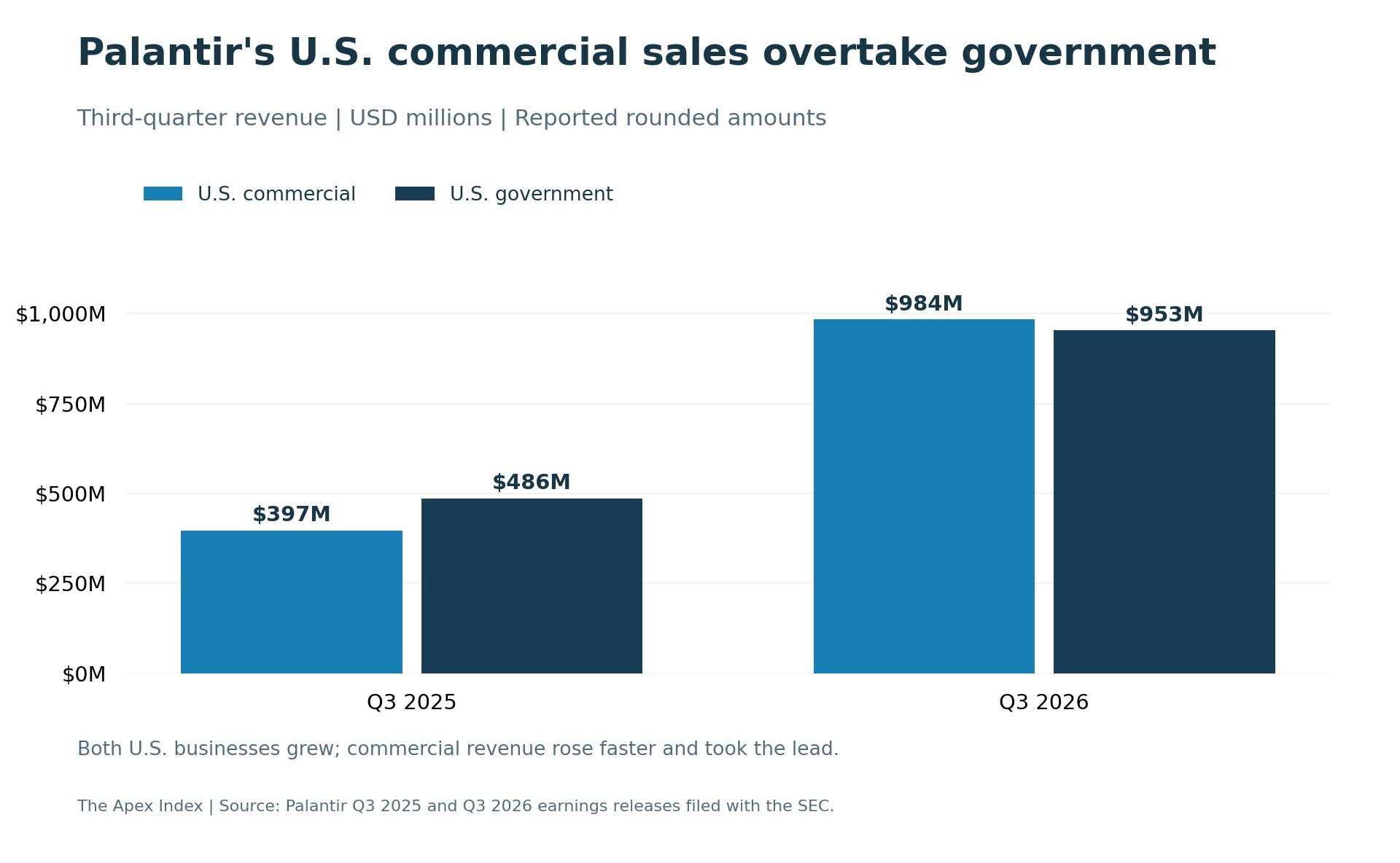
U.S. commercial sales reached a record $984 million, growing 148% year over year and 29% from the previous quarter. Government work in the United States also grew sharply, bringing in $953 million, but commercial customers pulled ahead for the first time in the company's history.
The results cleared consensus on both sales and profit. Analysts had expected revenue of $2.17 billion and adjusted earnings of $0.40 a share, according to Bloomberg data reported by Yahoo Finance. Palantir delivered adjusted earnings of $0.44 a share.
Commercial customers change the revenue mix
The November 2 release puts total U.S. revenue at $1.937 billion, up 119% from a year earlier and 23% sequentially. That makes the American business the source of most of the company's $2.313 billion quarter.
The crossover reflects growth on both sides. U.S. government revenue increased 96% year over year and 18% quarter over quarter. A year earlier, government sales were $486 million and commercial sales were $397 million, according to the company's corresponding 2025 earnings release.
Chief Executive Alex Karp singled out the change:
Our U.S. commercial revenue has surpassed our U.S. government revenue for the first time in our company’s history.
Karp tied the results to demand for Palantir's AI software and its products, including Foundry, Ontology and AIP. His broader argument is that institutions are being divided by how effectively they put AI to work. The sales figures show the company's U.S. commercial business expanding quickly; his assessment of what that means for the wider market is management's view.
Profits and cash flow rise with sales
Palantir reported $1.085 billion in operating income under generally accepted accounting principles, a 47% margin. Adjusted operating income was higher at $1.427 billion, or a 62% margin.
The adjusted measure excludes stock-based compensation and related employer payroll taxes. Stock-based compensation alone totaled $318.9 million in the quarter, making the distinction between the two profit measures meaningful.
Net income attributable to common stockholders reached $1.128 billion, up from $475.6 million a year earlier. Both GAAP and adjusted diluted earnings rounded to $0.44 a share, even though the underlying net-income measures differed.
The company generated $1.205 billion in operating cash flow. It reported $1.216 billion in adjusted free cash flow, a separate non-GAAP measure, and held $10.4 billion in cash, cash equivalents and U.S. Treasury securities.
New contracts add to the picture, but they measure something different from sales already earned. Palantir closed 212 deals worth at least $1 million, including 64 worth at least $10 million. Those larger deals are included in the 212, rather than additional contracts to add on top.
Total contract value closed during the quarter reached $2.918 billion, up 6% year over year. U.S. commercial remaining deal value rose 79% to $6.517 billion. These measures include assumptions about contract options and termination, so the full amounts are not guaranteed future revenue.
The company raises its year-end targets
Palantir now expects full-year revenue of $8.530 billion-$8.534 billion, ahead of the $8.2 billion analyst estimate reported in Yahoo Finance's coverage. The guidance implies about 91% annual growth.
The U.S. commercial target rises to more than $3.559 billion, representing growth of at least 143%. For the fourth quarter, management expects revenue of $2.649 billion-$2.653 billion and adjusted operating income of $1.640 billion-$1.644 billion.
It also raised its full-year adjusted free-cash-flow outlook to $4.8 billion-$5 billion and continues to expect GAAP operating profit and net income in every quarter of the year. Those targets depend on performance still to come, including converting its growing commercial business into another higher-revenue quarter.