

Apple beat Wall Street's earnings and revenue estimates on November 2, with stronger iPhone sales helping it finish its fiscal year at a record high. Revenue reached $114.5 billion in the September quarter, while diluted earnings came in at $2.10 a share.
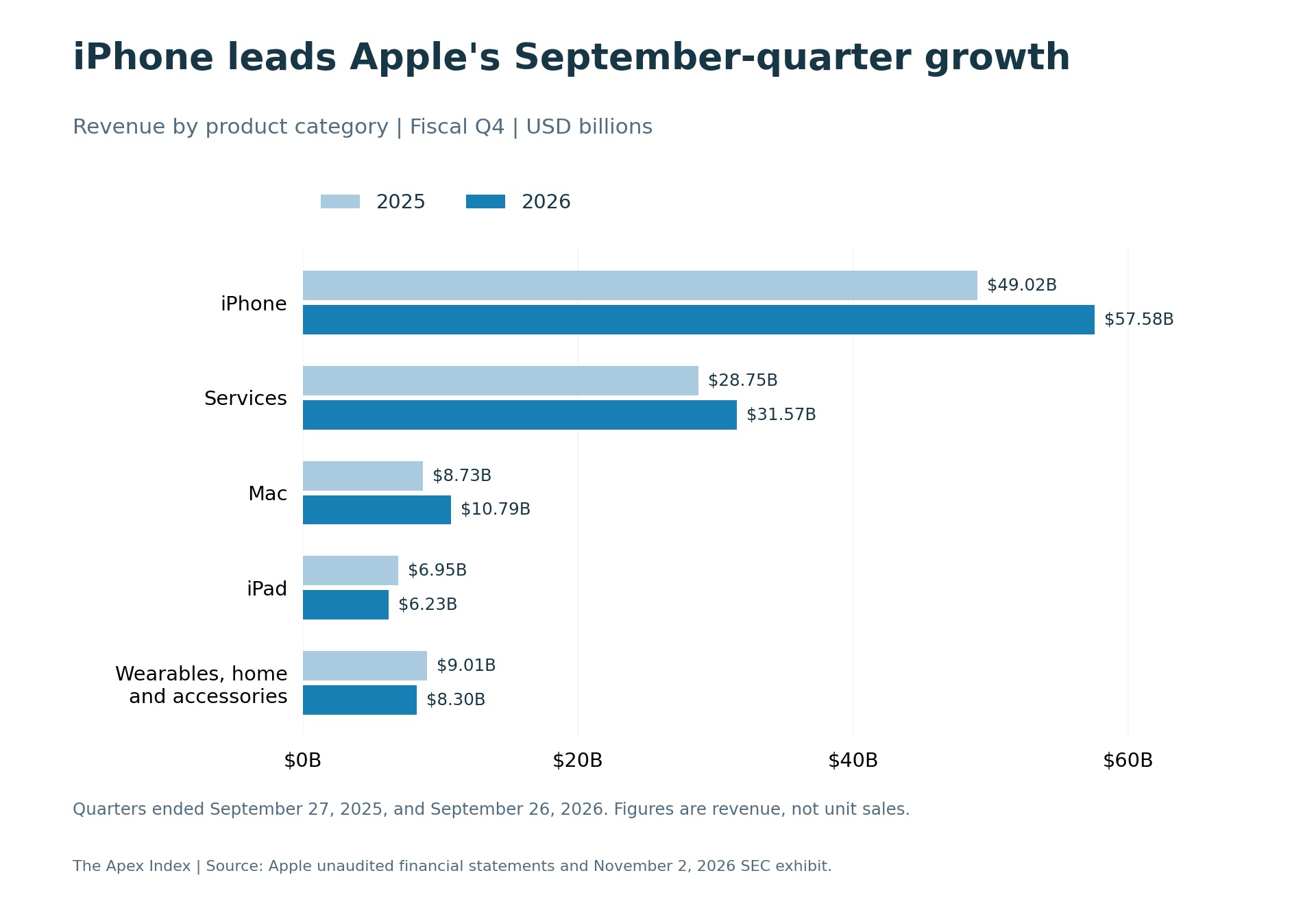
The iPhone brought in $57.583 billion, up from $49.025 billion a year earlier. That is growth of about 17.5% and a September-quarter record for Apple's biggest business. The figures cover the three months ended September 26, 2026.
Wall Street had been looking for $2 a share on revenue of $113.46 billion, according to Bloomberg consensus estimates reported by Yahoo Finance. The iPhone also cleared its $56.48 billion forecast, leaving the company with a beat on both its overall results and its most closely watched product line.
The iPhone did the heavy lifting
The detailed statements put total quarterly sales at $114.477 billion, up from $102.466 billion. Net income rose to $30.711 billion from $27.466 billion, while operating income increased to $35.631 billion.
The growth was uneven across the lineup. Mac revenue rose about 23.7% to $10.792 billion, comfortably above the $9.69 billion analysts expected. Services reached an all-time high of $31.573 billion, up about 9.8%, although that was just below the $31.58 billion consensus.
The weaker spots were iPad and the wearables, home and accessories business. iPad sales fell about 10.4% to $6.229 billion. The broader wearables category dropped about 7.9% to $8.3 billion. Rising iPhone, Mac and Services revenue more than offset those declines.
Greater China was another mixed result. Sales increased to $17.539 billion from $14.493 billion a year earlier, but still missed the $18.75 billion forecast. Revenue growth and an earnings-season disappointment can happen in the same market when expectations are higher still.
Tariff refunds gave earnings a lift
There is a useful qualification in Apple's November 2 release. Tariff refunds added $0.05 to diluted earnings per share and approximately one percentage point to gross margin. Reported gross margin was 47.9%.
That benefit matters when assessing the size of the beat. The reported $2.10 per share was $0.10 above the Bloomberg consensus, with half that difference equal to the refund contribution Apple disclosed. The company did not present a separate adjusted earnings measure in the release.
Operating expenses also increased. Research and development spending reached $11.73 billion, compared with $8.866 billion a year earlier. Total operating expenses rose to $19.189 billion from $15.914 billion.
Finance chief Kevan Parekh pointed to the cash the business generated:
We generated $28 billion in operating cash flow during the quarter, allowing us to return $28 billion to shareholders.
Parekh also said:
Thanks to our very high levels of customer satisfaction and loyalty, our installed base of active devices reached a new all-time high across all major product categories and geographic segments.
The holiday lineup belongs to the next quarter
As Apex reported ahead of these results, the iPhone Duo went on sale on October 23. Those retail sales fall after the September reporting period, making the foldable phone part of the holiday-quarter story rather than the explanation for this quarter's iPhone revenue.
CEO John Ternus highlighted that upcoming lineup, including the Duo, iPhone 18 Pro and Pro Max, new home hardware, Touch on Mac and the new Siri AI. His comments describe the products Apple is taking into the holiday season, rather than a numerical sales forecast for them.
For fiscal 2026 as a whole, revenue reached $478.834 billion and net income totaled $132.175 billion. Diluted earnings were $8.98 a share, compared with $7.46 the previous year.
The board declared a $0.27 quarterly dividend, payable November 16 to shareholders of record at the close of business on November 12.