

You own ten shares in a company. It sells more shares to someone else, and you still own ten. Nothing has disappeared from your account, but your percentage of the business has fallen. That's the basic idea behind stock dilution.
The harder question is whether you're worse off. A company receives something when it issues shares, often cash, another business or employees' services. What it receives, what investors pay and how management uses the proceeds all matter. A smaller ownership percentage does not automatically mean a smaller investment value.
This guide separates ownership, earnings per share and share-price effects using worked examples. Every example is hypothetical, uses U.S. dollars for convenience and assumes one class of ordinary shares unless stated otherwise. Shareholder rights and approval requirements depend on local law, exchange rules and the company's documents.
Start with your share of the business
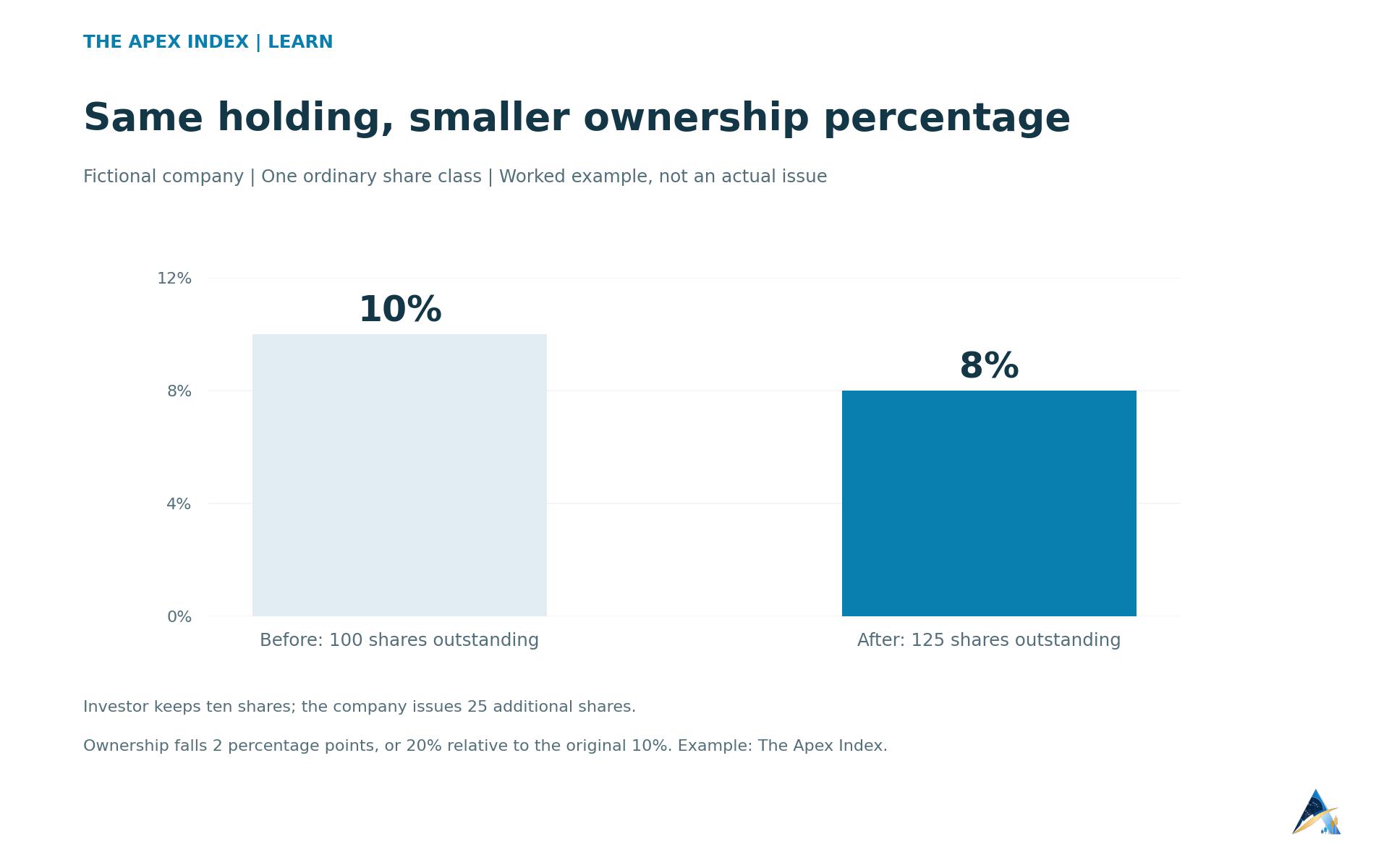
Your ownership percentage is the number of shares you hold divided by the relevant shares outstanding. Suppose a company has 100 shares and you own 10. You own 10% of that share class. If it issues 25 new shares and you don't buy any, you own ten out of 125, or 8%.
The share count increased 25%, while your percentage ownership declined 20% relative to where it started. Your ownership also fell by two percentage points, from 10% to 8%. These are three different comparisons, so check which one an announcement or analyst is describing.
The new investor owns 25 out of 125 shares, or 20%. It would be wrong to divide the new shares by only the old share count and call that the new investor's stake. Ownership after the transaction uses the total after the transaction.
This calculation concerns a particular class of shares. Economic rights and voting power don't always line up when a company has several classes, preferred shares or special voting arrangements. A simple percentage based on the number of ordinary shares can't capture every contractual right.
The business gets something in return
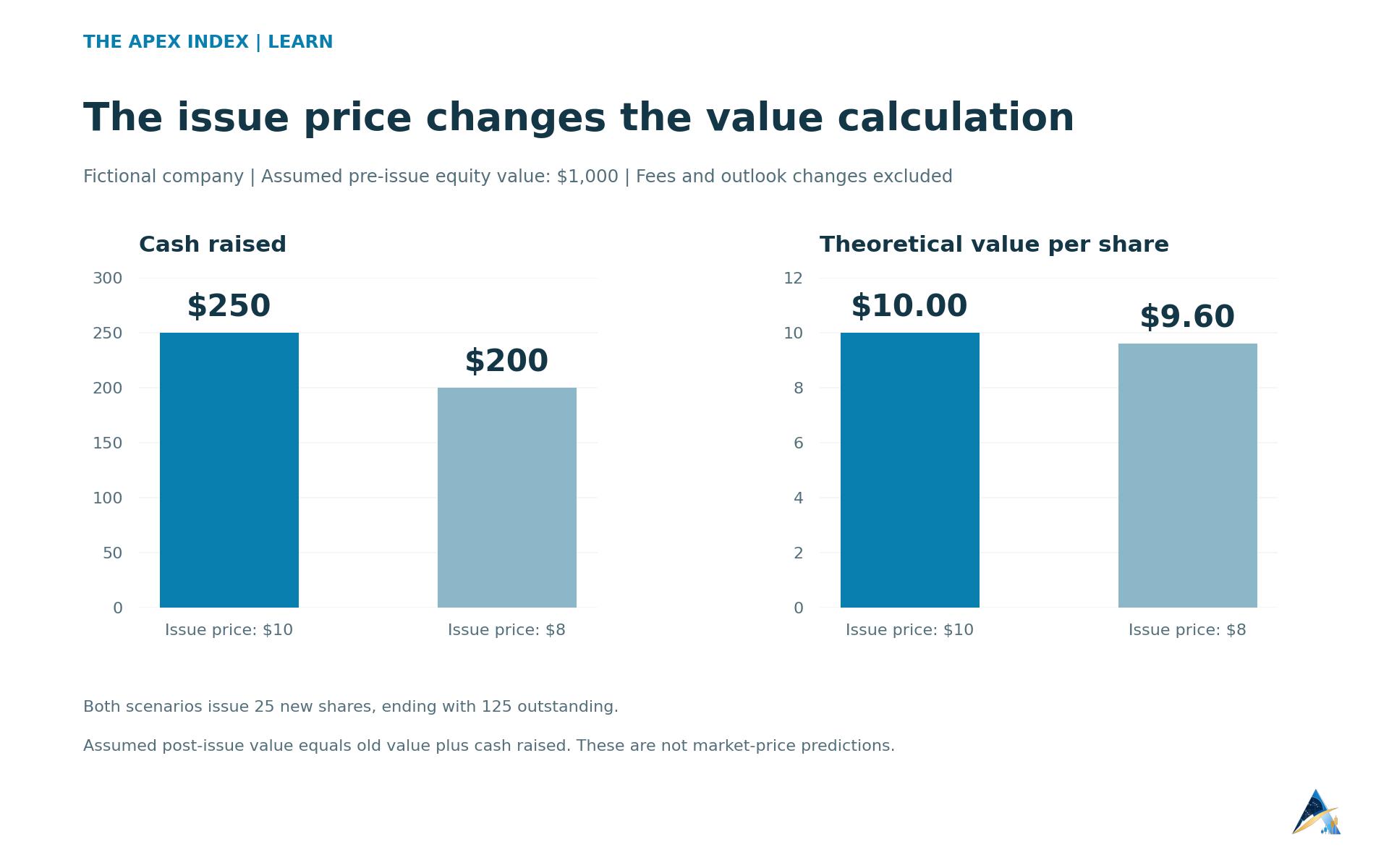
Now give our company an assumed equity value of $1,000 before the transaction, equivalent to $10 per share. It issues 25 shares at $10 each and receives $250. Ignoring fees and any change in the business outlook, the combined value becomes $1,250 across 125 shares.
The theoretical value remains $10 a share. Your ten shares still represent $100, even though your ownership percentage fell. This is a simplified valuation illustration, not a prediction of how a traded stock will react. It shows why the ownership calculation alone cannot establish a loss.
Change the issue price to $8, with everything else held constant. The company raises $200 instead of $250. Its assumed post-transaction equity value is $1,200 across 125 shares, giving a theoretical value of $9.60 per share. Your ten shares would be worth $96 under these assumptions.
That is a 4% decline in your holding's value, compared with a 20% relative decline in your ownership percentage. The two measures answer different questions. An actual market price can move by much more or less because investors also reassess risk, future profits and the reason for the sale.
Fees would reduce the money reaching the company. A financing attached to valuable contracts or an investment opportunity could change its expected worth. A distressed sale could also reveal problems investors hadn't fully priced in. Our example deliberately leaves those effects out so the arithmetic stays visible.
Why companies choose to sell shares
A company may need money to build facilities, develop a product, buy another business or strengthen its finances. Selling equity can provide funding without the fixed interest and repayment obligations of ordinary borrowing. Existing shareholders share the ownership with new investors instead.
Debt has different costs. Creditors generally have a claim ahead of common shareholders if the business fails, and loan terms can restrict what management can do. Equity avoids some of those obligations but gives new shareholders a claim on the business. Neither financing choice is automatically the cheaper or safer one.
The quality of the spending matters. New funding can support a project that raises future earnings enough to benefit existing shareholders. It can also cover repeated losses without fixing the business. Read the stated use of proceeds and the evidence supporting management's plan before judging the share issue on size alone.
A large cash balance after a sale doesn't prove the transaction created value. The company has raised money from investors and now owes them an explanation of how it will be used. Later cash generation, financial obligations and business performance help test whether that explanation held up.
New shares can arrive through several routes
A public offering sells shares to investors through a disclosed process. A private placement sells to selected investors. An at-the-market program allows sales over time under its terms. The timing, price-setting method, fees and eligibility rules can differ across markets and transactions.
A rights issue can give eligible existing holders the opportunity to buy shares in proportion to their holdings. That can let them maintain their percentage if they participate fully. It requires additional money and attention to deadlines; having the opportunity is different from automatically avoiding dilution.
Share-based pay can also increase shares outstanding. Options may be exercised, and restricted share awards may result in shares being delivered when their conditions are met. Some awards are settled in cash or use existing shares, so the plan's terms matter more than the headline award count.
Convertible debt or preferred securities may become common shares under specified conditions. Warrants can provide a right to buy shares at an exercise price. Their future effect depends on the terms, including prices, dates and any limits. Potential issuance and completed issuance belong in separate columns when you're assessing exposure.
When shares pay for an acquisition
Sometimes the new shares go to the owners of another business instead of cash investors. The buyer receives an operating business, with assets, liabilities and expected earnings. There may be no cash proceeds from that part of the transaction. Read the purchase terms before describing the enlarged share count as a cash fundraising.
Management may call a deal "earnings accretive" because it expects higher EPS after the acquisition. That forecast depends on the acquired business's profit, financing, accounting and any adjustments used. It doesn't establish that the buyer paid a good price. Integration spending, lost customers or weaker-than-expected demand can change the result after closing.
For that reason, compare the forecast with the combined company's later accounts. Keep management's expected savings separate from savings already achieved, and check whether the comparison includes transaction costs.
Watch earnings per share as well as ownership
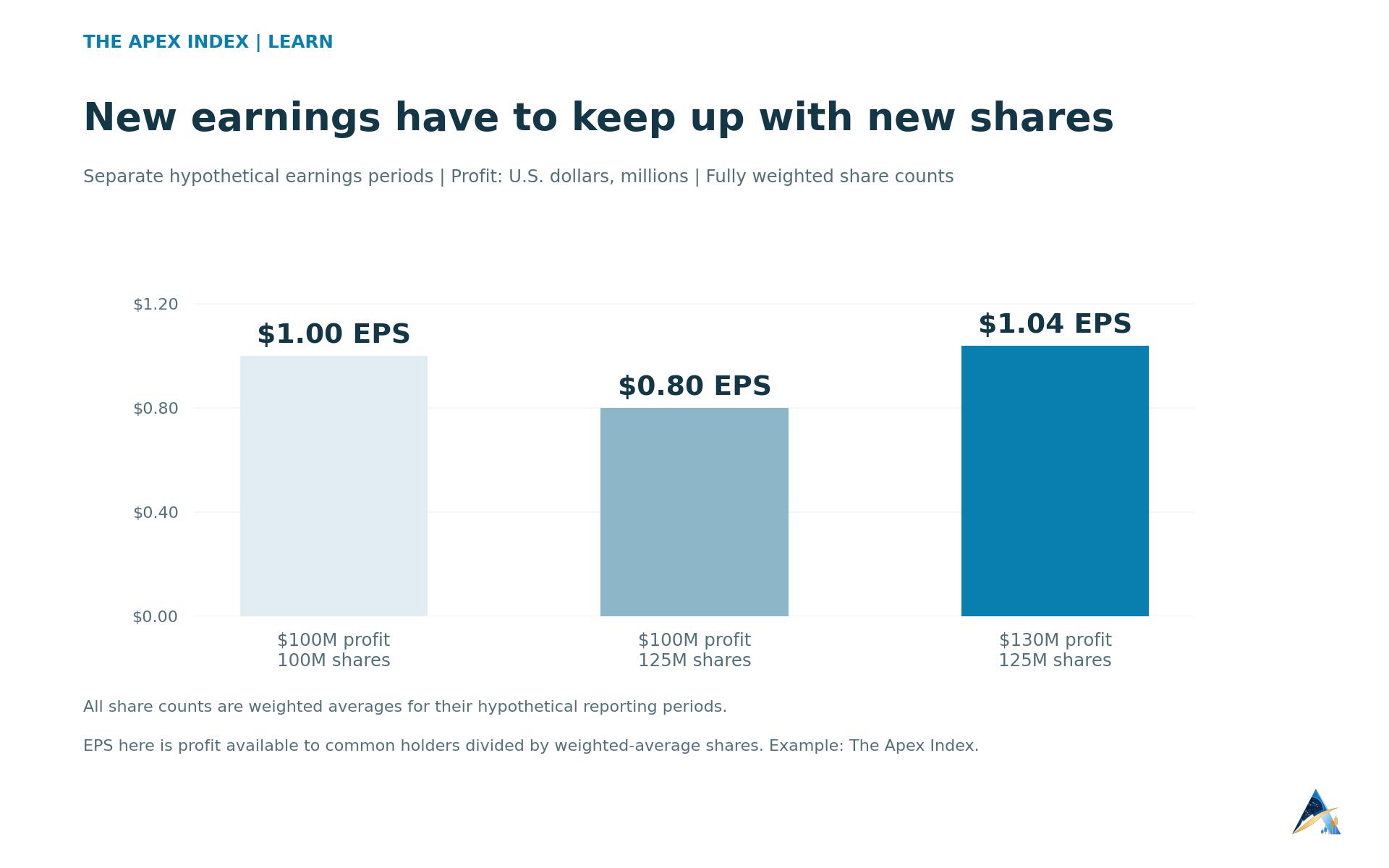
For a separate earnings example, assume a company earns $100 million available to common shareholders and has 100 million weighted-average shares. Basic earnings per share is $1. If the weighted-average count becomes 125 million while profit stays at $100 million, EPS falls to $0.80.
Suppose the funded expansion instead raises profit to $130 million with the same 125 million weighted-average shares. EPS becomes $1.04. To preserve the earlier $1 result, profit would need to reach $125 million. These are comparisons between hypothetical periods, not a promised return from raising capital.
The weighted-average detail matters. Shares issued late in a reporting period do not necessarily count as though they existed for the whole period. The examples above assume the stated weighted-average counts already reflect the relevant period. Quarter-end shares and the EPS denominator can therefore differ without an error.
Under IFRS, IAS 33 distinguishes basic and diluted EPS. Its standard addresses potential ordinary shares and the applicable calculations. Diluted EPS does not simply add every imaginable future share to today's count, and some potential shares are excluded when they would be antidilutive.
Read the share-count labels carefully
Authorized shares describe what the company is permitted to issue under its governing framework and documents. They are not all necessarily issued. Outstanding shares are shares held outside the company; shares held in treasury are generally excluded from that number. Presentation and terminology can vary by jurisdiction.
A company's ownership table may also use an "as-converted" or "fully diluted" count to show a particular scenario. Read its definition. It may include securities that have not converted or vested, and it may serve a different purpose from the diluted EPS calculation in financial statements.
Look at the dates on both counts before comparing them. A transaction can close after the balance-sheet date but before the earnings announcement. An annual report's cover-page share count may also refer to a later date than the period-end financial statements.
Check whether new shares are actually being created. An existing shareholder selling their own shares usually receives the proceeds; that sale alone doesn't increase the company's shares outstanding. Offerings can combine newly issued shares with shares sold by existing holders, so identify each part rather than relying on the offering's label.
A split and a buyback work differently
A proportional stock split changes the number of shares representing the same business without raising new equity capital. If every holder receives twice as many shares in a two-for-one split, their percentage ownership stays the same, apart from arrangements for fractional interests. A lower quoted price after the split doesn't establish a loss.
A buyback can reduce shares outstanding, but its effect depends on what happens afterward. Companies can hold repurchased stock in treasury or retire it, and new compensation shares may offset part of the reduction. Compare the net change in shares rather than assuming the announced buyback amount tells the whole story.
A buyback also uses cash. EPS can rise because the denominator shrinks even if total profit doesn't grow. That arithmetic doesn't establish whether management paid a sensible price or whether the business could afford the purchase. Both the share count and the cash spent deserve a place in the comparison.
Your rights depend on the transaction and market
Some jurisdictions and company structures give existing shareholders preemptive rights, or require approval for certain issues. Others allow specified transactions without offering every holder the same purchase opportunity. Eligibility can also depend on where an investor lives or holds their account. Don't assume a rule from one exchange applies everywhere.
ASX hosts a capital-raising guide describing Australian public-market routes and their tradeoffs. Its local setting matters: it can help explain a rights issue or placement, but its legal requirements should not be carried over to a company listed in another country.
Before deciding whether to participate, find the offer document, eligibility conditions, price, costs and deadline. Check whether your broker uses an earlier instruction deadline than the issuer. If there are several share classes, establish what rights the offered security carries and whether it matches what you already own.
Be especially careful with conversion terms
A fixed conversion price and a formula linked to a future market price can produce very different share counts. If a security promises a fixed dollar amount of stock at a price tied to the market, a lower conversion price may require more shares to deliver that amount. Exact protections and limits depend on the contract.
Check conversion discounts, minimum prices, caps and amendments rather than treating every convertible as a fixed number of future shares. Meta's October 27 pricing announcement is one example of an issuer setting out conversion ranges and a planned settlement date. The prospectus and governing terms supply the fuller conditions.
Also ask what an exercise or conversion does to the company's finances. Exercising a cash-paid warrant can bring in money. Converting debt can remove a debt claim while creating common shares. Those transactions change more than the denominator, which is another reason a share-count estimate cannot replace a financial analysis.
Work through an announcement before judging it
Start with the number of new shares, the price or pricing formula and the net proceeds after costs. Add the new shares to the relevant existing count, then work out the resulting ownership. Keep unissued options, possible future sales and completed transactions separate rather than mixing them into one certain outcome.
Next, read why the company needs the money and what it gives up or receives. Compare the planned investment with expected cash generation, debt obligations and the period before any expected payoff. A management forecast can explain the plan without establishing that the promised earnings will arrive.
Finally, watch the transaction's conditions. A registration, an announced plan, a priced offering and a completed sale represent different stages. Find the closing announcement and the next financial disclosure before treating the maximum proposed amount as money already received. Concepts and source references in this guide were checked on October 27, 2026, UTC.