


Nvidia plans to invest $3 billion in Meta as the two companies expand their work on Muse, the AI assistant at the center of Mark Zuckerberg's push for personal superintelligence. The agreement puts the chipmaker's money behind a customer that is also planning to use more of its computing hardware.
The announcement, distributed on October 27, comes as Meta increases its broader equity fundraising plan to as much as $97.5 billion. The companies want to make Muse and its related models faster and cheaper to run, while Meta builds the infrastructure needed to take personal AI agents to billions of people.
What Nvidia and Meta are building together
Their announcement covers both training, when models learn, and inference, when those models respond to requests. Engineers will work across the computing systems and software to improve performance and reduce the overall cost of running them.
Zuckerberg described the goal this way:
"Muse is how we bring personal superintelligence to everyone. We're excited to keep working with NVIDIA to deliver the best personal agents and frontier models for billions of people."
Muse, known internally as Hatch, can connect to email, calendars, payments, health, shopping and smart-home apps, Reuters reported on October 27. Users can withdraw access at any time. That makes it a tool intended to carry out tasks across someone's digital life, with permissions becoming an important part of how it works.
Meta said in its October 26 financing announcement that more than 10 million users in the U.S. and Canada had joined Muse in its early weeks. Shopping was the leading use case, with more than a quarter of weekly active users using that feature. Those are company-reported figures.
Meta's fundraising plan just got bigger
The latest terms increased the common-stock offering to $25 billion from $22.5 billion, at $625 a share. A separate offering of depositary shares representing mandatory convertible preferred stock adds $12.5 billion. Both offerings are expected to close on October 29, subject to closing conditions.
The remaining $60 billion is a proposed program to sell shares over time at market prices. Meta has not established that program, which is not expected to begin before the first quarter of 2027. The common-stock sale also uses forward agreements, so Meta does not expect to receive those proceeds immediately.
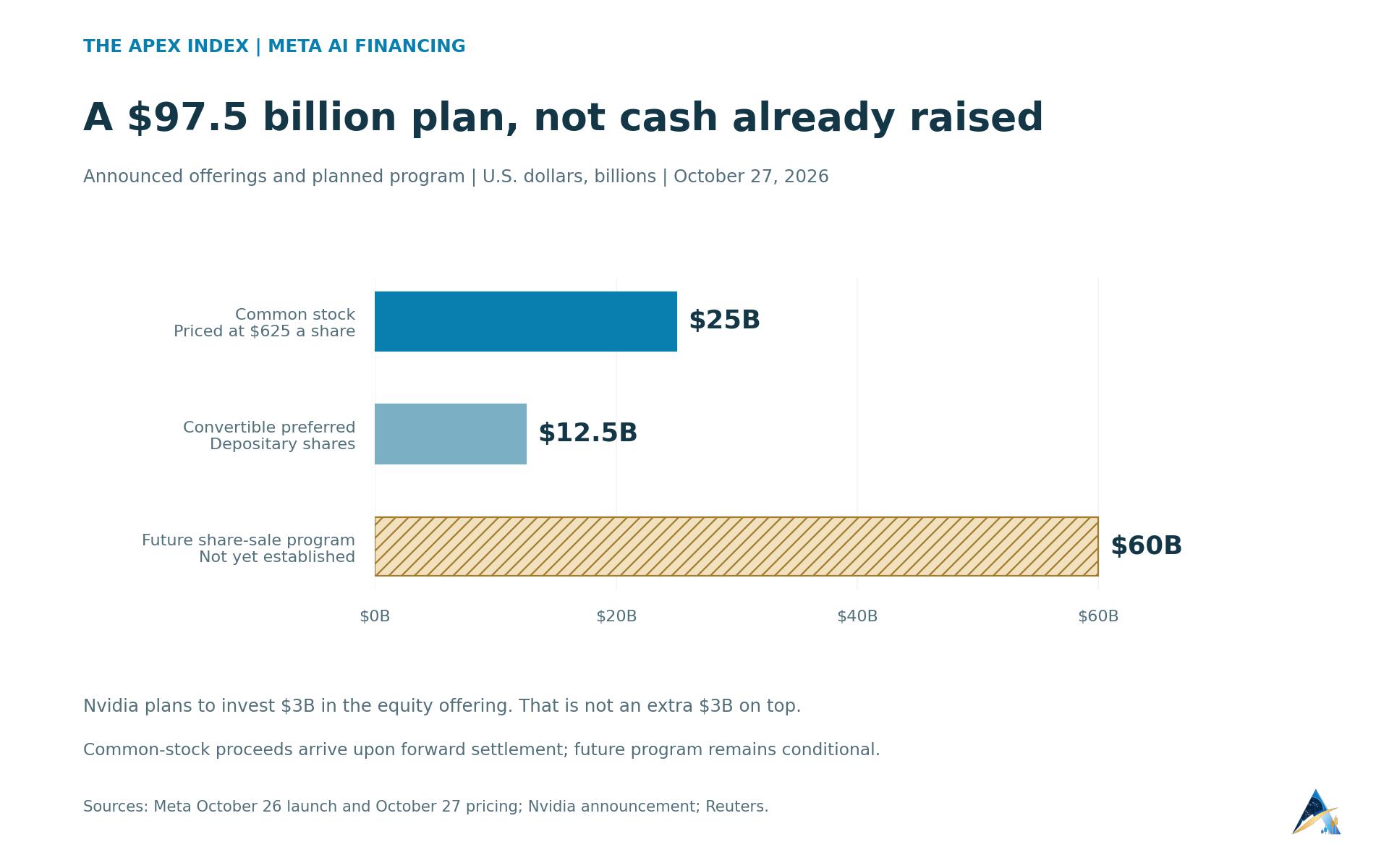
Nvidia's planned purchase belongs within the equity offering. Meta's earlier announcement said Nvidia, AMD and Broadcom had expressed nonbinding interest in buying as much as $5 billion combined. Those preliminary indications were not completed purchases.
More chips, and possible safeguards for agents
Meta intends to expand its use of Nvidia's Vera Rubin systems and Vera CPUs. The companies also named Spectrum-X Ethernet networking and BlueField-4 technology as parts of the infrastructure plan. They did not provide a spending breakdown for that hardware in the partnership announcement.
They are considering further work involving OpenShell, a framework for deploying agents safely, and Sentry, which monitors agent behavior. That part remains under consideration rather than a confirmed deployment across Muse.
Nvidia CEO Jensen Huang said:
"This changes how we use computers, from operating applications to working with intelligent agents."
The relationship builds on the companies' February infrastructure partnership, which already covered computing chips, networking and work to improve AI performance. This latest agreement ties that hardware relationship more closely to Meta's personal-agent products and adds the proposed equity investment.
The cost of the ambition
Meta expects capital spending of $135 billion-$145 billion this year. Its October 26 announcement said it plans to fund investment through operating cash flow, debt, partnerships and equity, rather than relying on one source of money.
Chip suppliers buying into a major customer also raises questions about how AI expansion is being funded. In an October 27 Reuters report, William Blair analysts said:
"We expect investors to continue to question the financing and potential for future capital raises."
Those analysts still expected Meta to build a profitable AI business over time. The forward-sale agreements have a separate timetable: Meta expects settlement on or before November 19, 2027.