

A prediction market turns a question about the future into something people can trade. Will a candidate win an election? Will inflation finish above a stated level? Will a city record a certain temperature? Traders buy positions whose payouts depend on the answer, and prices change as people react to information and each other.
The appeal is easy to understand: a number on a screen seems more concrete than another confident forecast. The important part is understanding what that number actually represents. A market price reflects trading under particular rules and conditions. It doesn't turn uncertainty into a promise, or make the headline question more precise than the contract underneath it.
Start with the contract, not the prediction
A common event contract has two outcomes, Yes and No, and pays a fixed amount, often $1, to the winning side. The losing position pays nothing. This guide uses that simple, fully paid structure for its examples; other products can have different payout arrangements or additional risks.
The U.S. Commodity Futures Trading Commission's explainer describes both the familiar binary format and more complex contracts involving multiple choices, combinations or partial payouts. The label "prediction market" therefore doesn't tell you everything about what you're buying.
The question needs an objective test. A contract about an economic statistic should identify which statistic, which release, the relevant date and the source used to settle it. Everyday wording can hide important differences, such as whether a threshold means strictly above a number or at least that number.
What a 40-cent price means
In a standard contract paying $1 if Yes wins and zero otherwise, a 40-cent Yes price is commonly read as roughly a 40% market-implied probability. That interpretation connects the purchase price with the possible payout, before considering costs and other complications.
It does not mean 40% of people believe Yes, or that someone has measured the event's true probability. Traders have different information, budgets and reasons for taking positions. The price is produced by the orders available in that market, rather than a representative survey of the population.
A display can also differ from the price available for your order. A platform might show the latest trade or a midpoint between buying and selling quotes. Check its method. The number being discussed on social media may be an indication, not a price at which you could immediately buy the quantity you want.
Work through the money before buying
Suppose you buy ten Yes contracts at $0.40 each. The position costs $4 before charges. For this fictional example, assume a $0.20 total entry fee, making the amount spent $4.20. That fee is an illustration, not a quote from any exchange's schedule.
If the contract settles Yes, the ten contracts pay $10 and the net profit is $5.80. If it settles No, the payout is zero and the loss is $4.20. The $10 payout is the amount received, not the profit on top of the original investment.
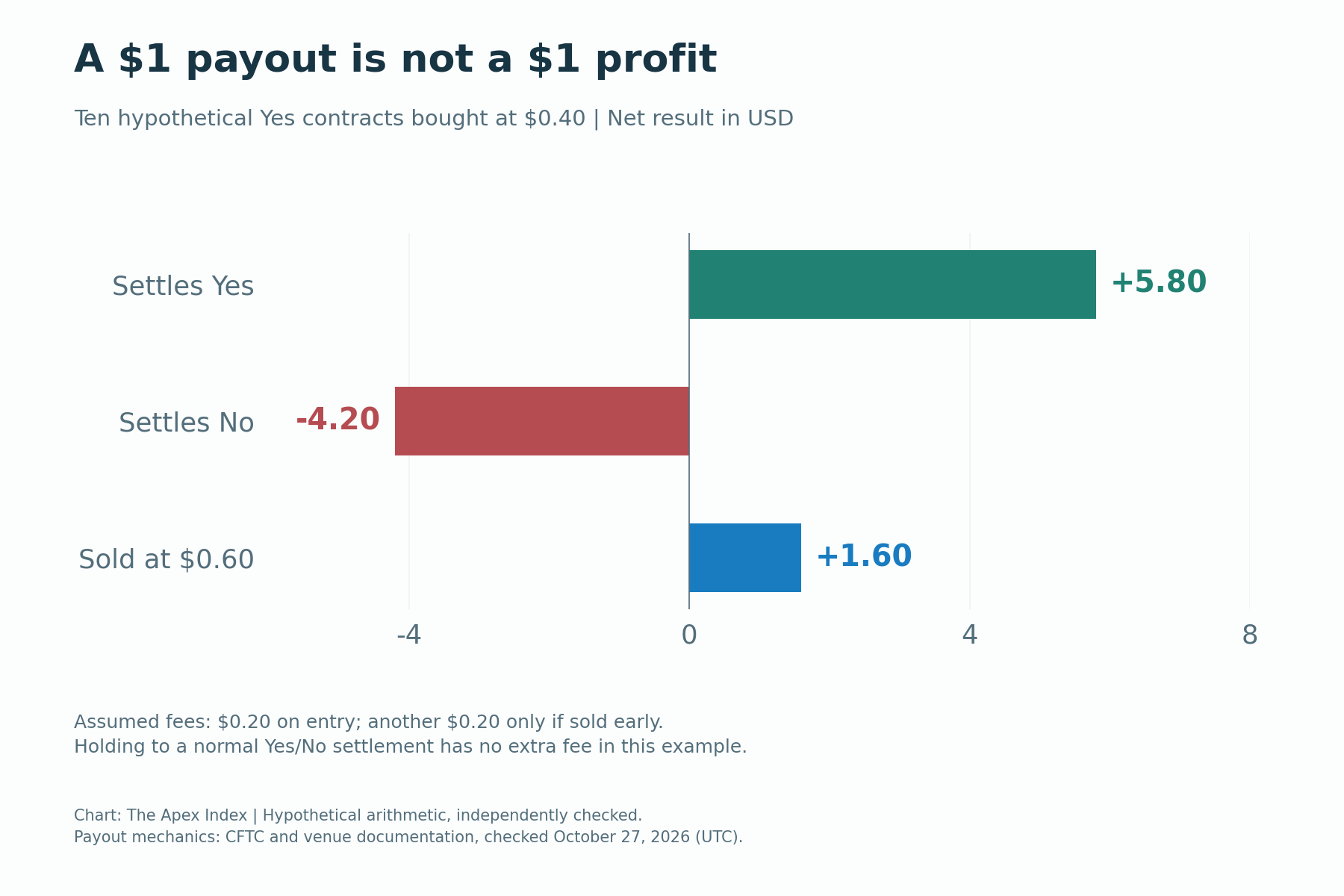
Those assumptions also change the break-even calculation. With a $10 winning payout and $4.20 total cost, the position needs a 42% chance of winning to have zero expected profit, before taxes and any other charges. That doesn't mean you know the probability is 42%; it describes the arithmetic of the price paid.
If your own estimate were 55%, the expected net result would be $1.30 under the same assumptions: 55% of $10, less $4.20. An individual trade would still settle into its actual outcome. Expected value describes a probability-weighted calculation, not a payment you can expect to collect on every position.
Trading out can produce a different result
You don't always need to wait for settlement to close a position. Where trading remains open and another participant is willing to buy, you can sell at an available price. The result depends on that execution, along with entry and exit costs.
Using the same ten contracts, suppose an eventual buyer pays $0.60 each and an additional hypothetical $0.20 exit fee applies. The sale brings in $6 before that fee. After subtracting the $4 purchase and both assumed fees, the net profit is $1.60.
That is a completed trading result, regardless of which side later wins. Conversely, the event can eventually go your way after you've already sold at a loss. Keep a view about the outcome separate from a decision about what price is worthwhile now.
The order book explains your actual price
An order book lists bids from buyers and offers from sellers. The highest bid and lowest offer form the best quoted prices. Their difference is the spread. Available quantity matters as much as the headline quote when you want to trade more than a small amount.
Kalshi's order-book documentation explains how its binary sides relate. Its API can represent the book using bids on Yes and No, with the opposite side's bid providing the complementary offer. Other interfaces may present the same economic choices differently.
Imagine five Yes contracts offered at $0.62 and another five at $0.66. Buying ten by taking those offers costs $6.40, an average of $0.64, before fees. You couldn't buy the entire order at the initially displayed $0.62 because only five were available there.
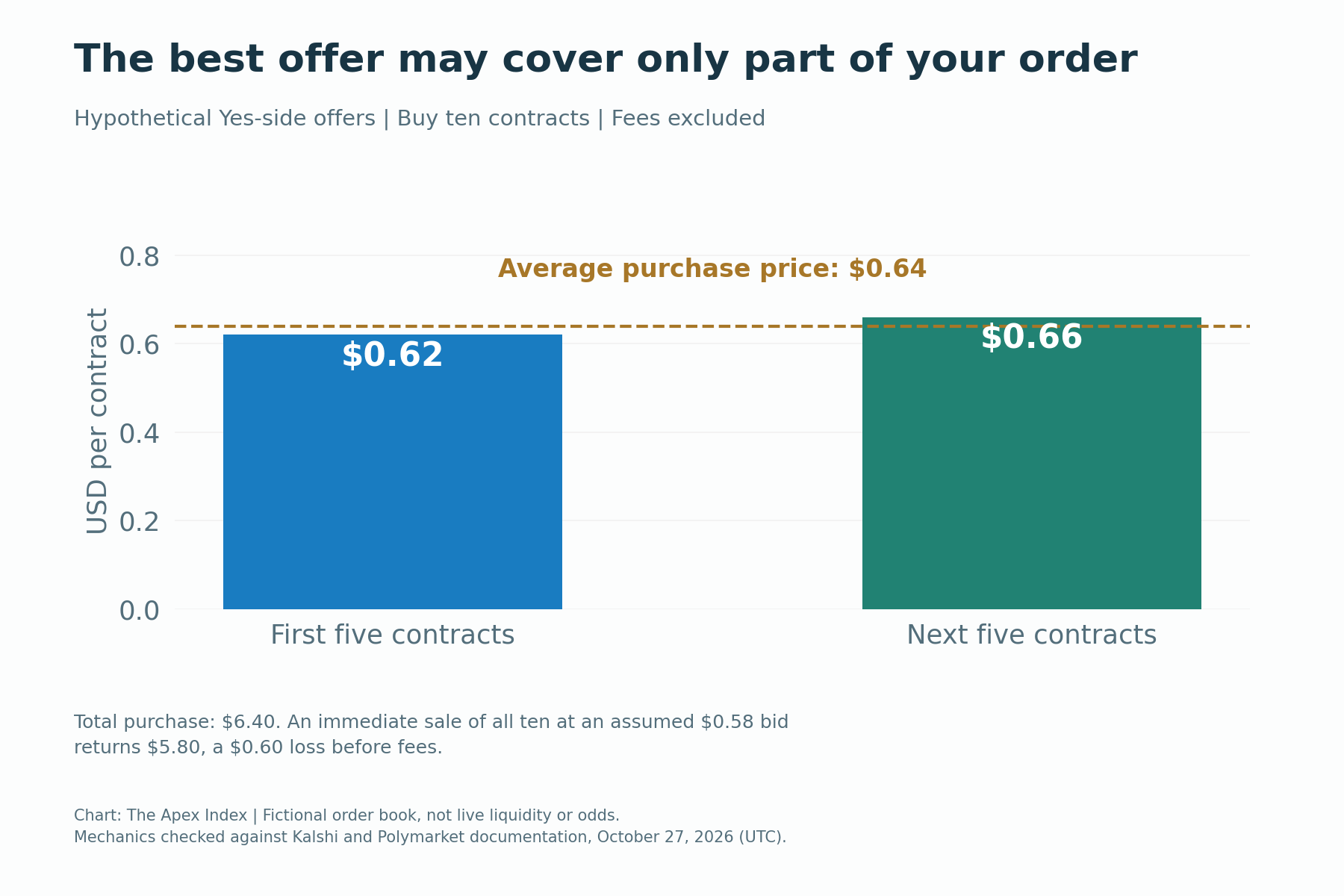
In that separate hypothetical market, assume ten contracts can immediately be sold at a $0.58 bid. Selling all ten brings in $5.80, leaving a $0.60 loss before fees. The cost comes from available execution prices; no change in the event's actual outcome was needed.
Limit orders control price, not whether someone trades
A limit order specifies a price you're willing to accept. If an order cannot find a matching counterparty on those terms, it can remain unfilled or fill only partly. Waiting gives you price control while leaving uncertainty about whether the transaction will happen.
An order designed to execute immediately accepts available liquidity within its price constraints. A rapidly changing book can produce a different result from the snapshot you saw while deciding. Read the platform's execution rules, especially how it handles partial fills, cancellations and sudden pauses.
Being able to open a position doesn't guarantee an easy exit later. Activity can fade after the initial attention, or participants can move their orders when news arrives. If you need cash at a particular time, don't assume a market will provide a buyer at a convenient price.
Read the rules that decide the winner
The market title is a starting point. Settlement rules should explain the resolution source, timing and treatment of unusual circumstances. A weather contract might rely on a named station, while an election contract could depend on a specified official determination rather than the first media projection.
Polymarket's current resolution documentation explicitly distinguishes the headline question from the rules that determine settlement. It describes different resolution systems for different market types, including processes through which a proposed answer can be challenged.
Do not assume one platform's challenge procedure, deadline or payout policy applies everywhere. An event becoming widely understood and a contract being formally finalized are different stages. Read the procedure for ambiguity, cancellation or exceptional outcomes before deciding that a position is an easy win.
For economic releases, also check how revisions are handled. The first published number can differ from a later corrected series. A sound forecast about the eventual economic picture can still lose a contract whose rules refer to the initial release.
Prices can contain information without being infallible
Prediction markets give participants a financial reason to find information that others have missed. An informative announcement can bring in new orders and change the price quickly. That can make a market useful for following how expectations are changing.
It doesn't establish that every price is accurate. A market with little trading activity, few informed participants or high participation costs can provide a weak signal. A large order can move the quote because it consumes the available book, even when it brings no new information about the event.
One correct or incorrect outcome also tells you little about a forecaster's calibration. If many comparable events are assigned a 70% probability, a well-calibrated set would see roughly 70% happen over a sufficiently large sample. A particular 70% forecast can fail without proving the original estimate was irrational.
To judge forecasting quality, examine a record of predictions made before outcomes were known, the evaluation method and whether the questions are genuinely comparable. Screenshots of successful calls leave out too much information to establish a repeatable advantage.
A high win rate can still leave you with nothing
Consider ten separate fictional trades, each costing $0.90 for a $1 winning payout, before fees. Nine wins earn $0.10 each, or $0.90 altogether. One loss costs $0.90 and wipes out those gains. The trader was right nine times out of ten and still made no money before charges.
That is why a public record of correct predictions needs prices and position sizes attached. Buying an apparently likely outcome at a very high price leaves little room for profit and a much larger loss if the surprise happens. Compare money earned and lost, not just the percentage of winning calls.
Money committed to a position has a timing cost
Waiting for a contract to settle can tie up capital. A position with a small possible gain might remain open for weeks or months. Consider how long the money could be unavailable, whether you may need it elsewhere and what an early exit might cost.
Even after trading stops, a market may require an official release, a challenge process or administrative steps before the balance becomes available. Check its timeline rather than treating the date in the headline as a guaranteed payment date. A large displayed account value can include positions that cannot yet be converted into spendable funds.
This timing risk matters especially when several contracts rely on the same announcement. They may all remain unresolved together, leaving less available cash than the number of separate positions suggests.
Costs and platform structure change the risk
Fees can vary by venue, category and order type. Some platforms distinguish participants providing resting orders from those taking available offers. An exchange advertising low fees for one market doesn't establish the total cost of another, or cover charges imposed by payment providers.
A centralized account and an onchain position also create different operational questions. Ask who holds collateral, how trades settle, which systems handle withdrawal and what happens if the service is unavailable. A blockchain record can show a transaction without guaranteeing that every related interface, token or resolution decision is risk-free.
Don't confuse the growth of the industry with the profitability of a customer's account. Exchanges can collect fees while individual traders lose money. High turnover can produce revenue for a platform without showing that its users successfully predicted more events.
Check eligibility and decide what you can lose
Rules depend on the jurisdiction, operator and specific product. In the United States, the CFTC oversees regulated event-contract markets, but that is not a blanket statement that every app or every contract is permitted for every customer. Check the named operating entity, local restrictions and current terms.
Read the maximum-loss explanation for the product you're actually using. The fully paid binary positions in this guide can lose their purchase cost and associated fees. That limited example should not be carried over to leveraged products, borrowing or other contract structures without checking their separate obligations.
Treat several positions tied to the same event as connected risks. Buying contracts with slightly different headlines may still leave you exposed to one underlying development. The number of positions isn't a reliable measure of how much uncertainty you've spread out.
Before placing an order, write down the event definition, settlement source, maximum intended spending and price at which the position makes sense to you. Check available quantity and the full charges, then keep the confirmation and original rules. If the argument depends on a certain outcome being inevitable, reconsider what the contract can actually guarantee.
These examples are hypothetical educational calculations, not recommendations or live odds. Platform mechanics and the cited regulatory guidance were checked on October 27, 2026 (UTC). Rules, eligibility and fees can change, so consult the current contract and operator information before trading.