


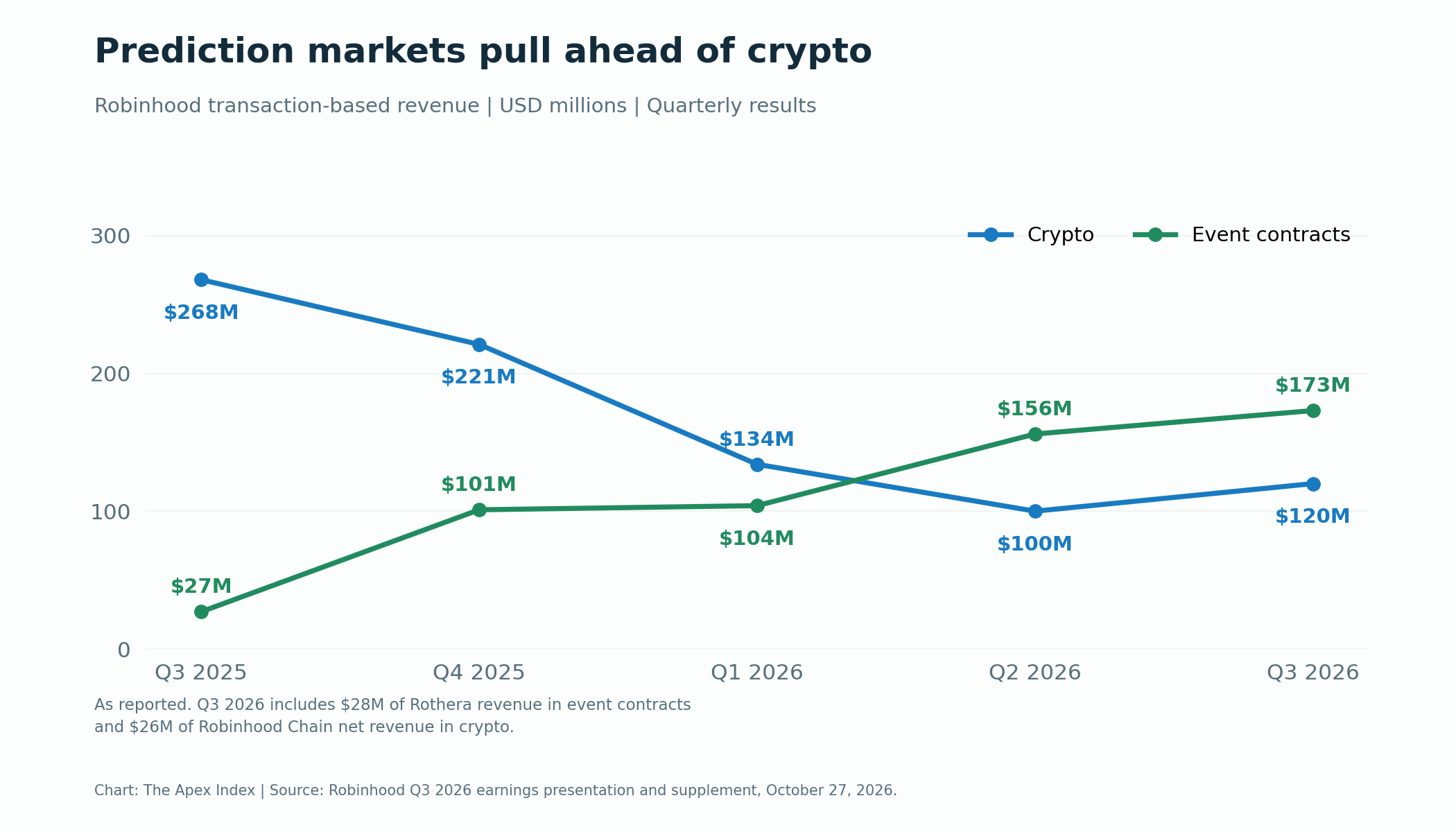
Robinhood's crypto revenue fell 55% from a year earlier in the third quarter, but the company still brought in a record $1.42 billion in total revenue. Prediction markets helped cover the shortfall, generating $173 million from event contracts, ahead of crypto's $120 million.
The October 27 results show a business getting more money from customers trading outcomes, options and stocks, even as token trading slows. Record sales didn't produce record profits, though. Net income fell 14% to $476 million, while diluted earnings per share dropped 16% to $0.51.
Prediction markets bring in more than crypto
Event-contract revenue was more than six times its level a year earlier, according to the company's results. Customers traded a record 16.4 billion event contracts during the quarter, more than seven times the year-earlier count. That is a count of contracts, rather than dollars of company revenue.
The $173 million revenue total includes $28 million from Rothera, Robinhood's exchange joint venture. Its earnings presentation separates that contribution from activity through the Prediction Markets Hub.
Chief Financial Officer Shiv Verma said:
"Customers are trusting us with more of their assets as we deliver on our product roadmap, leading to our highest quarter ever for revenues."
Crypto's slump comes with an important distinction
Crypto revenue fell from $268 million in the third quarter of 2025. Compared with the second quarter of this year, however, it rose 20% from $100 million. The 55% decline in the headline is a year-over-year comparison.
Crypto trading volume was down 38% from a year earlier to about $50 billion. That included approximately $21 billion through the Robinhood app and $29 billion at Bitstamp. The revenue line also includes $26 million in Robinhood Chain net revenue, according to the company's presentation.
Robinhood's mix of businesses is changing alongside the wider industry's push into prediction markets, as previously reported by Apex.
Options and stocks help carry the quarter
The company earned $399 million from options, up 31%, and $121 million from equities, up 41%. Together with event contracts and other trading-related services, those businesses lifted transaction-based revenue 19% to $867 million.
Using the company's rounded figures, event-contract revenue increased by $146 million from a year earlier, almost matching the $148 million decline in crypto. Options and equities added another $130 million between them. The total revenue gain across the business was $150 million.
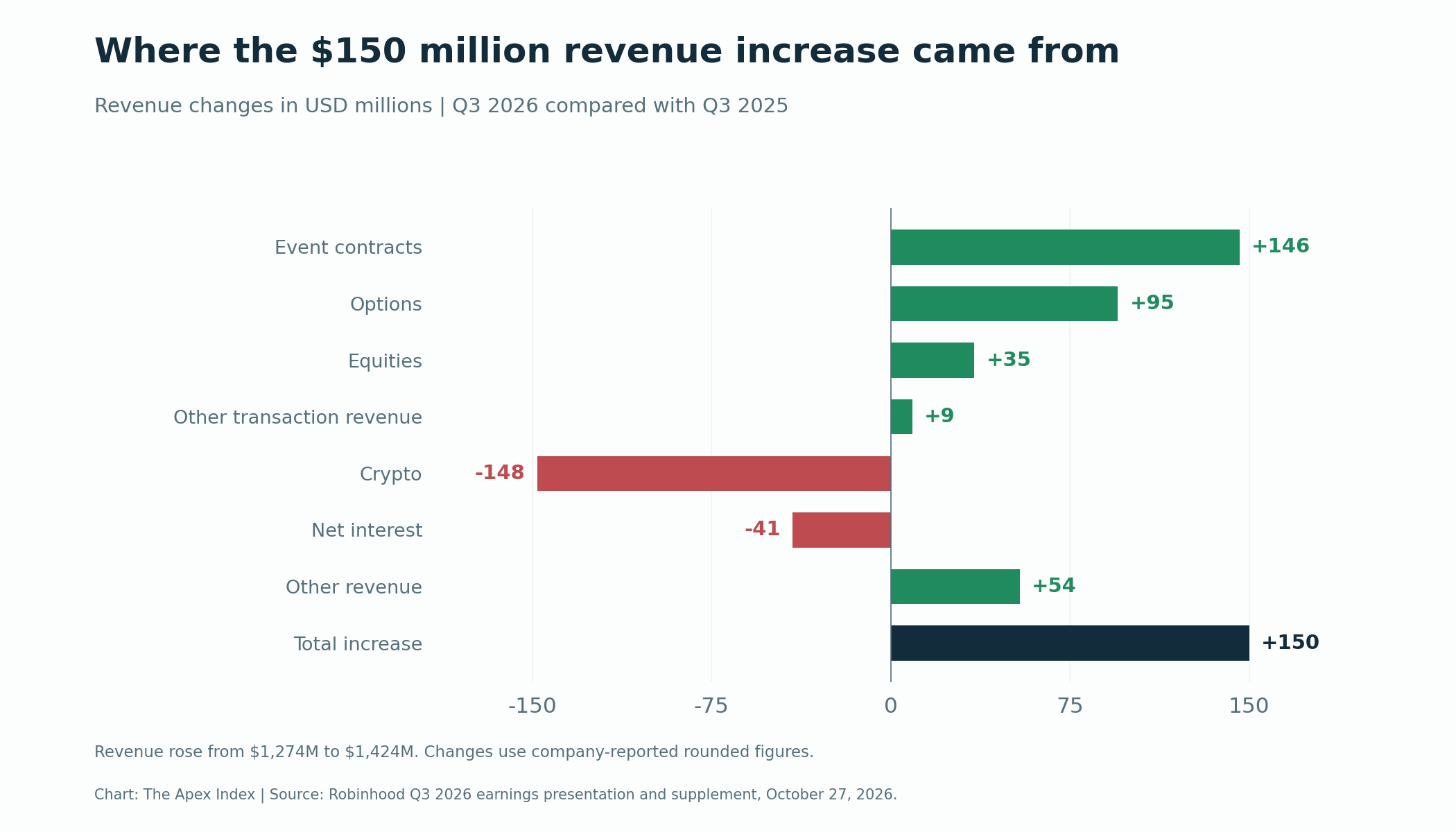
There were other weak spots. Net interest revenue fell 9% to $415 million, which Robinhood attributed mainly to lower securities-lending activity and short-term interest rates. Other revenue grew 61% to $142 million, helped by Trump Account service fees and Gold subscriptions.
More customers, higher costs and lower profit
Funded customers reached 28.7 million, up 7% from a year earlier. Gold subscribers rose 34% to a record 5.2 million, while total platform assets increased 19% to $396 billion. Third-quarter net deposits were $15.7 billion.
Operating expenses climbed 16% to $739 million. Robinhood pointed to higher provisions for credit losses as its credit-card loan book grew, costs tied to Trump Accounts and Rothera, and spending on marketing and expansion.
Profit also included $67 million in unrealized losses, mainly related to changes in the value of Robinhood Ventures Fund I. The company introduced adjusted net income and adjusted EPS this quarter, reporting $550 million and $0.60, respectively. Both are non-GAAP measures, and both fell 3% from a year earlier.
For the full year, Robinhood lowered the upper end of its adjusted operating-expense and share-based-compensation forecast by $25 million, to a range of $2.675 billion to $2.75 billion. That forecast excludes credit-loss provisions and certain other costs.
Verma also gave an October update that helps explain the next quarter's deposit figures:
"And we're entering Q4 with strong momentum, as October Net Deposits have already topped $13 billion month-to-date, including $6 billion from the Dell family's contribution to Trump Accounts."