

Liquidity is the ability to buy or sell an asset promptly, in a useful size, without pushing its price far away from the level you expected. A market is liquid when buyers and sellers can meet on reasonable terms. An asset can have a high quoted value and still be difficult to sell when its owner needs cash.
That distinction matters to everyone from a household selling a fund to an institution moving a large bond position. The question is not simply whether someone traded the asset today. It is how much can be traded, at what price, through which venue and with what access to the proceeds afterward.
A price is not a promise to buy your entire position
The last traded price records a completed transaction. It does not establish what the next seller will receive. A small trade may occur at a flattering price while a larger order has to accept progressively worse bids. Market capitalization, calculated from a quoted price and outstanding supply, likewise does not measure cash waiting to buy every unit.
Imagine an asset quoted around $100. Buyers may be willing to take only a few units at $99.90, with additional buyers appearing at $99.50 and $98. A sale larger than the first bid consumes several levels. The final execution price depends on the order's size and the available demand, not just the number shown on a screen.
Liquidity has several dimensions. Tightness describes the cost of crossing from a bid to an offer. Depth describes how much can trade near current prices. Resilience describes how quickly quotations recover after a trade or shock. Immediacy describes how quickly an investor can complete a transaction. A market can score well on one and poorly on another.
These qualities vary with the time of day, the instrument and conditions. A heavily traded stock can become less liquid around an unexpected announcement. A token can look active during an incentive campaign but lose buyers when rewards end. A normally reliable bond market can struggle when many institutions need to reduce similar positions together.
Understand the bid, ask and order book
The bid is the best advertised buying price; the ask is the best advertised selling price. Their difference is the bid-ask spread. If the bid is $99.90 and the ask is $100.10, the spread is $0.20. Relative to their $100 midpoint, that is 0.20%, or 20 basis points. One basis point is one-hundredth of a percentage point.
An order book shows orders waiting at different prices. Coinbase's exchange documentation distinguishes the best bid and ask from deeper aggregated and individual orders. Its matching engine uses price-time priority, meaning better-priced orders take precedence and earlier orders have priority at the same price.
A market order seeks immediate execution at available prices. A limit order specifies the worst acceptable price but may remain unfilled. Neither order type eliminates risk. A market order can execute badly in a thin book; a limit order can fail to complete when a price moves away. The appropriate choice depends on whether speed or price control matters more.
Displayed orders can also change before an investor reaches them. A quote snapshot is not a guarantee that the same quantity will remain available. Technology, competing orders and cancellations affect execution. Treat the order book as evidence about current conditions, then allow for the possibility that conditions change during the trade.
Why size changes the cost of trading
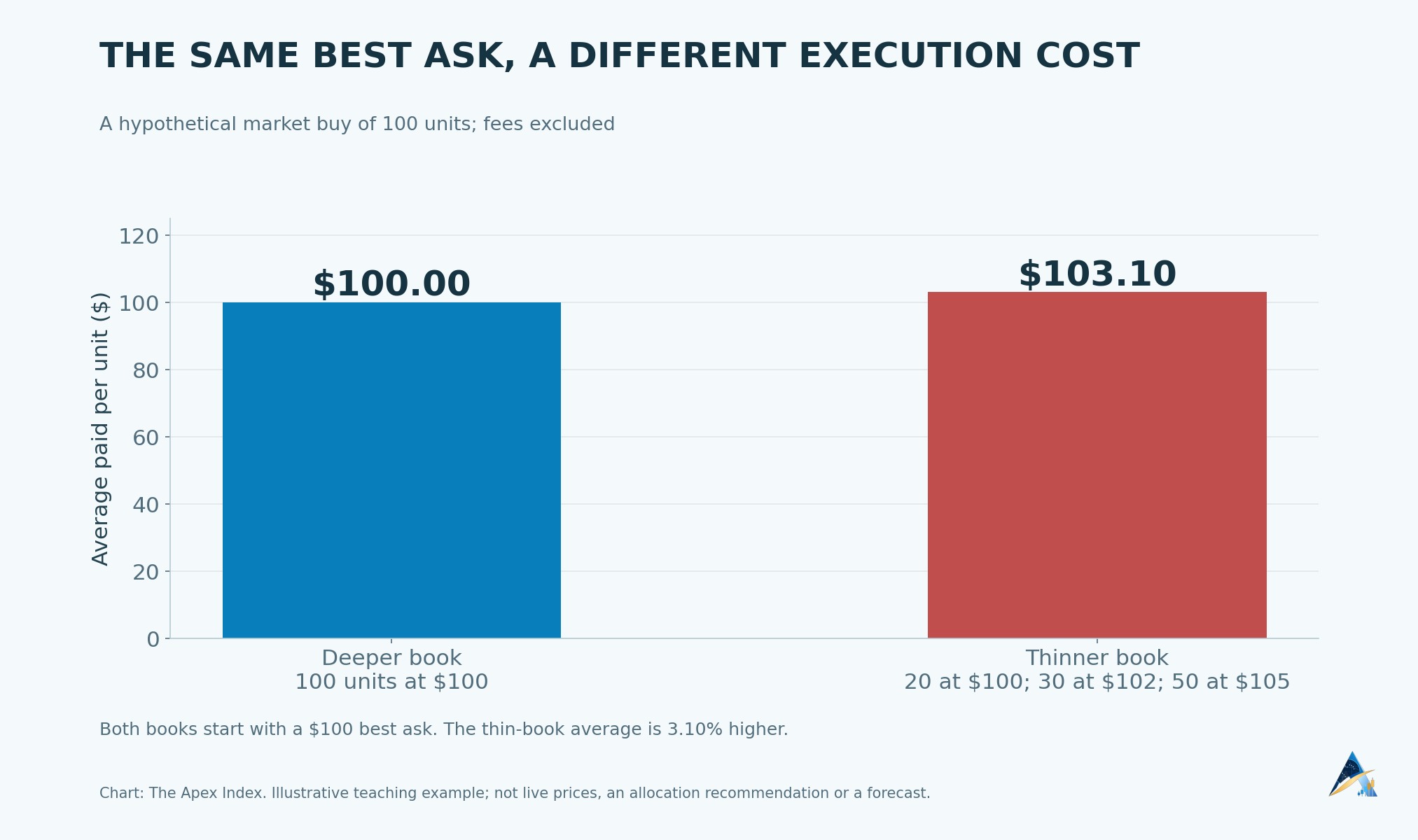
Consider two hypothetical order books offering the same asset. In the deeper book, 100 units are available at $100 and another 100 at $101. In the thinner book, only 20 are available at $100, followed by 30 at $102 and 50 at $105. Buying 100 units therefore costs $10,000 in the first book and $10,310 in the second.
The thinner-book average is $103.10, even though both screens initially showed a $100 offer. That is 3.10% above the initial best ask before commissions or other charges. The comparison does not predict any real asset's liquidity. It demonstrates why order size and depth must be evaluated together.
Slippage usually describes the difference between an expected reference price and the actual execution price. Its meaning depends on the reference: the best quote, the midpoint when the decision was made, or another benchmark. A fair comparison identifies that starting point instead of presenting a single unexplained percentage.
Splitting an order into smaller pieces may reduce immediate price impact, but creates other risks. The market can move between trades, and repeated transactions can increase costs. Institutions use execution strategies to manage that trade-off. Breaking an order apart does not create buyers who were not there or guarantee a better result.
Liquidity is different across asset classes
Large exchange-listed stocks usually have multiple trading participants and visible quotations. Smaller companies can have wider spreads and less depth. The relevant question for either is the size of the position compared with available trading, especially during stressed conditions. A company can be profitable without its shares being easy to sell in quantity.
Bonds often trade through dealers or requests for quotations rather than a single public order book. Issue size, age, credit quality and dealer capacity affect trading. A government benchmark bond and an obscure corporate issue may carry very different liquidity risk even if both are described simply as fixed income. Liquidity can influence the yield investors demand.
Commodity exposure adds the distinction between physical goods and financial contracts. Standardized futures in widely traded maturities may be liquid while physical delivery requires storage, transport and suitable buyers. A futures contract approaching delivery has different operational demands from a small holding in a commodity fund. Read the instrument's terms before assuming the market is interchangeable with the physical asset.
Crypto trades across venues that can have different order books, customer access and custody arrangements. An asset listed on many exchanges is not automatically liquid on the exchange you can use. The depth of Bitcoin trading on a particular venue can differ from the depth available for a smaller token, or from Bitcoin trading elsewhere.
Property and private investments often require weeks or months to sell. Their valuations may change less frequently than public-market prices, but that does not mean the investments have less economic risk. A price that is not updated daily can conceal changes in what a buyer would actually pay. Liquidity and reported volatility are separate properties.
How liquidity works in a decentralized pool
Some decentralized exchanges use pools instead of buyers and sellers placing conventional orders. In a simplified constant-product pool, reserves of two tokens satisfy x × y = k. Buying one token removes it from the pool and adds the other, changing the reserve ratio and therefore the price of further purchases.
The original Uniswap v2 mechanism is a useful teaching model. Current designs, including concentrated-liquidity systems and v4 hooks, can behave differently. A constant-product illustration should not be mistaken for a full description of every modern decentralized exchange or every pool's available liquidity.
Suppose a fee-free teaching pool starts with 1,000 units of a token and 100,000 quote-currency units. The initial reserve ratio is 100 quote units per token. Removing 100 tokens leaves 900. Maintaining the same product requires roughly 111,111.11 quote units in the pool, so the buyer supplies about 11,111.11, averaging 111.11 per token.
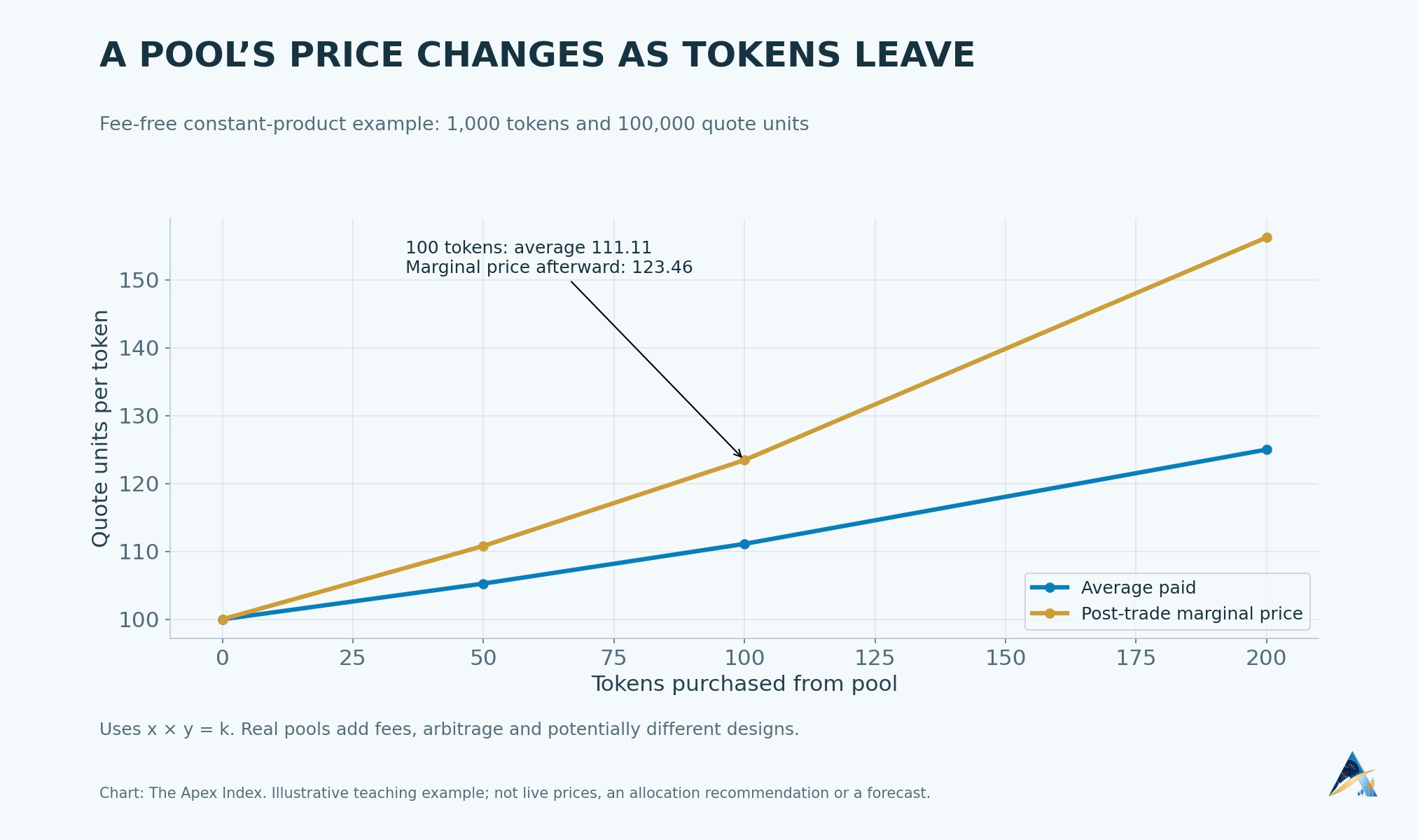
The marginal reserve-ratio price after that purchase is about 123.46, which differs from the average paid for the 100 tokens. The curve becomes steeper as more of the token is removed. Fees, external market prices and arbitrage affect real trades; the example isolates the reserve mathematics rather than estimating a live exchange quotation.
Providing liquidity to a pool is also different from holding its assets separately. Changes in relative prices alter the composition of a provider's position, while fees and contract risks affect the outcome. A displayed yield is not a substitute for understanding those mechanisms. A provider's ability to withdraw also depends on the protocol and the position's terms.
Market liquidity and funding liquidity are connected
Market liquidity concerns trading an asset. Funding liquidity concerns obtaining cash or financing to meet obligations. A trader can own assets that appear valuable but still be unable to satisfy a margin call. The BIS treats funding liquidity as a distinct source of risk because financing access can disappear when it is most needed.
The two can reinforce each other. Falling asset values reduce the collateral lenders accept. Borrowers must post more collateral or sell positions. Their sales pressure market prices, which can generate more collateral demands. This is a liquidity spiral, not necessarily evidence that every asset involved suddenly became worthless.
That distinction matters for leveraged stocks, futures and crypto derivatives. Forced selling happens because a position must be reduced, not because its owner found a thoughtful new valuation. A liquid reserve can preserve flexibility during such conditions. Without one, a long-term investor may discover that their effective holding period is set by a lender.
Trading volume is useful but incomplete
Volume records turnover over a period. Depth records available quantity near a price at a moment. An asset can show large daily volume but offer little depth for a large order right now. A sudden burst of trading can also reflect a rush to exit rather than comfortable conditions for completing the next trade.
Open interest in derivatives measures outstanding contracts, not immediately available buyers. Total value locked in a protocol measures deposited value under a particular definition, not necessarily withdrawable trading capacity. Some assets can be counted across interconnected protocols. Treat each metric according to what it measures, rather than using large numbers as interchangeable proof of safety.
For a fund, distinguish the trading of its shares from the liquidity of its underlying assets. A fund can appear easy to buy while holding securities that are harder to sell under stress. Redemption terms, cash buffers and the structure of the vehicle affect how that mismatch is managed. A daily price alone does not resolve it.
Why liquidity providers charge a spread
Someone offering to buy immediately takes the risk of owning the asset afterward. A dealer who buys a corporate bond may need to hold it until another customer appears. A market maker buying stock can be left with unwanted inventory if the price falls. The spread helps compensate for inventory risk, operating costs and the possibility of trading with someone who has better information.
In quiet conditions, competition can keep that compensation small. Around unexpected news, a liquidity provider may widen quotations or offer less size because the asset's fair value is harder to estimate. Several providers making the same adjustment can reduce depth quickly. This is why the spread is partly a price for immediacy and partly a reflection of uncertainty.
Available financing also constrains the supply of liquidity. An intermediary cannot absorb every sale if its capital or borrowing capacity is limited. Regulations, internal risk limits and collateral requirements shape how much balance-sheet capacity it can commit. A market may have willing buyers in principle while still lacking enough immediately deployable money to clear large orders smoothly.
This helps explain why liquidity is a condition rather than a permanent badge attached to an asset. A deep market can become expensive to trade during a common shock, then recover when uncertainty or financing pressure eases. Investors who must trade during the stressed period cannot rely on the market's usual average spread. Planning for liquidity means allowing for the occasions when its price is much higher than normal.
Check the whole route from an asset to spendable cash
An executed trade is one step. Settlement, withdrawal and transfer can add delays or restrictions. A brokerage balance, a bank deposit and a token in a wallet have different legal and operational meanings. Before treating an investment as emergency money, verify how the proceeds reach the account from which the bill will actually be paid.
Compare spreads and depth for the amount you intend to trade, not for an arbitrary minimum order. Check the venue's operating rules and the instrument's settlement arrangements. Include commissions, financing costs and conversion costs in the comparison. A seemingly cheap price can be offset by a difficult or expensive exit.
The practical test is simple: if you needed to reduce this position under adverse conditions, what would happen next? Identify the buyers, the trading route, the likely price concession and the remaining steps to access cash. That exercise is more useful than assuming that everything with a quoted price is liquid, or that today's liquidity will always be available tomorrow.