

A stock falls 20%, but an investor loses 40% of their money. Then the broker asks for more cash or starts selling the position. That can happen without the company going bankrupt. Borrowing to invest changes what a price move does to the money you put in.
Leverage lets you take financial exposure larger than your own capital. A margin loan is one way to do it. Futures and some other derivatives can create leveraged exposure through a relatively small amount of collateral. The details differ, but the shared problem is that losses can become large before the underlying asset has moved very far.
This guide uses hypothetical U.S.-dollar examples, not live prices or recommendations. The main worked example is a simple long stock position financed with a fixed loan. Rules, investor protections and liquidation procedures vary by country, broker, product and account agreement.
Measure the exposure before looking at the return
Suppose you put in $5,000 and borrow another $5,000 to buy $10,000 of stock. You have $10,000 of exposure supported by $5,000 of your own equity. Dividing exposure by equity gives two times leverage, often written as 2x.
Your equity is the value of the assets minus the amount owed, before considering other account items. The borrowed $5,000 belongs to the lender. It does not become your money because the investment has gone up. Interest and fees also belong in the final calculation.
A cash purchase without borrowing works differently. If you buy $5,000 of stock outright, a 20% decline leaves $4,000, a $1,000 loss. In the leveraged purchase, the same percentage decline affects $10,000 of stock rather than $5,000.
The label on the account doesn't establish your actual leverage. A margin account can hold an unborrowed position. Conversely, a derivative can produce leverage even without a conventional loan balance. Inspect exposure and the capital supporting it, rather than assuming every account or product works alike.
Follow the loss through the account
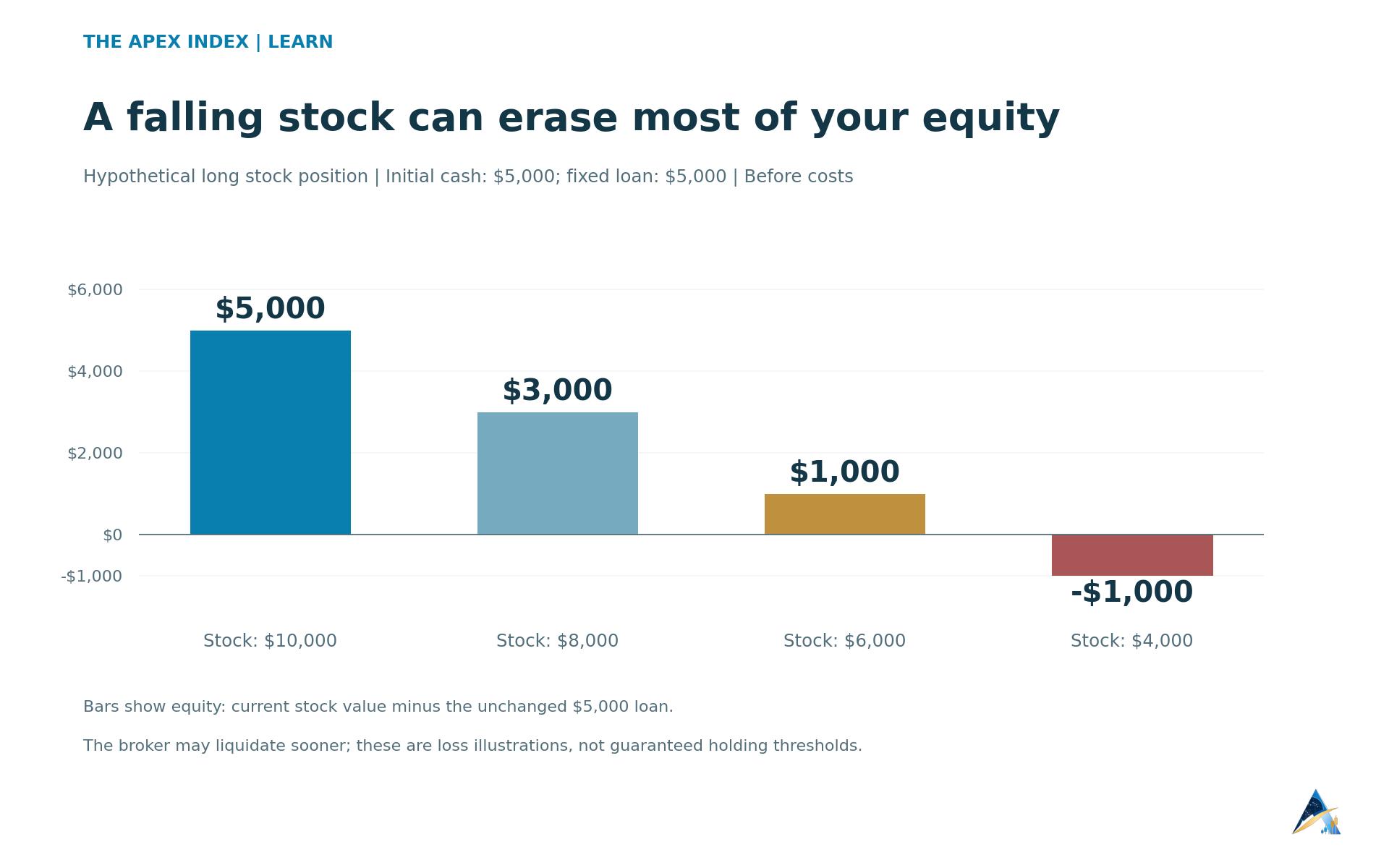
Start with the leveraged stock purchase above and temporarily ignore interest and fees. If the stock's value falls from $10,000 to $8,000, the loan remains $5,000. Your equity is $3,000. You've lost $2,000, or 40% of the $5,000 you supplied.
If the position falls to $6,000, equity drops to $1,000. That's an 80% loss on your initial money, even though the stock fell 40%. A position worth $4,000 against the same $5,000 debt would leave negative $1,000 of equity: you would owe more than the position is worth.
These are loss illustrations, not a sequence a broker promises to let you sit through. Its margin requirements can trigger sales much earlier. A rapid price gap can nevertheless create a shortfall before positions can be closed. Liquidation does not guarantee that the sale proceeds cover the debt.
Gains are amplified too. If the $10,000 position rises 20% to $12,000, equity becomes $7,000 before costs. The $2,000 gain is 40% of the initial equity. The same arithmetic applies in both directions; leverage doesn't improve your ability to choose the direction.
It also changes as the account changes. With $8,000 of stock and $3,000 of equity, exposure divided by equity is about 2.67x. You started at 2x, but falling prices increased the leverage of the remaining position. A broker's risk checks therefore use current account conditions.
Borrowing costs continue while you wait
A stock-margin loan normally incurs interest, with the rate and calculation set by the broker. It can change over time. Fees, currency conversion and the asset's distributions can also affect the result. Compare returns after those costs rather than multiplying the stock's percentage move and stopping there.
For a separate one-year cost example, assume the same $5,000 loan stays outstanding at a hypothetical simple annual interest rate of 8%. Interest would be $400. If the stock's value ended unchanged, that cost alone would reduce your initial $5,000 equity to $4,600, ignoring other charges and cash flows.
That assumed rate is not a current broker quote. Actual interest can accrue daily and use different rates or conventions. Check which balance attracts charges and whether interest adds to the amount owed. An investment that takes longer to recover can cost more to finance even when the expected price eventually arrives.
Initial margin and maintenance margin do different jobs
Initial margin concerns the capital required to open or add to a position. Maintenance margin concerns the equity required to keep it. A broker can impose requirements above a regulatory minimum, and some securities may not be eligible for ordinary margin lending at all.
For U.S. stock accounts, FINRA's investor guide explains that Regulation T generally permits lending up to 50% of a margin stock's initial purchase price. It also describes a general 25% maintenance minimum, with higher firm requirements possible. Other rules and account conditions can apply.
Those U.S. figures are not global defaults, and they don't define a crypto exchange's liquidation rules. A broker may also change its own requirement, including during volatile trading. You can face a shortfall because the required percentage rises, even without a further drop in the stock.
Why selling $500 may not fill a $500 shortfall
Use a hypothetical 25% maintenance requirement for our single stock, with no other assets. At a market value of $6,000 and a loan of $5,000, equity is $1,000. Required equity is $1,500, leaving a $500 shortfall.
One way to restore the example requirement is to deposit $500 in cash and apply it against the loan. Debt becomes $4,500, while the stock remains worth $6,000. Equity is then $1,500, exactly 25% of the stock's value. This assumes no intervening price move, costs or requirement change.
Selling stock works differently because the proceeds repay debt. If you sell $500 of stock and reduce the loan by $500, you have $5,500 of stock and owe $4,500. Equity stays $1,000, below the $1,375 required at 25%. The equity shortfall has not disappeared.
To restore the same requirement through sales alone, this simplified account would need to sell $2,000. That leaves $4,000 of stock, a $3,000 loan and $1,000 of equity. The equity is 25% of the remaining stock. Real brokers calculate the actual requirement using the account's positions, prices and applicable rules.
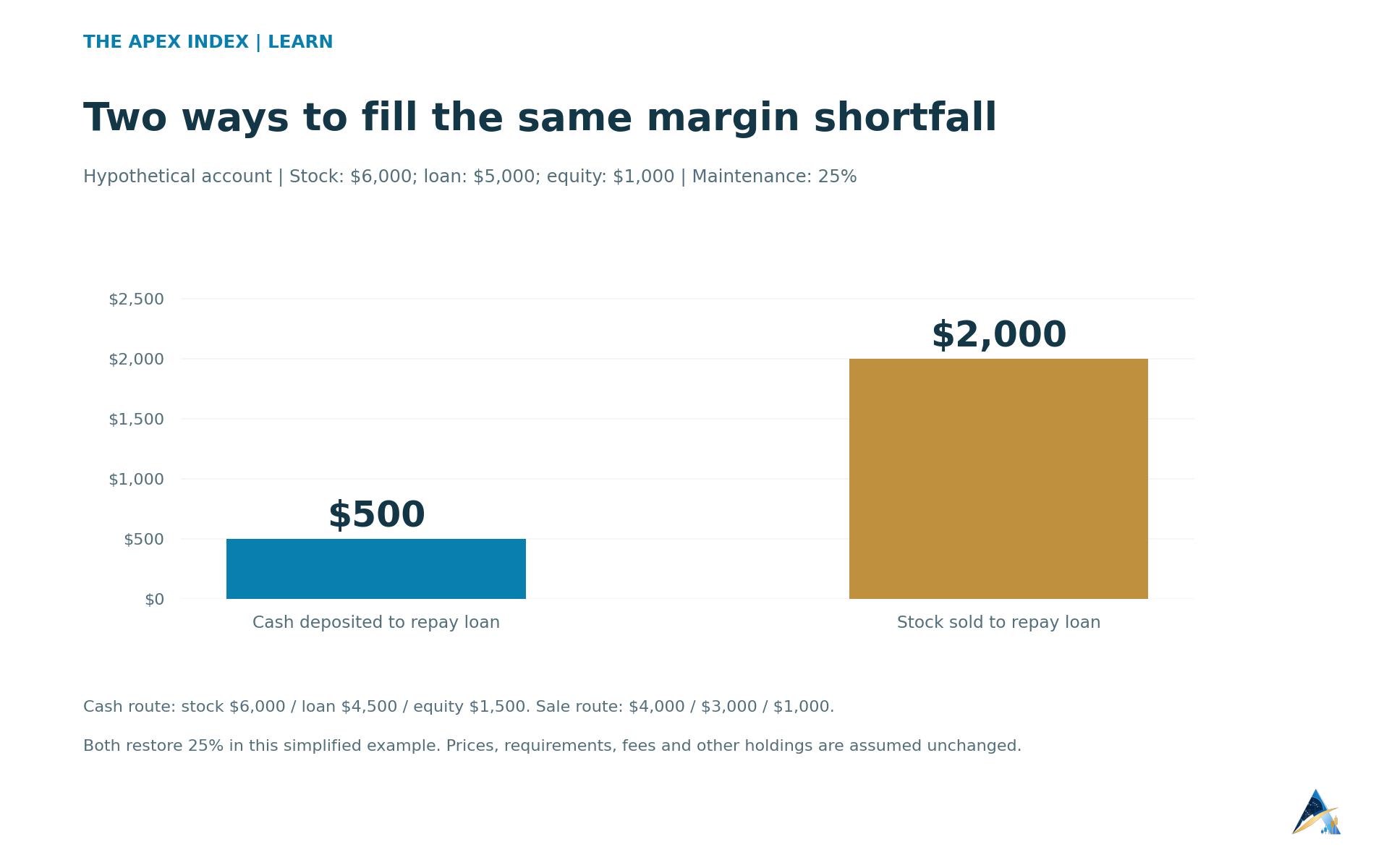
The comparison explains why a broker's proposed sale can exceed the cash amount on a notice. Selling reduces the assets supporting the loan as well as the debt. Adding eligible funds can change equity differently. Ask the broker for the account-specific calculation instead of treating those two actions as interchangeable.
You can also calculate the boundary for this simplified loan. Equity is the stock value minus $5,000; it must equal at least 25% of the stock value. Solving that relationship gives a stock value of about $6,666.67, assuming unchanged debt and no costs. Below that level, the account falls short under the example rule.
This boundary is a calculation, not an instruction to wait until a particular price. A different house requirement, another holding or interest charged to the loan changes the result. A platform's displayed risk figure also may update before an ordinary price chart or account summary refreshes.
A margin call may not give you time to wait
A margin call tells you the account does not meet a requirement and needs action under its terms. It does not necessarily provide a protected period to decide what to do. The firm can sell assets under the agreement, and you may not get to choose which holdings it sells.
FINRA's U.S. margin-disclosure rule states:
"The firm can sell your securities or other assets without contacting you."
The disclosure also warns that customers can lose more than they deposit and that firms can raise their own maintenance requirements. A broker's previous practice of phoning first is not a promise that it will do so next time. Read the actual agreement and current notices.
Futures and crypto contracts have their own mechanics
A futures position uses margin as collateral supporting the contract, rather than simply as a down payment on shares. Its exposure depends on the contract price and size. The CFTC's explanation describes the leverage created when a small amount of margin controls a much larger contract value.
Consider a separate simplified linear contract with $10,000 of exposure and $1,000 of collateral. Before fees and other adjustments, a 5% adverse move on that exposure produces a $500 loss, half the initial collateral. That comparison doesn't tell you the liquidation price: maintenance requirements can trigger action before the collateral is exhausted.
Crypto perpetual contracts add features such as funding payments and exchange-specific pricing rules. A platform may use a mark price, calculated under its methodology, rather than the last displayed trade to assess risk. Collateral valuation, maintenance tiers and closing fees can affect the threshold.
Isolated margin and cross margin also need careful reading. An isolated arrangement assigns collateral to a position; cross margin can use eligible collateral across positions. Automatic top-ups, fees and contract terms can change what money is exposed. The name alone does not guarantee a maximum possible loss.
Funding on a perpetual contract is separate from ordinary borrowing interest. It can create payments between holders of opposing positions under the platform's rules. The direction and rate can change, so a quoted funding payment for one interval doesn't establish the cost of holding the contract for a month.
Settlement mechanics also matter. Futures can require cash movements as the contract is marked to market, even before the position is finally closed. A trader needs access to eligible funds when those obligations arise. An expected gain elsewhere doesn't automatically supply cash to the account at the required time.
Why a hedge can still produce a margin call
Businesses sometimes use derivatives to reduce exposure to a price they already face. A farmer, for example, can sell futures against an expected crop. If market prices rise, the futures position can lose money while the crop's expected selling value improves. That can still create a need for cash margin before the crop is sold.
The financing problem and the economic hedge are different parts of the situation. Quantity, delivery timing and the relationship between the contract price and the physical selling price can also prevent a perfect offset. Using leverage for a commercial purpose doesn't remove those cash demands or contract risks.
An exit order isn't a guaranteed exit price
A stop order can trigger an instruction when its conditions are met, but a stop-market order may execute at a worse price in a fast or thin market. A stop-limit order sets a price condition, which can leave it unfilled. Neither arrangement removes every gap or liquidity risk.
Forced sales can arrive when many traders are trying to leave the same position. Price moves can reduce collateral value and create more sales pressure. If the collateral itself falls in value, it can weaken the account while the investment is also losing money.
Holding several leveraged positions doesn't necessarily solve that problem. Their prices may fall together, and one account's loss can consume collateral supporting another position. Review what the broker or platform can use to meet obligations, rather than assuming different position names create separate risk.
Check the product before transferring money
Investor protections depend on the legal entity and product. Some jurisdictions provide eligible retail CFD customers with negative-balance protection. That does not establish an equivalent guarantee for stock-margin loans, futures or an offshore crypto account. Check the regulated provider, customer classification and contract that actually apply to you.
Leveraged funds add another distinction. A fund targeting a multiple of daily returns can reset its exposure each day. Its return over several days can differ from that multiple of the underlying asset's cumulative return. Owning the fund outright and borrowing personally to buy it also create different obligations.
Before opening exposure, identify the amount supporting it, financing costs, maintenance rules, collateral accepted and the firm's liquidation powers. Work through a loss large enough to test whether you could meet those obligations. An attractive expected return doesn't establish that you'll be able to hold the position through a decline.
If a genuine margin notice arrives, verify it through the firm's official website or app and read the calculation and deadline. Contact the provider about the available actions and their consequences. Adding money can keep exposure open, while selling can lock in a loss; neither should be treated as a routine button press without checking the account. Rules and source references in this guide were checked on October 27, 2026, UTC.