

Goldman Sachs, Wells Fargo and Citi beat third-quarter profit expectations on October 13, while JPMorgan missed despite earning more than a year earlier. The four banks reported combined net income of roughly $31.8 billion, with trading, lending and corporate services contributing differently to each result.
JPMorgan earned $5.57 per share, below the $5.93 estimate reported by the Associated Press. Goldman delivered $17.01, Wells Fargo $1.87 and Citi $2.85. All four institutions posted higher year-over-year profits, but a profit increase is not the same as an earnings beat. Wells also missed revenue expectations, according to Reuters’ earnings report.
JPMorgan misses as Goldman’s equities business surges
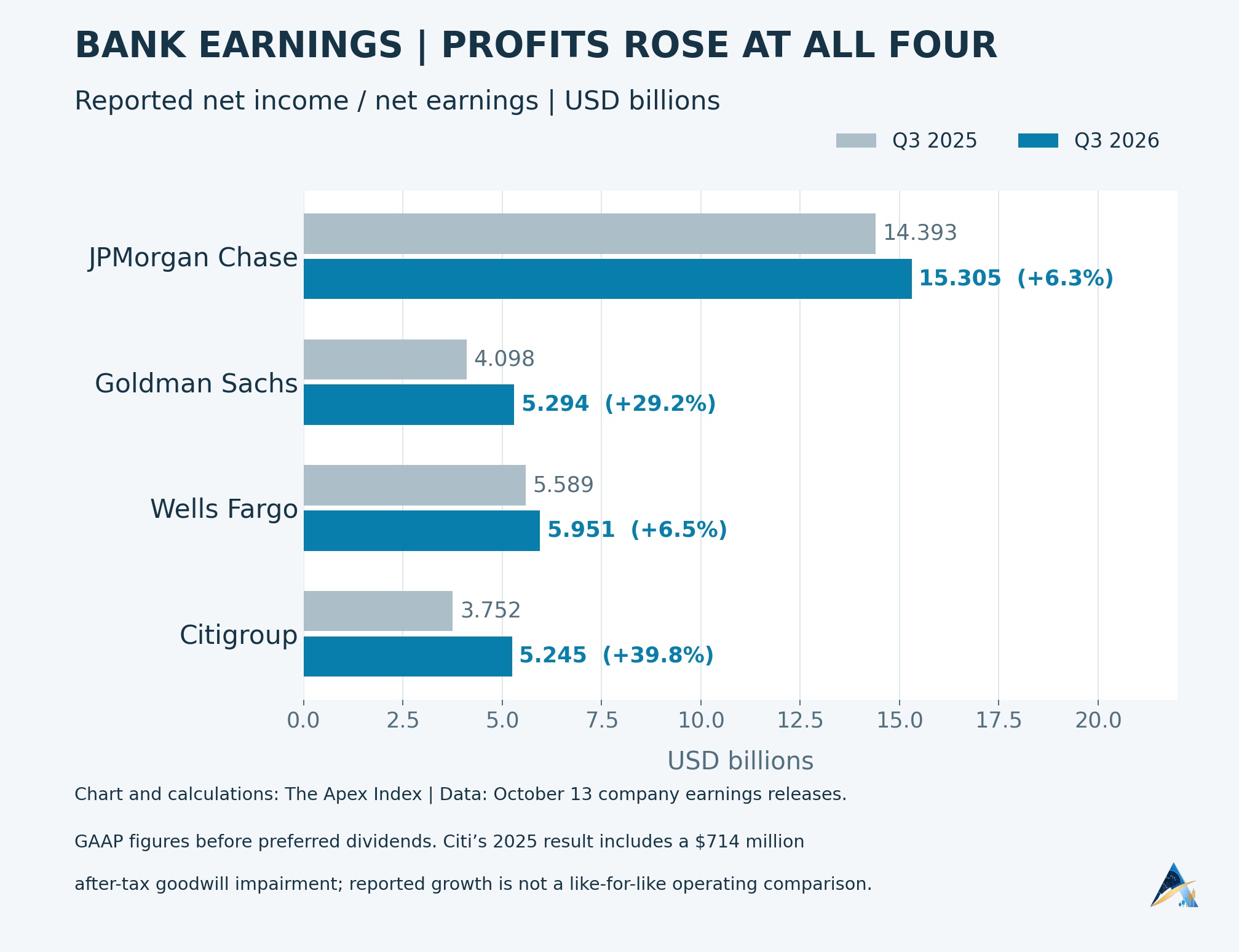
JPMorgan’s release put reported net income at $15.305 billion, up 6% from $14.393 billion a year earlier. Reported revenue reached $50.172 billion; its managed revenue figure was $50.907 billion. The latter is a non-GAAP measure with taxable-equivalent adjustments, so it should not be treated as interchangeable with reported revenue.
A significant securities loss explains part of the earnings shortfall. JPMorgan recorded $658 million of net investment securities losses before tax, a $498 million after-tax hit that reduced EPS by $0.18. Excluding that item, the bank reported $5.75 per share. That adjustment improves the result, but it does not turn the reported $5.57 into a beat against the AP-cited forecast.
Its businesses were not uniformly weak. Investment-banking fees rose 14%, while total markets revenue increased 15%. Equity markets revenue climbed 49%, but fixed-income markets revenue fell 4%. The split matters: buoyant stock trading did not prevent a decline in another major Wall Street business.
Expenses rose 12% to $27.295 billion, driven partly by compensation, brokerage costs, marketing and technology spending. Credit-loss provisions declined to $2.743 billion from $3.403 billion. JPMorgan therefore missed expectations even while reporting lower credit charges and strong activity across several divisions.
Jamie Dimon, chairman and chief executive, said:
“The U.S. economy continued to be fueled by strong business investment and ongoing consumer spending. However, large fiscal deficits, sticky inflation, elevated asset prices, rising interest rates and geopolitical conditions continue to shift under the surface. These forces may be manageable, but we remain prepared for a wide range of outcomes.”
Goldman’s results showed a sharper profit increase. Net earnings reached $5.294 billion, against $4.098 billion a year earlier, while revenue climbed 23% to $18.679 billion. Its $17.01 EPS was up from $12.25. The result beat analysts’ profit expectations.
Equities revenue jumped 72% to $6.441 billion, reflecting growth in financing and derivatives activity. Investment-banking fees increased 21% to $3.224 billion. Fixed-income, currencies and commodities revenue was essentially unchanged at $3.471 billion, while the investment-banking fee backlog declined from the previous quarter. Those details temper any suggestion that every part of Goldman’s business accelerated.
Wells Fargo and Citi beat, with different caveats
Wells Fargo’s report showed net income of $5.951 billion, compared with $5.589 billion last year. Revenue increased 2% to $21.870 billion, and net interest income rose 5% to $12.517 billion. Average loans and deposits each grew 11%, supporting the bank’s core lending franchise.
There were offsets. Credit-loss provisions increased to $1.029 billion from $681 million, and net charge-offs reached $983 million. The annualized net loan charge-off rate was 0.38%. Higher provisions do not mean that 51% more borrowers defaulted: the charge also reflects changes in allowances for expected losses.
Chief executive Charlie Scharf described the customer picture this way:
“While economic uncertainty exists and consumer sentiment remains mixed, our data shows that our consumer and business customers are doing well. Consumers are spending more, loan delinquencies are low, and deposit and investment balances have grown.”
Citi reported net income of $5.245 billion, up from $3.752 billion, on revenue of $23.845 billion. Services revenue grew 15% and markets revenue rose 6%. Banking revenue including loan hedges increased 6%; excluding those hedges, growth was 2%. Investment-banking revenue climbed 9%, with equity capital markets particularly strong.
Its reported profit growth needs qualification. Last year’s quarter included a $714 million after-tax goodwill impairment tied to the agreement to sell a 25% stake in Banamex. Excluding that item, prior-year net income was approximately $4.5 billion. Reported EPS rose 53%, but the increase was 27% against the adjusted prior-year figure; share repurchases also reduced the share count.
Citi returned $4.1 billion through common dividends and repurchases. Return on tangible common equity reached 11.5%, and chair and chief executive Jane Fraser said the bank expected to exceed its annual return target. That is management’s outlook, not a guaranteed year-end result.
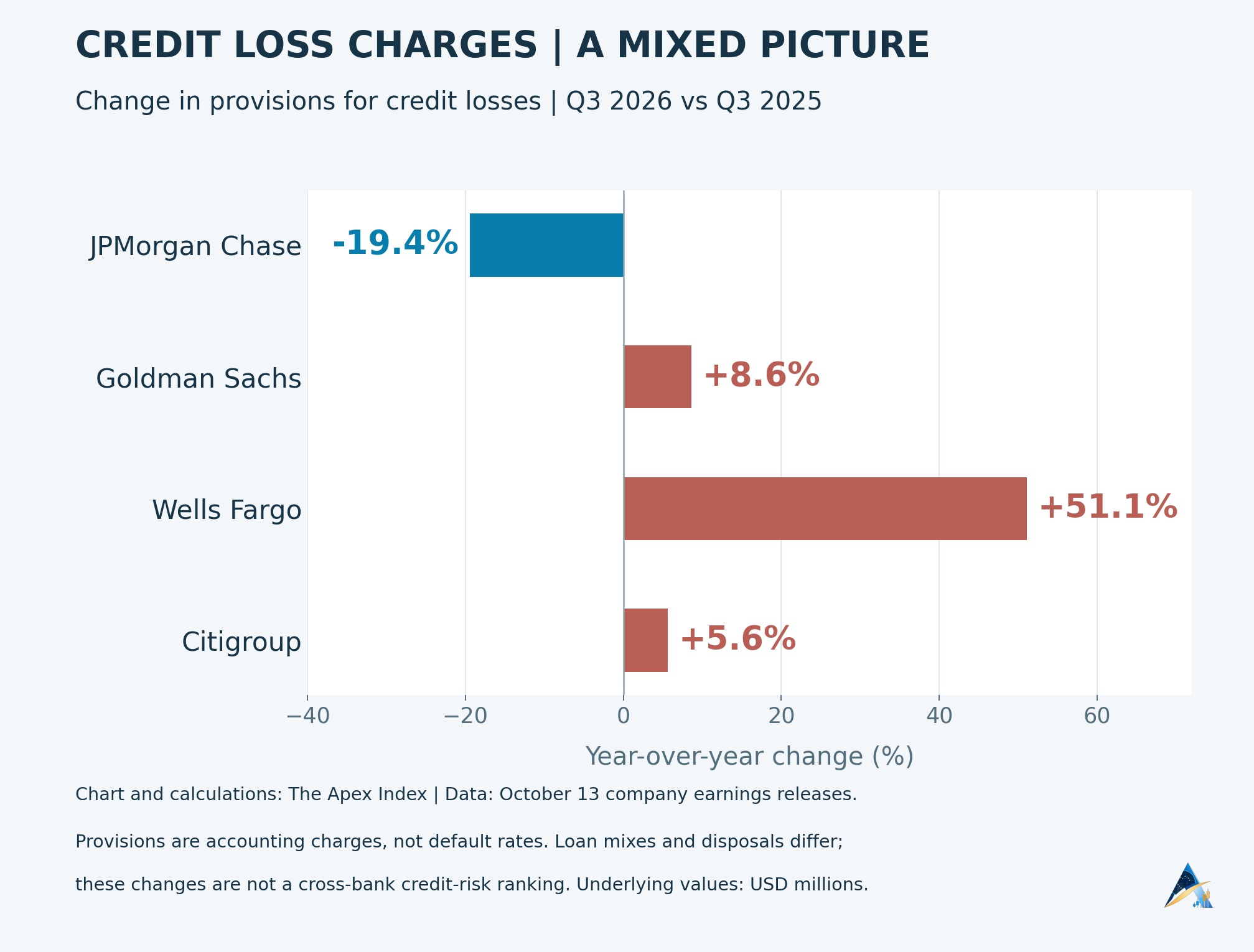
The credit data resist a single industry-wide conclusion. JPMorgan’s provisions fell, while Goldman’s, Wells Fargo’s and Citi’s rose. Different loan portfolios and disposals limit direct comparisons. Provisions measure accounting charges, not default rates or a ranking of which bank is safest.
As previously reported by Apex, Treasury yields reached a 24-year extreme last week. The banks’ latest statements place borrowing costs, persistent inflation and geopolitical risk alongside continued customer activity. Stronger quarterly profits give investors evidence of resilience, but they do not erase the revenue misses, trading divergences and credit costs inside these results.