
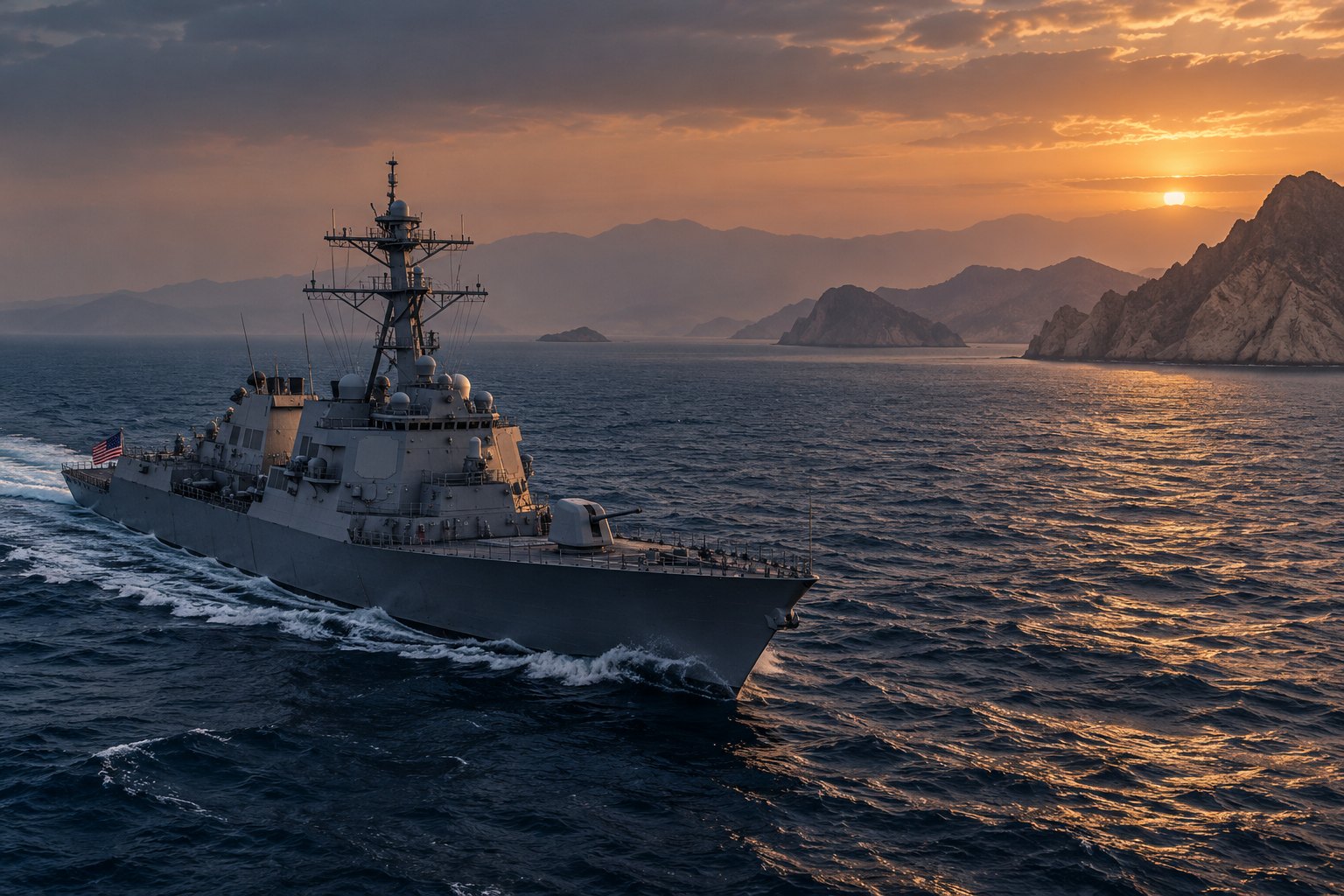
Iran's Revolutionary Guard navy has threatened to sink American warships that approach the Strait of Hormuz, challenging Washington to prove it can keep the waterway open. Its commander, Rear Admiral Ali Ozmaei, said his forces were waiting for the encounter.
The United States answered with a claim of its own: American forces and their regional partners control the strait and are helping oil cargoes get through. The exchange comes as Iran reports more incidents involving commercial ships, including a container vessel it says sank after hitting a mine on October 14.
In a televised interview aired on October 13 and reported by Tasnim, Ozmaei challenged U.S. naval forces to move closer. He said Iranian forces were enforcing restrictions on ships using routes Tehran considers unauthorized.
A direct threat to American ships
He spelled it out:
We are waiting for US warships to approach the entrance to the Strait of Hormuz so we can sink them. We are counting down every moment until this happens.
He also accused the United States and its regional partners of hiding attacks on vessels that ignored Iranian restrictions. According to the commander, the Guard released footage of two incidents to challenge that silence.
That was Iran's account. Washington rejected his claim of control, dismissing him as a navy commander who "has no navy." The U.S. military said it had helped Gulf partners move more than 19 million barrels of crude through Hormuz on October 12. That is a figure supplied by the military, not an independently verified tally of cargoes.
The two sides are arguing over who can decide which ships pass, and on whose terms. Ozmaei says vessels need Iranian authorization. Washington says it and its partners are protecting commercial traffic.
A reported sinking puts commercial crews in the picture
On October 14, the Guard's naval public relations office said a ship carrying more than 2,500 containers had struck a mine, caught fire and sunk in the southern part of the strait. The statement, carried by state broadcaster Press TV, said the vessel had taken an unauthorized route.
The account has not been independently confirmed. It did not identify the vessel or give a casualty count. The office warned local boats and fishermen to watch for containers floating in the water.
Iran's regular navy also reported a tanker fire east of Hormuz, saying the vessel had switched off its tracking equipment and entered a prohibited area. Those details remain the navy's account. The navy said it was monitoring traffic across the Gulf of Oman and Arabian Sea, as well as east of Hormuz. It urged other crews to keep their electronic equipment switched on and coordinate any passage with Iran's armed forces.
Washington says its blockade stays in place
In an October 14 CENTCOM statement, the U.S. military rejected an Iranian complaint that its forces were intimidating civilian mariners over maritime communications channels. It said the American blockade of Iran had been in place for months and was being communicated professionally.
Its response also repeated the promise to protect shipping:
Despite these unjustified attacks, commercial traffic continues to flow through the Strait of Hormuz with coordinated protection from U.S. forces and regional partners.
As previously reported by Apex, officials have described discussions about a possible operation against Iran before elections. The White House denied that account. Trump's latest rally remarks threatened further action without announcing targets or a date.
The confrontation is unfolding alongside renewed threats from Donald Trump. At his October 13 campaign rally in Wasilla, Alaska, the president told supporters: "Wait till you see what we do to Iran. We're going to do a number. We sort of had it. You know we've had it."