
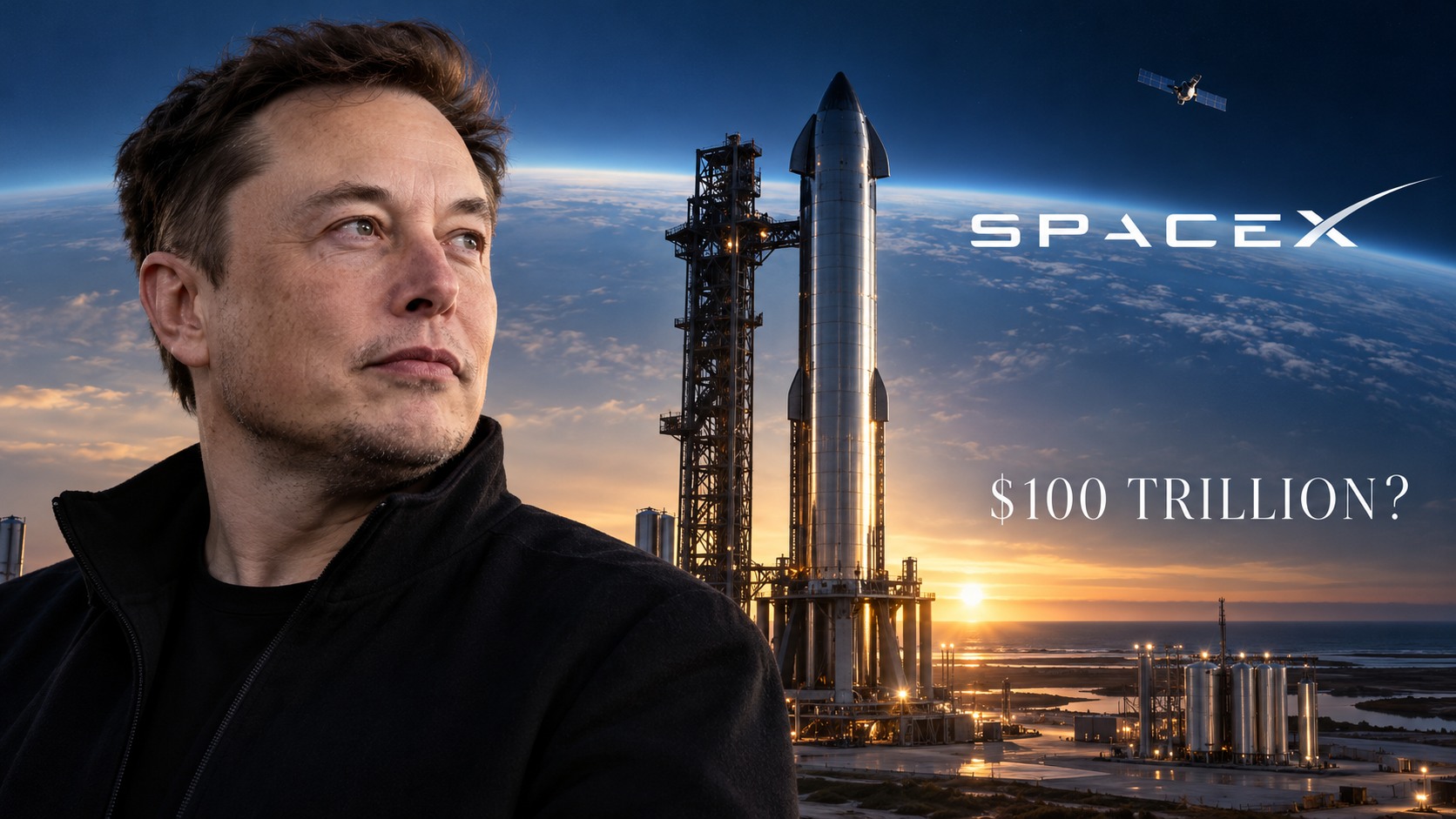
Elon Musk thinks SpaceX can become a $100 trillion company in less than a decade. His biggest qualification is a grim one: the world needs to avoid a major war first.
The prediction puts a rough deadline on an ambition he has been floating for the space company. Less than ten years from October 2026 means before October 2036, and leaves investors with a huge number to weigh against the business SpaceX is building today. It is his forecast for the company, rather than a valuation investors have already awarded it.
In an October 15 report, Baha Breaking News quoted Musk's post on X:
Unless there is a major world war, SpaceX probably gets to >$100T in <10 years
That is a claim about the company's market value, not its annual revenue. Reaching it would require investors to assign an extraordinary value to the earnings they expect SpaceX to generate. The eventual value would depend on what those businesses earn and how much shareholders are willing to pay for that growth.
Musk has been building toward this number
A week earlier, Musk had already pushed the conversation well beyond rockets and satellite subscriptions. The same news service quoted an October 8 statement in which he described a much larger opportunity:
This will sound super crazy, but I see a path to SpaceX being worth orders of magnitude more than the current Earth economy
There is a distinction worth keeping here. The value of a company reflects expectations about future earnings, while the size of an economy usually refers to output over a year. Putting the two alongside each other makes for a striking comparison, but they measure different things.
SpaceX's immediate expansion plans are easier to pin down. As previously reported by Apex, its proposed Starlink Mobile network combines satellite connectivity with a terrestrial coverage layer, including an agreement for low-band spectrum designed to improve reception inside buildings.
That earlier announcement described authorization for 15,000 mobile satellites. It also said the spectrum transfer still required final Federal Communications Commission approval. Those are separate steps: permission to launch a constellation does not finish the licensing or construction work needed to run the proposed service.
A fresh Starship proposal shows the scale of the ambition
A more immediate development arrived on October 14. The Federal Aviation Administration updated its project page with plans for an environmental review of a substantial expansion at SpaceX's Starbase launch site in Texas.
The proposed first phase would allow up to 100 Starship-Super Heavy launches a year. A second phase would raise that to as many as 456, with launches restricted to weekdays. The agency is opening a public scoping process, with meetings in November and comments due November 30.
These are proposed operating levels under review, not an approved launch schedule. Even so, they show the scale SpaceX is seeking for the rocket intended to carry people and cargo to the Moon and Mars. A business built around that frequency would have to manufacture, launch and land vehicles repeatedly, rather than rely on occasional showcase flights.
There is a financing question alongside the engineering. Apex had earlier reported that SpaceX was seeking $40 billion to purchase Nvidia chips through a proposed package of bank loans and investment-grade debt. That effort adds a large AI infrastructure commitment to the company's space and communications ambitions.
The FAA has scheduled public meetings in Brownsville and Port Isabel, alongside a virtual session. Residents will have a chance to comment on the scope of the environmental review, including which impacts and alternatives it should examine. Musk is looking a decade ahead. The next public discussion about the physical expansion behind that ambition comes in November.