
Live updates
Tesla's flying Roadster is invite-only and not approved for public roads
Tesla's flying Roadster comes with a restriction that the launch spectacle could easily drown out: the Rocket version is invitation-only, seats one person and is not approved for public road use. The warning appears directly beneath the description of the airborne version on Tesla's own website.
That puts some distance between watching the car clear a Tesla Semi and being able to take one home for the daily commute. The company is separating its more extreme hardware into different versions, with different seating arrangements and intended uses. The car that flies is the most exclusive of them.
Tesla's updated Roadster page describes the Rocket package this way:
“Air ready with seating for one. Features a multi-mode suction system paired with cold-gas thrusters positioned around the perimeter of the vehicle that support forward and upward acceleration as well as lateral rotational movement. So yes, it can fly.”
Immediately below that description, Tesla adds: “Not approved for public road use.” It also says the Rocket trim is not available in every region. Those restrictions deserve attention alongside the footage, especially for anyone treating the unveiling as the arrival of an everyday flying car.
The Thrust version takes a different approach. Tesla labels it a limited release and describes it as:
“Race ready with seating for two. Features a multi-mode suction system paired with cold-gas thrusters in the rear of the vehicle that propel Roadster from 0-60 in under 1 second.”
The engineering details go beyond the rockets. Tesla says a fan and ground-sealing system pulls air from beneath the car, generating enough suction to hold it upside down even while stationary. Active wings and powered fans are intended to manage grip, while Track Mode lowers the car and changes the suspension setup.
Weight is another part of that effort. Tesla's description points to a fixed seat position and materials including magnesium, titanium and carbon fiber. Its steer-by-wire system and yoke are also part of the redesigned cockpit. These are the company's descriptions of the hardware, rather than results from an independent road test.
As previously reported by Apex, Tesla delivered 486,532 vehicles in the third quarter. Its next earnings report is scheduled for October 21, according to Tesla's investor-relations calendar, which also announces a live Q&A webcast.
That gives management another opportunity to explain where an extreme sports car fits alongside its other projects. The practical questions now concern production, customer access and what buyers will actually be allowed to do with the hardware. Tesla has demonstrated the spectacle. Its own product page makes clear that the flying version comes with significant limits.
Roadster flies in Texas, but buyers face a wait until 2028
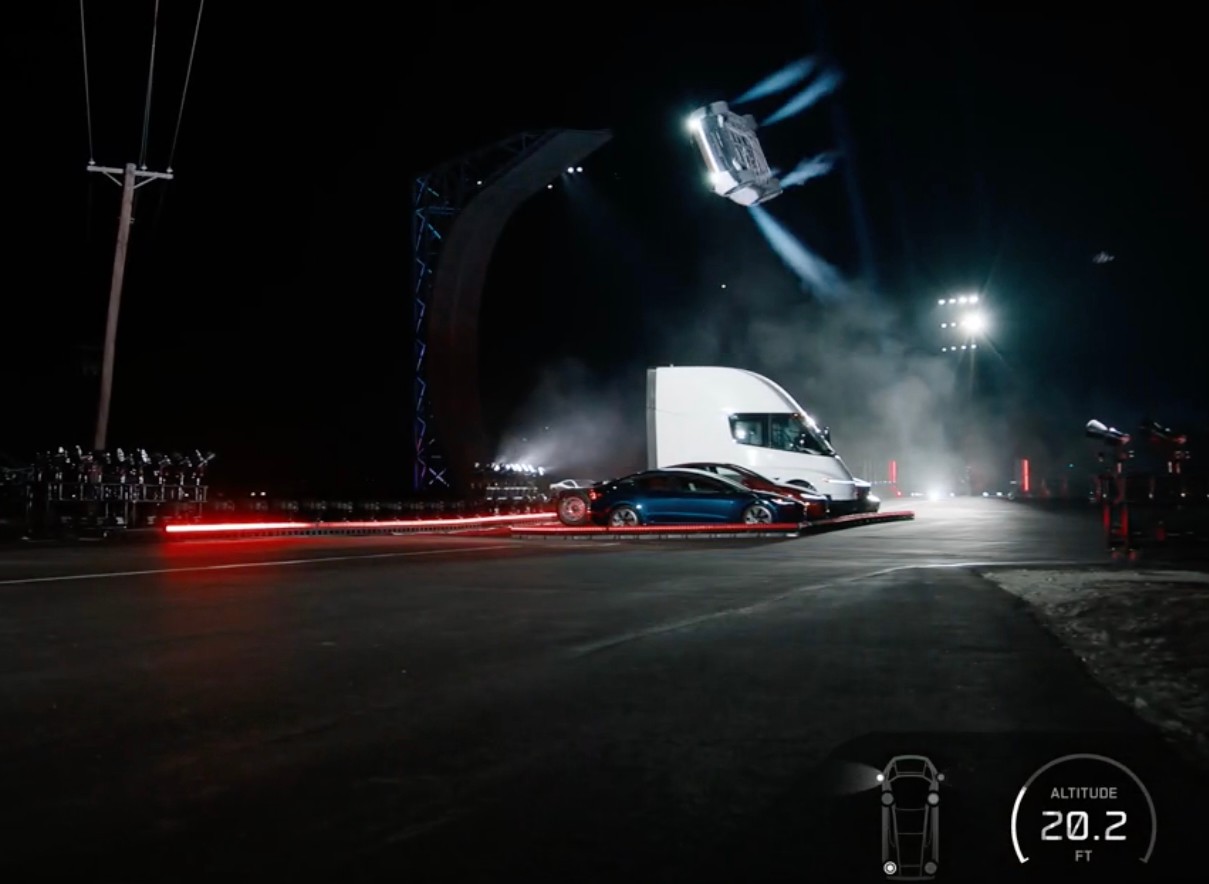
Elon Musk finally put a Roadster in the air. At Tesla's unveiling in Texas, the redesigned electric sports car drove up an inverted ramp, flipped using thrusters and landed back on the pavement. It also lifted itself over the company's vehicle lineup, including the towering Tesla Semi. After years of promises, the flying demonstration actually happened.
The trick combines two systems: powerful fans that pull the car toward the road and compressed-air thrusters that control its movement once airborne. Tesla and SpaceX engineers developed the hardware together. The demonstration took place at SpaceX's rocket development facility in McGregor, near Waco, where the audience watched the car perform its maneuvers.
Tesla also showed a recorded acceleration run that it said took the Roadster from zero to 60 mph in 0.81 seconds. That's a company claim, rather than an independently verified performance test. The Verge's original event report described both the acceleration claim and the flying demonstrations.
Musk leaned into the spectacle, while acknowledging the tradeoff:
So it can basically fly like a rocket. And it could do rolls. It could do, like, crazy gymnastics. Whatever you want, really. Now, I should say that this is not necessarily a safety-optimized car. But it takes the fun meter to 11 out of 10.
Tesla engineering chief Lars Moravy described two tanks holding a combined 600 liters of compressed air, feeding 10 nozzles. The car can recharge its air supply. In its own post, Tesla said adapting spacecraft thrusters for a vehicle required entirely new hardware and controls, with pressure vessels packed into available spaces.
The unveiling also brings a human-driven sports car back into focus while Tesla promotes robotaxis. As previously reported by Apex, Cybercab and Optimus were central to its Paris showcase, showing just how differently Tesla imagines the future of driving.
For buyers, the less exciting number is 2028. That's Musk's latest production target. Tesla first unveiled the second-generation Roadster in 2017 and initially promised deliveries in 2020. Several deadlines have come and gone since then, so a working demonstration still leaves a substantial manufacturing job ahead.
There are also important differences between the versions. TechCrunch reported that Tesla's website listed a two-seat Performance model, a two-seat Thrust model with rear cold-gas thrusters, and a single-seat Rocket version with 10 thrusters. The Rocket version is invitation-only. A reservation isn't a final purchase price, and Musk did not announce one at the event.
Musk described the engineering effort this way:
This is the culmination of incredible work by Tesla and SpaceX Engineers working closely together to make something you haven't seen in any movie, better than any James Bond car.