
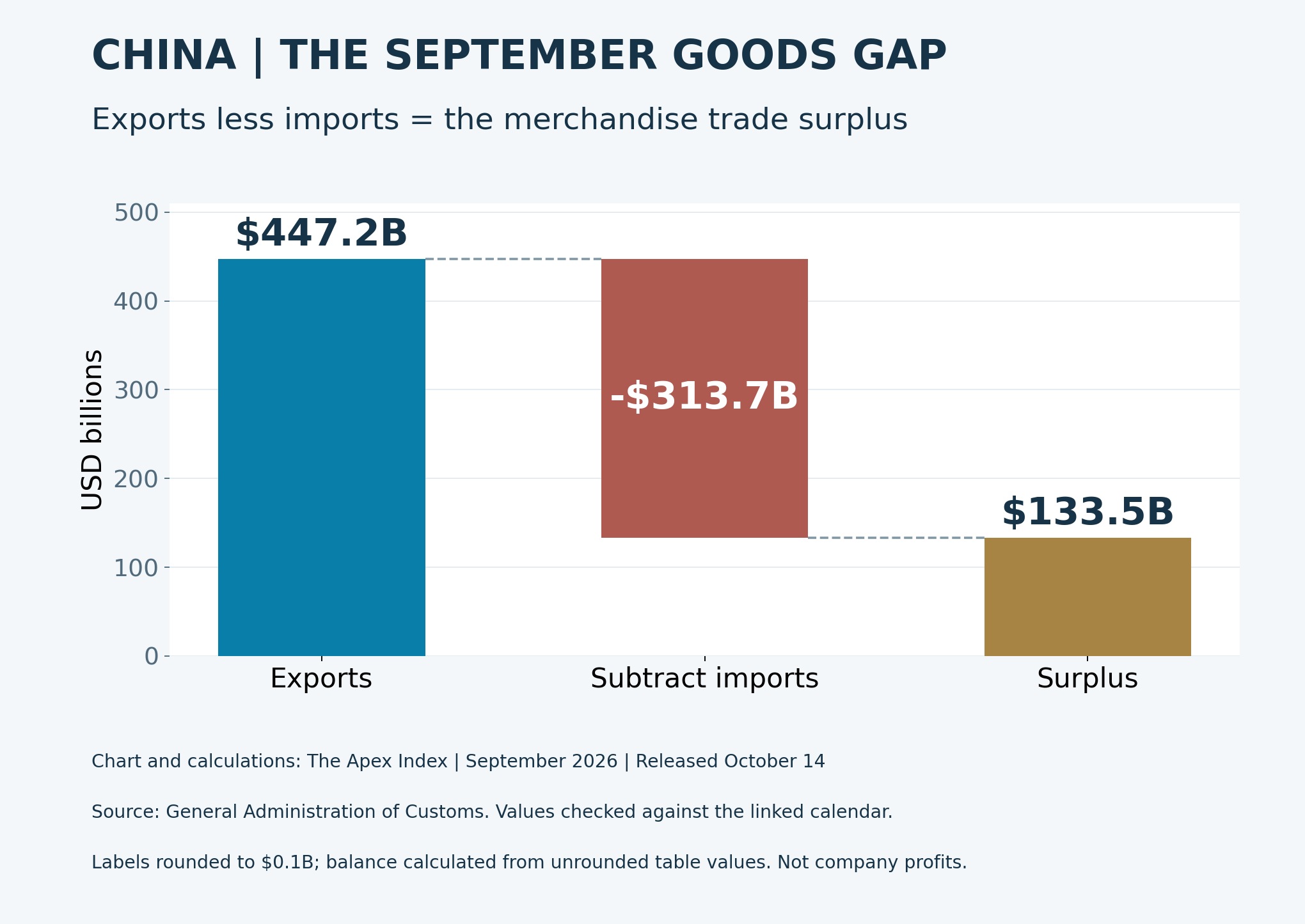
China sold $133.5 billion more in goods to the world than it bought in September, as an export surge outpaced a sharp rise in imports. The monthly surplus reached $133.53 billion, giving the country's manufacturers another strong result even as spending at home remained sluggish.
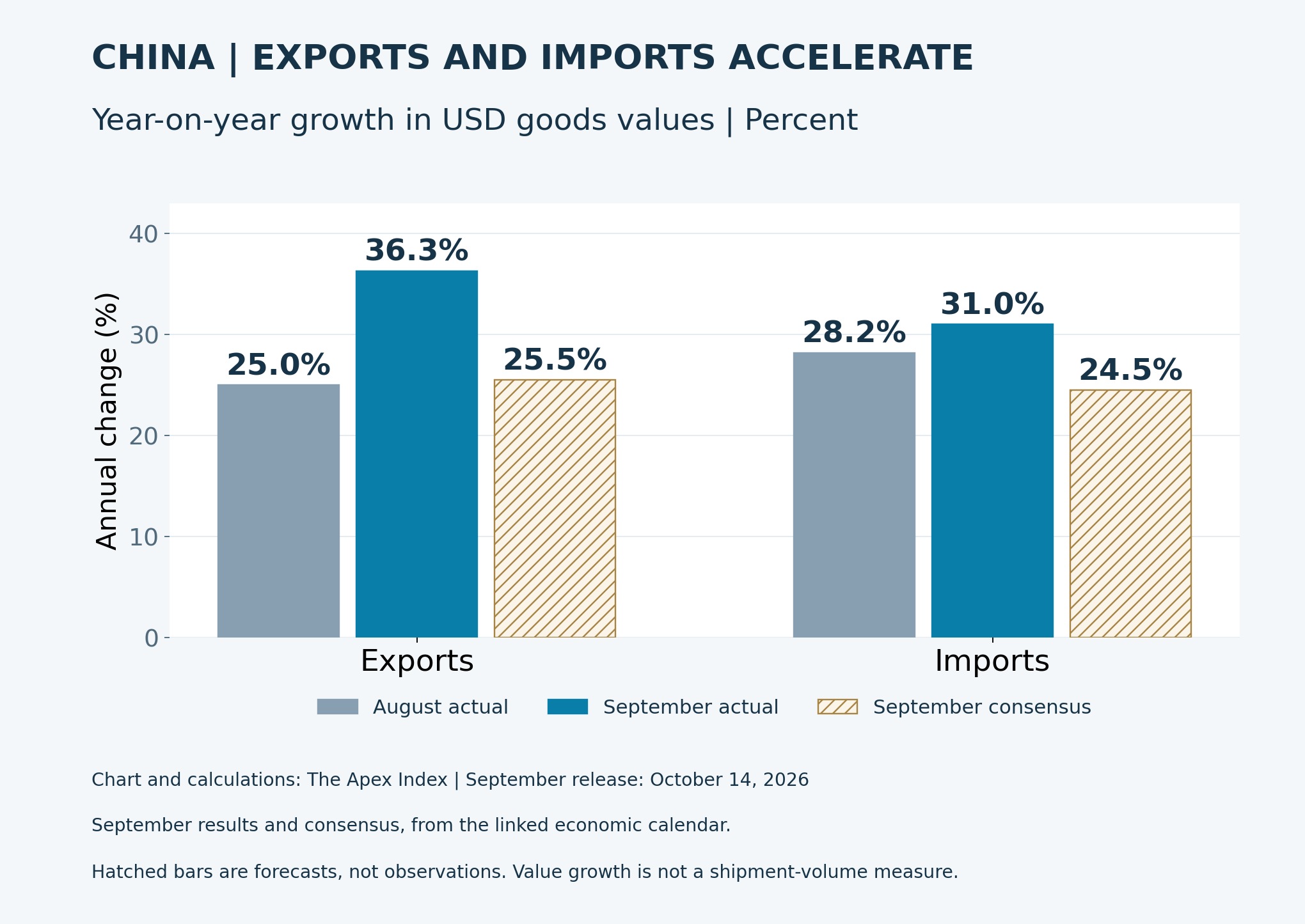
Exports climbed 36.3% from a year earlier to about $447.2 billion. Imports rose 31.0% to roughly $313.7 billion. The gap widened because overseas sales grew from a larger base, not because China stopped buying foreign goods. Both sides of its trade ledger expanded rapidly.
A much bigger gap than expected
The October 14 customs figures put September's surplus $14.44 billion above August's $119.09 billion, an increase of about 12.1%. It was the largest monthly surplus since January 2025, rather than an all-time record.
The result also overshot the $118.1 billion consensus in Trading Economics' calendar by $15.43 billion. Export growth beat a 25.5% forecast, while imports exceeded the expected 24.5% increase. Economists had anticipated a slightly smaller surplus; China delivered a substantially larger one.
The General Administration of Customs presented its first-three-quarter results at an October 14 briefing. The year-to-date surplus reached $938.51 billion, according to the published customs series. That nine-month total must be kept separate from September's $133.53 billion balance.
In yuan terms, total goods trade rose 18.8% in the first three quarters, according to the briefing's initial government release. That measure combines exports and imports; it is neither the surplus growth rate nor a dollar-denominated comparison.
These are merchandise trade values. The surplus is not a government windfall or a measure of exporters' profits. Factories still pay for imported components, energy, wages and financing. The numbers show how much more China shipped abroad than it brought in, before services and other cross-border payments enter the picture.
The AI boom keeps orders coming
Demand for equipment used in AI infrastructure remains an important support for Chinese exports. The business stretches beyond finished chips to the components and manufactured products needed to build data centres.
In its September export assessment, Trading Economics said the increase was:
supported by robust demand for China-made components used in AI data centers.
The rise was spread across major destinations. Exports to the United States increased 9.8% from a year earlier, while shipments to the European Union grew 16.4% and those to ASEAN countries climbed 28.7%. South Korea and Taiwan recorded increases of 39.1% and 37.3%, respectively. Those are growth rates for individual destinations, not their shares of total exports.
As previously reported by Apex, U.S. semiconductor imports jumped 84% in the first eight months of 2026. That earlier figure covers America's purchases from all suppliers, not just China. It helps explain the scale of the wider chip-buying boom without assigning the whole increase to Chinese factories.
September's import growth also matters. China buys machinery, industrial inputs and energy as well as consumer products. A rise in those purchases can accompany stronger factory activity and export orders. It does not, by itself, establish that Chinese households are spending freely again.
Strong exports, a quieter home market
The contrast with domestic shopping remains stark. In its September 16 release, the National Bureau of Statistics said:
In August, the total retail sales of consumer goods reached 3,982.4 billion yuan, up by 0.4% year on year. Specifically, the retail sales of consumer goods excluding automobiles reached 3,654.5 billion yuan, up by 2.5%.
Those August figures are older context, not a September retail reading. They show why a booming export sector cannot be taken as proof of a broad consumer recovery. Retail sales and customs trade also cover different activities and currencies, so their growth rates should not be treated as interchangeable measures.
China's consumer prices rose 0.9% from a year earlier in September, the statistics bureau separately announced on October 14. That fresh inflation reading adds to the domestic picture, but it does not explain how much of the dollar-denominated trade increase came from prices, exchange rates or shipment volumes.
For businesses abroad, China's growing sales offer a mixed prospect: more demand for suppliers feeding its factories, alongside tougher competition from the products those factories export. For Beijing, the immediate gain is a stronger external engine while domestic demand needs work.
The next test is whether that engine keeps pulling. September delivered more exports, more imports and a bigger surplus than expected. It has not yet answered whether Chinese consumers will provide an equally strong source of growth.