


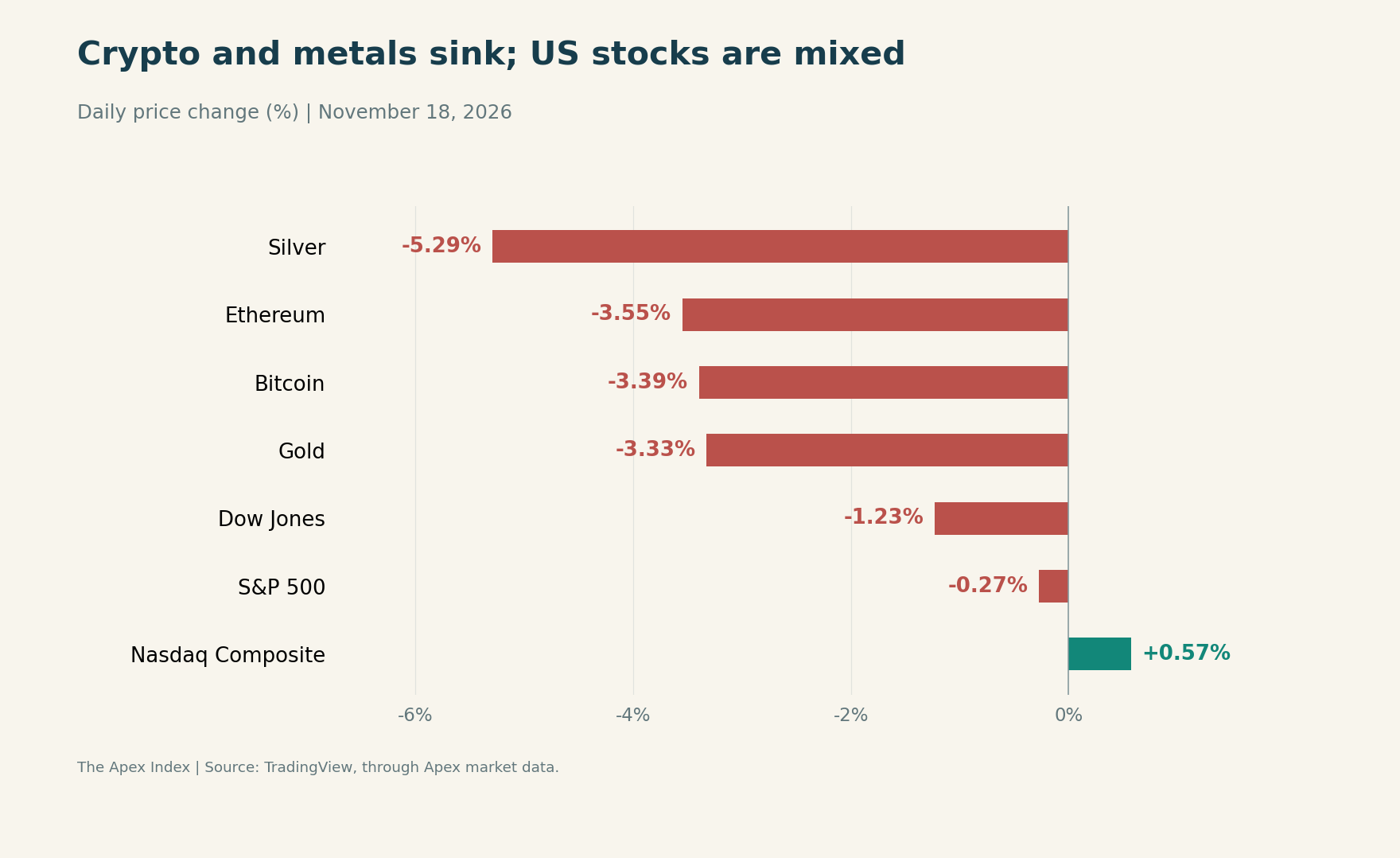
Bitcoin, Ethereum, gold and silver are all falling sharply Wednesday as investors face the prospect of more Federal Reserve rate increases, a firmer dollar and weaker demand for crypto funds. Those pressures reach different assets through different routes, but they share a common problem: holding them becomes harder to justify when borrowing costs stay high and competing investments offer substantial income.
US stocks are having a more uneven day. The Dow and S&P 500 are lower, while the Nasdaq Composite is still positive. That matters when making sense of the selling: the largest declines are in metals and crypto, rather than an equally severe crash across every market.
What is actually falling?
As of the time this article was written, Bitcoin traded around $62,674, down 3.39%, and Ethereum was near $1,758, down 3.55%, in the site's TradingView data. Gold was about $3,721 an ounce, down 3.33%, while silver lost 5.29% to roughly $44.87 an ounce.
The Dow had fallen about 626 points, or 1.23%. The S&P 500 was down 0.27%, while the Nasdaq Composite gained 0.57%.
The dollar was moving the other way. Its index against a basket of currencies rose about 0.27% to 103.875. The 10-year Treasury yield stood at 5.064%, although it had fallen about 4.5 basis points during the session. High yields remain part of the backdrop, even on a day when bonds themselves are gaining ground.
The Fed is making investors rethink the price of money
The clearest fresh policy development is Wednesday's release of the October 27-28 Fed minutes. Almost all participants thought further rate increases would likely be appropriate under their baseline economic outlooks. A couple were prepared to consider a larger move at the December meeting if inflation disappointed.
The record said:
A couple of participants noted that an increase of more than 25 basis points could warrant consideration at the next meeting if incoming inflation data were unfavorable.
As previously reported by Apex in the article below, Governor Christopher Waller also floated a half-point December increase in an interview Wednesday. He left room for a quarter-point move if officials clearly signaled another hike in January.
A higher policy rate affects more than the cost of a mortgage. It raises financing costs for businesses and leveraged investors, while giving savers a stronger alternative to assets whose payoff depends heavily on a future price increase.
For stocks, higher discount rates reduce the present value of expected future profits, other things equal. For gold, the comparison is with interest-bearing assets. For crypto, tighter financial conditions can make investors less willing to carry volatile positions. The same policy concern can therefore weigh on all three without each market needing its own new disaster.
Why gold and silver are selling off too
Gold pays no coupon. When Treasury yields are above 5%, an investor choosing bullion has to weigh the income forgone by owning it. A stronger dollar adds another obstacle because dollar-priced metal becomes more expensive for buyers using other currencies, assuming the metal's dollar price is unchanged.
That explains why inflation anxiety can hurt gold in the short term. If investors respond by expecting more aggressive rate increases, the interest-rate and currency effects can outweigh demand for protection against rising prices.
Silver carries an additional exposure to the economy. The Silver Institute's overview documents its use in solar panels, electronics, automobiles and other industrial products. Concerns about the effects of tighter policy on growth can therefore bear on expected industrial demand as well as investment demand.
That combination helps explain silver's larger decline. It has to contend with the same dollar and interest-rate pressures as gold while also being sensitive to the outlook for factories, construction and equipment spending. Today's price drop alone cannot tell us how much each factor contributed, but those channels explain why a precious metal can move with riskier assets.
Crypto also has a demand problem
Fund flows provide a concrete sign of selling pressure beyond the day's price charts. Farside Investors' data show US spot Bitcoin ETFs lost $239.9 million on Tuesday, November 17. BlackRock's IBIT accounted for $209.5 million of those net outflows.
US spot Ethereum ETFs recorded another $29.1 million in net outflows that day. These are the latest completed daily figures in those tables, rather than a completed total for Wednesday.
That leaves both markets facing withdrawals from an important investment channel while the interest-rate outlook becomes less friendly. Bitcoin's limited supply does not prevent its traded price from falling when holders sell and new demand fails to absorb the offers at the previous price.
Leverage can amplify that process. A trader using borrowed exposure may have to add collateral or close a position when prices fall. Forced sales can then push prices lower and put other leveraged positions under pressure. This is a mechanism that can magnify a decline; the ETF figures measure a different, directly observed source of demand weakness.
Stocks have their own mix of earnings and crowded bets
The split between the Dow and Nasdaq shows why company results still matter. Nvidia reported a 103% revenue increase Tuesday, as previously reported by Apex in its earnings coverage. Yet its shares were down about 2.32% at $151.86 in the latest reading. Strong business growth and a falling share price can coexist when investors reassess valuation and risk.
Positioning adds another vulnerability. Apex previously reported Tuesday that Citi had identified $45.9 billion in bullish S&P 500 futures exposure, with 95% of those positions sitting on losses. That is a measure of the positions in its analysis, rather than a count of all stock-market investors.
The Fed's own discussion also highlighted financing risk around AI:
Most participants observed that AI-related debt had grown rapidly and that much of this growth had taken place through complex and opaque financing structures.
Together, expensive financing, weaker fund demand and vulnerable positions can make several markets fall at once. Wednesday's surviving Nasdaq gain and lower Treasury yields show that investors are still making distinctions. The pressure is broad, but the reasons to sell, and the size of the losses, differ across assets.