

Federal Reserve officials head toward December with broad support for raising interest rates again, and a couple are open to a bigger move if inflation data disappoint. Minutes released Wednesday show that almost all participants at October's meeting thought further increases would likely be appropriate under their baseline economic outlooks.
The debate is increasingly about how quickly to act. Officials left the federal funds target at 3.75%-4.00% in October, but some wanted an immediate increase. The next decision comes December 8-9, when policymakers will also publish updated economic projections.
A larger December move is on the table
The minutes, covering the October 27-28 meeting, spelled out the case for moving faster:
A couple of participants noted that an increase of more than 25 basis points could warrant consideration at the next meeting if incoming inflation data were unfavorable.
That was a conditional argument for a larger increase. The record does not identify the participants behind it. Almost all supported further tightening more broadly, while a few warned that inflation could prove persistent enough to require a more restrictive stance.
Governor Christopher Waller made the half-point case publicly in a CNBC interview Wednesday. He argued for more aggressive action against inflation and floated a 50-basis-point December increase.
Christopher also left room for a smaller move: a quarter-point increase could suffice if officials clearly signaled another hike in January. Without that guidance, he favored doing more in December.
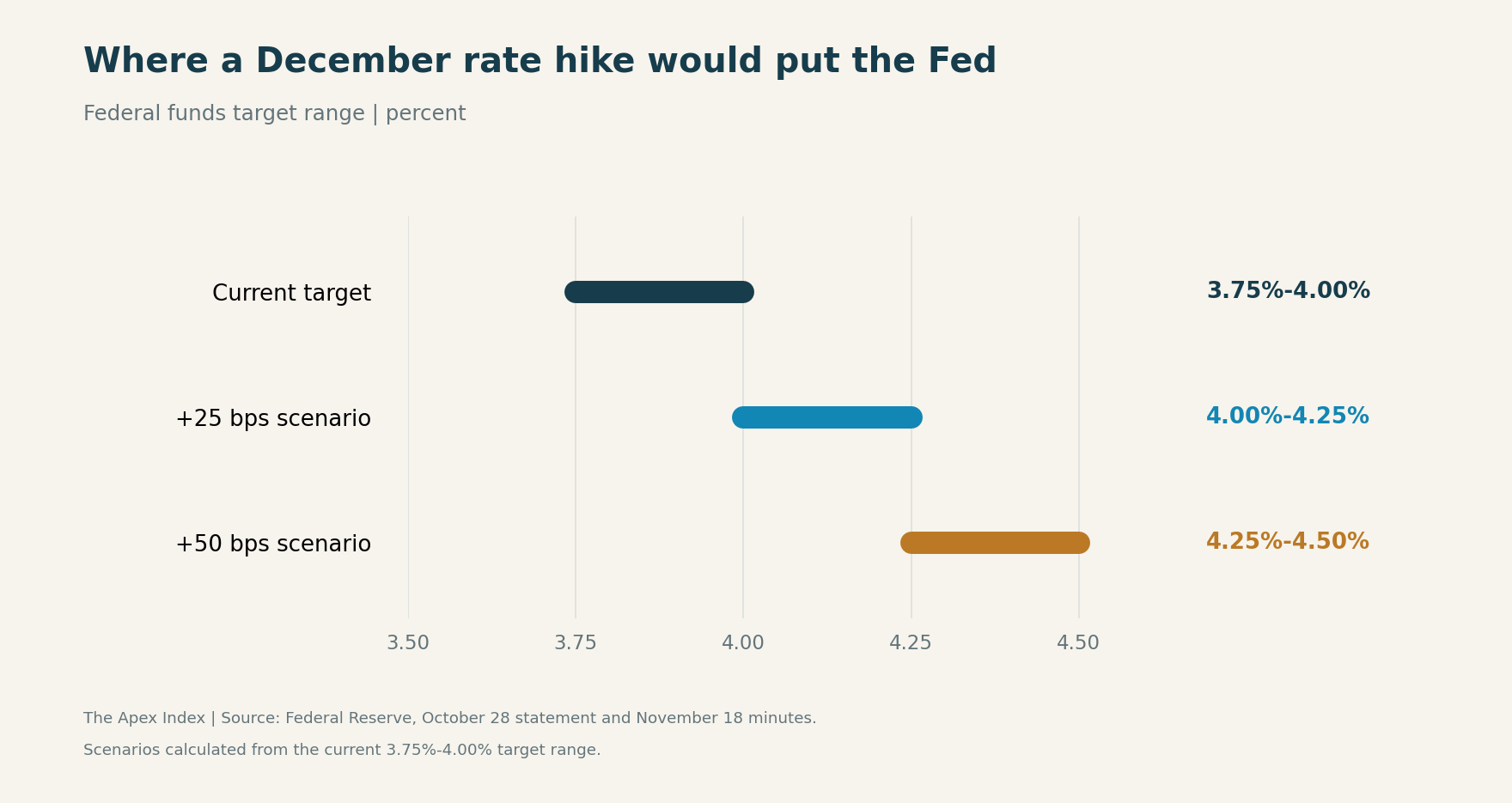
A quarter-point increase would take the target to 4.00%-4.25%. A half-point move would lift it to 4.25%-4.50%, making a larger change in borrowing conditions at a single meeting.
October's pause bought time to assess the economy
The October decision passed 10-2. Lisa Cook and Beth Hammack dissented, preferring a quarter-point increase then. Other participants who backed holding steady described it as a close call.
Many wanted more information on AI investment demand, financing conditions, geopolitical developments and how September's rate increase was working through the economy. A couple argued that gradual tightening would give households and businesses time to adjust.
The pause nevertheless came with a warning: many officials wanted to make clear that holding rates steady did not weaken their commitment to bringing inflation back to 2%.
Inflation data have continued arriving since that discussion. As previously reported by Apex in the article below, annual producer-price inflation rose to 6.5% in October from 6.3% in September, although the monthly increase slowed to 0.3%.
That November 13 report measures prices received by producers. The Fed's 2% target applies to the separate personal consumption expenditures price index, so the producer reading provides context on business-price pressures rather than a direct comparison with the target.
AI spending and energy keep inflation risks in focus
Officials saw upside risks from energy prices and constraints on refined fuels. Many also regarded the AI investment boom as a material inflation risk, with construction and equipment spending potentially running ahead of available supply.
The minutes said:
A majority noted the possibility that higher costs could be passed through more broadly and persistently to consumer and business prices.
There was another side to that discussion. Some officials thought expanding productive capacity and improving productivity could eventually ease price pressures. Greater scrutiny of AI companies' returns and financing could also slow investment, reducing demand.
Meanwhile, participants generally described the labor market as stable and close to maximum employment. They saw economic activity expanding strongly, supported by resilient household spending and business investment, even as housing and other interest-sensitive sectors struggled.
December's meeting will bring those competing forces together with fresh forecasts. Officials will have to judge whether inflation calls for another measured step or the larger increase already raised in their discussions.