
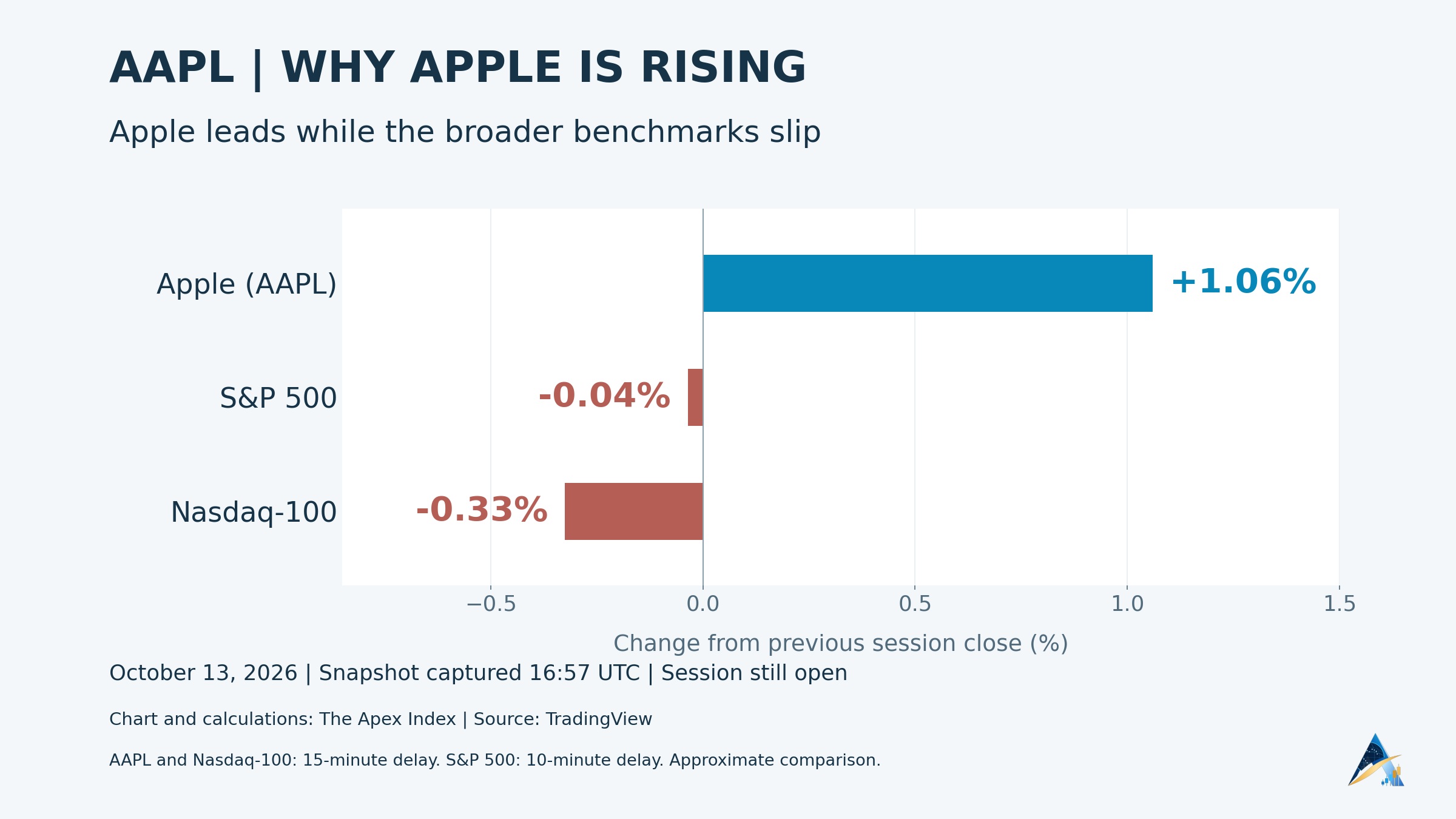
Apple is rallying on October 13 as a new smart-home lineup gives investors a concrete product story to trade. AAPL stood at $344.59, up 1.06%, in a delayed snapshot captured at 16:57 UTC. It had traded as high as $348.15. These are intraday observations, not closing prices.
The standout development is HomeView, a $299 household display built around Siri AI. Refreshed speakers, a new television box and connected-home accessories expand the announcement beyond one gadget. That gives the rally a plausible company-specific catalyst, although neither the releases nor the price data establish exactly why individual investors bought shares.
The benchmarks strengthen that interpretation. The S&P 500 was down 0.04%, while the Nasdaq-100 fell 0.33% in the same retrieval. Their feeds have different delays, so this is an approximate comparison. Still, Apple’s gain was not simply mirroring a rising technology benchmark.
What changed for Apple today?
The company’s October 13 announcement confirms that HomeView has a seven-inch display, supports tabletop and wall-mounted configurations, and recognizes household members to deliver personalized experiences. Pre-orders opened today, with availability beginning November 13. It connects entertainment, video calling and home controls through the same interface.
Greg Joswiak, senior vice president of Worldwide Marketing, described the product this way:
“It recognizes your face to shift from a household screen to your own experience, fills the room with incredible sound, keeps you connected to the people who matter most with FaceTime, and makes it easy to control your smart home.”
For investors, the potential lies in selling more devices and connecting them to existing services. HomeView supports Apple Music and compatible entertainment apps, while supported iCloud+ subscriptions enable additional camera features. More hardware could create more opportunities for subscriptions. That is a business thesis, not a verified forecast of incremental revenue.
The launch also includes the $149 HomePod mini 2, available October 30, and a refreshed Apple TV 4K arriving November 13. There is an execution caveat: Siri AI on HomePod mini 2 comes through a future software update. Buyers should distinguish hardware availability from delivery of every advertised software feature.
The Home Collection adds cameras, thermostats and a door lock developed with LG Electronics and Schneider Electric. Availability starts in December, with some accessories following in early 2027. That staged rollout means today’s announcement cannot be treated as immediate revenue from the entire lineup.
Matthew Costello, vice president of Hardware Engineering, said:
“Apple Home Collection makes it easy to choose smart home accessories with confidence. Working closely with industry leaders LG Electronics and Schneider Electric, we designed every accessory to work seamlessly with Apple Home, so managing your home is simple, reliable, and private.”
There is a geographic constraint, too. HomeView will not be sold in the European Union at launch because Siri AI is currently unavailable in iOS there. Its initial Siri AI language is English, with Canadian French planned later. Those restrictions matter when assessing how quickly a household product can become a global growth driver.
The financial starting point is stronger than a turnaround narrative suggests. Apple’s July 30 results showed fiscal third-quarter revenue of $109.4 billion, up 16%, and diluted earnings of $2.02 per share, up 29%. However, EPS included an $0.11 benefit from tariff refunds. Those are historical results, not evidence that the new home products have already improved earnings.
Does AAPL’s chart support the rally?
The price action is positive, but buyers have not kept every dollar of the morning advance. The stock opened at $344.67, above the inferred previous close of $340.97, and subsequently reached $348.15. At the snapshot, it was slightly below its opening price. Much of the daily gain therefore reflected the opening gap rather than a continuous climb throughout the session.
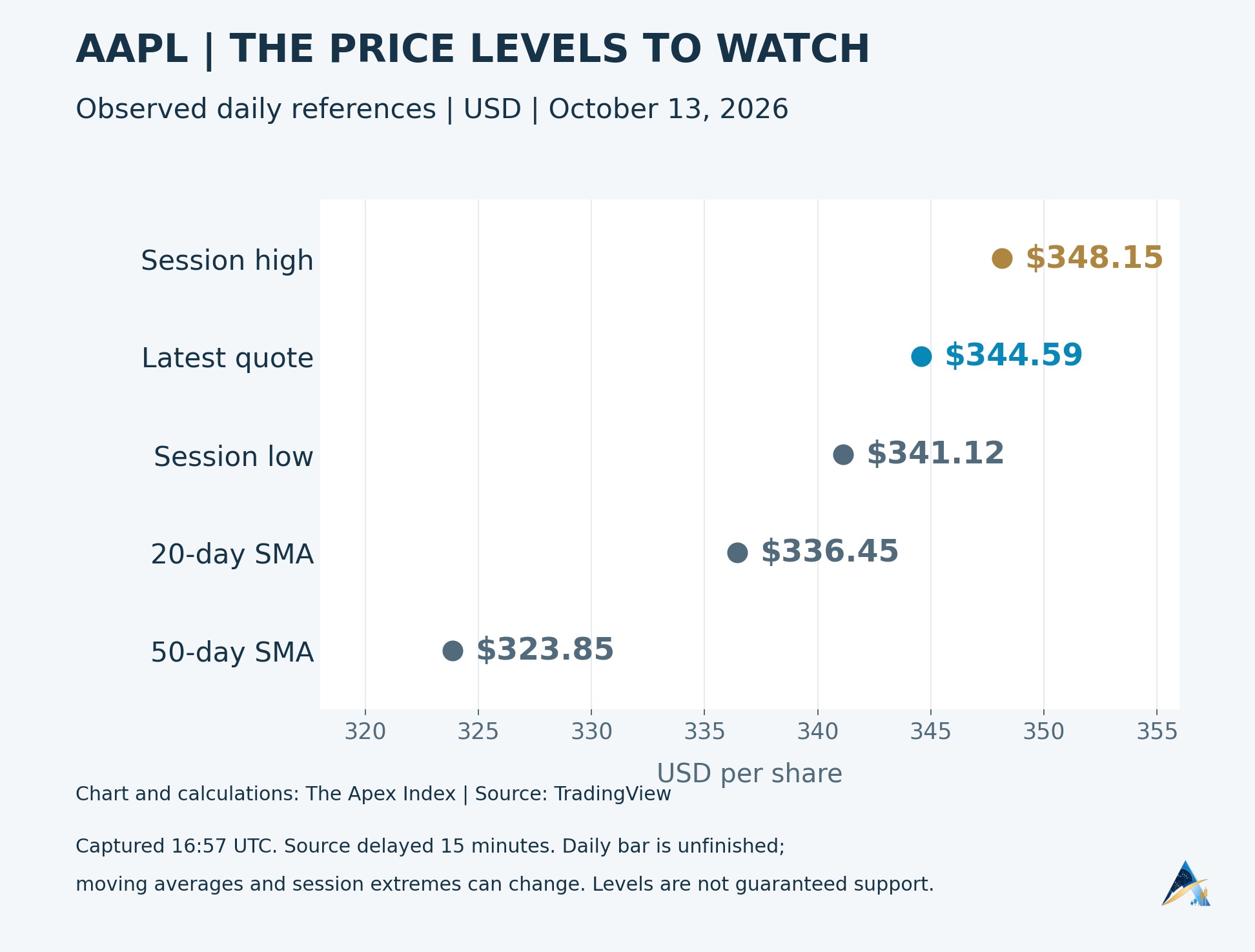
The current daily references put the 20-day simple moving average at $336.45 and the 50-day average at $323.85. AAPL was 2.42% above the former and 6.40% above the latter. Those averages include the unfinished daily bar. They describe the present setup and may change before the close.
Daily RSI was 63.28, below the conventional 70 overbought threshold. MACD stood at 4.05 versus a 3.87 signal line. Both readings fit positive momentum, but neither proves that a breakout will hold. The 14-day average true range was $6.73, underlining why a few dollars of movement should not automatically be read as a lasting trend change.
For a bullish continuation, the first test is whether AAPL can reclaim and sustain trading above the observed $348.15 session high. A closing break followed by a successful retest would offer stronger confirmation than an intraday touch. That is a conditional trading framework, not a promise of another record or a guaranteed price target.
On the downside, the $341.12 session low is the immediate reference, followed by the $340.97 prior-close area. Losing those levels would weaken the opening-gap move. The $336.45 average would then become another potential test; it is not guaranteed support.
Valuation leaves limited room for complacency: the provider’s trailing price-to-earnings ratio was about 39.50. Apple has delivered a fresh product catalyst, but the investment case still needs shipment execution, adoption and earnings to justify the price. Today’s rally establishes buyer interest. It does not establish how profitable the smart-home expansion will become.