

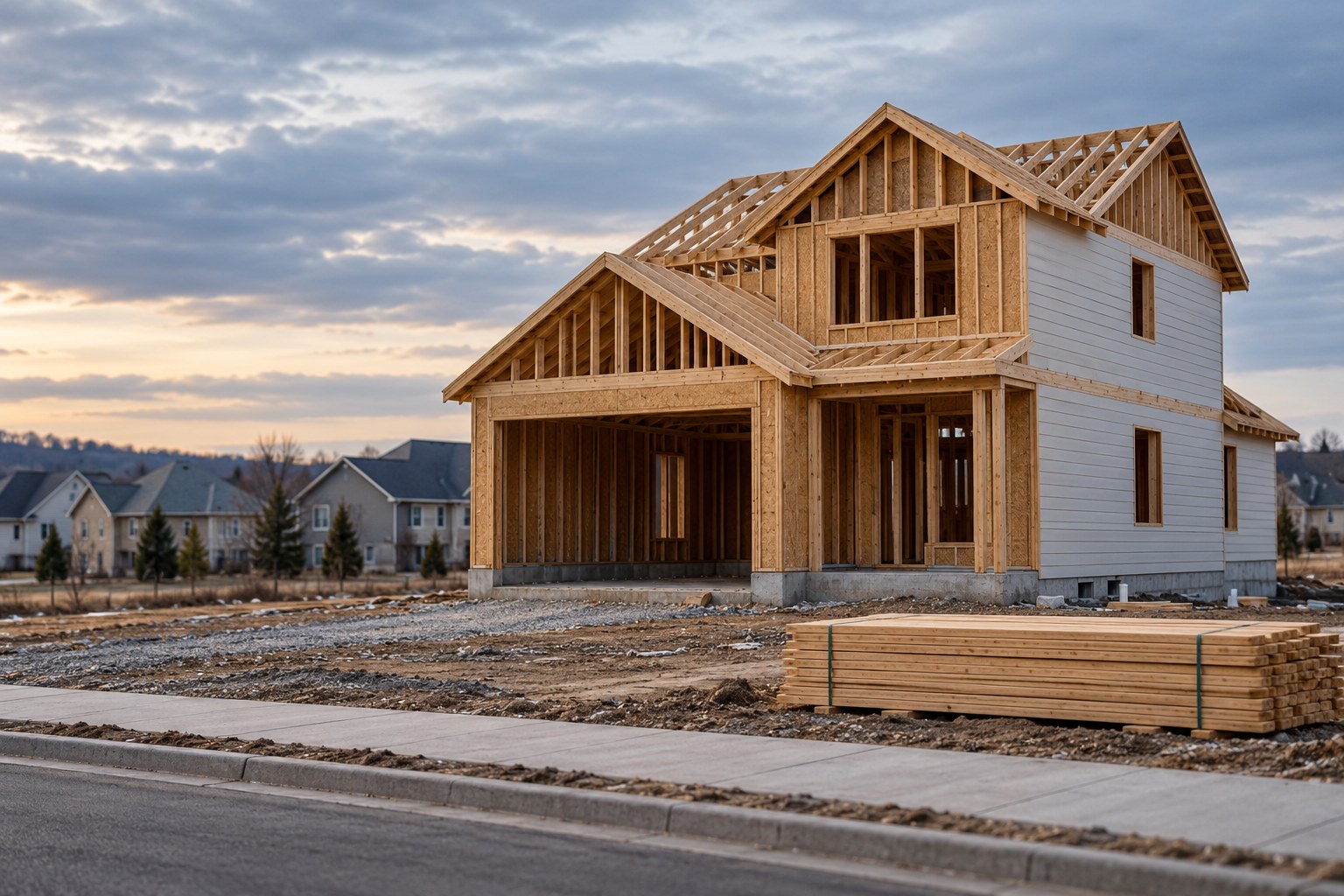
U.S. home construction fell an estimated 5.2% in September as builders pulled back in a market squeezed by expensive mortgages, high construction costs and buyers struggling to make the monthly payments work. Single-family construction and permits for future homes both declined.
Fresh mortgage data on October 21 offered little relief. Applications to buy a home fell 7% in the latest week even as the average contract rate on a conforming 30-year fixed mortgage eased to 7.41% from 7.50%.
The Census Bureau and the Department of Housing and Urban Development put September housing starts at a seasonally adjusted annual rate of 1.221 million, down from a revised 1.288 million in August. Single-family starts fell 4.6% to an annualized 859,000, their lowest pace in a year. The report was released October 20.
Apartment projects also slowed. Starts in buildings with five or more units fell 7.2% to an annualized 349,000, leaving that segment 25.9% below its year-earlier pace.
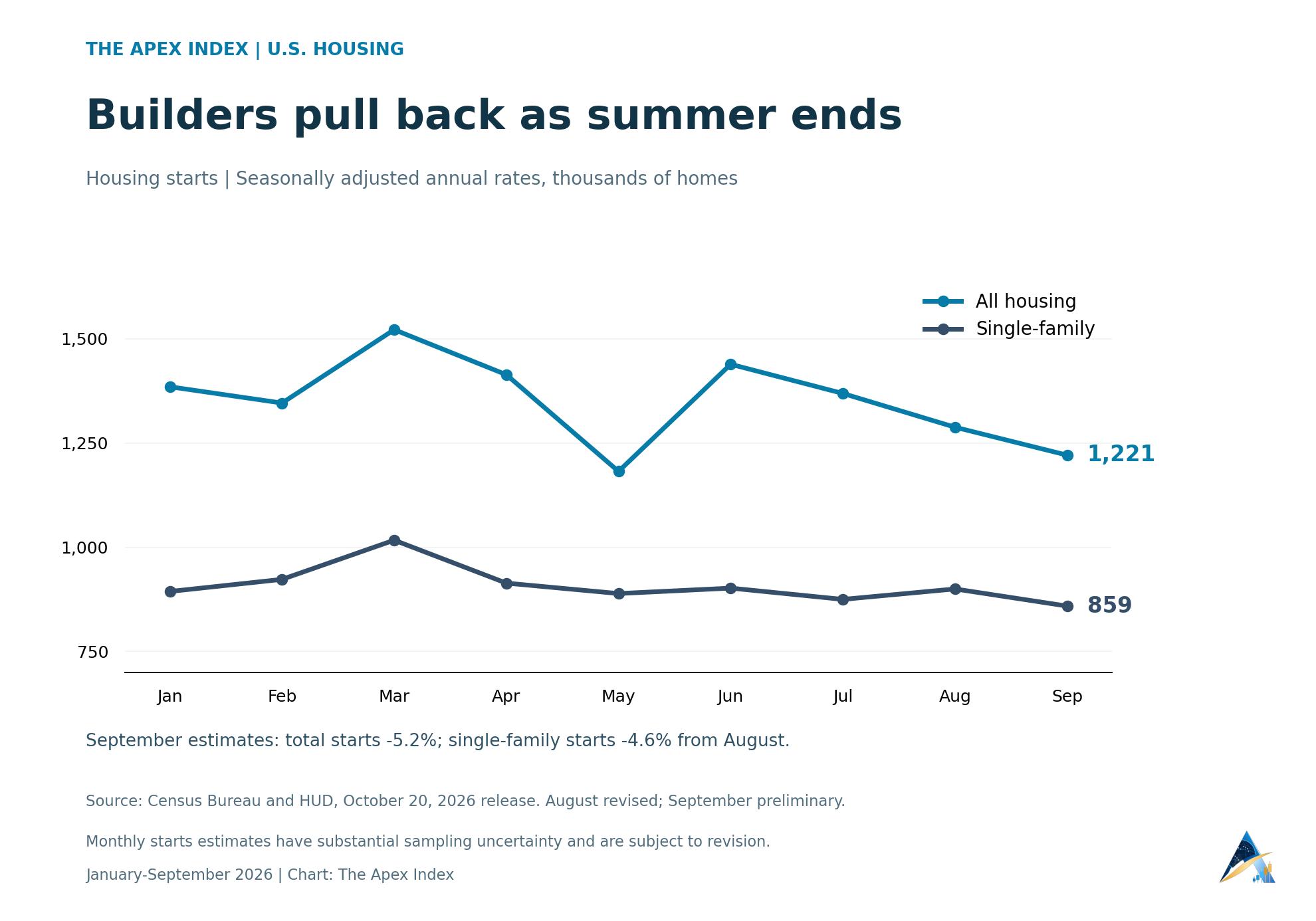
These are estimates of the annual pace implied by the month's activity. They carry substantial sampling uncertainty: the reported 5.2% monthly decline was not statistically significant at Census's 90% confidence level.
A slightly lower rate still leaves a steep bill
The Mortgage Bankers Association's survey for the week ended October 16 showed total loan applications falling 5.3%, according to HousingWire. Unadjusted purchase applications were 18% below their year-earlier level. Refinancing applications fell 2% on the week and were 59% below a year ago.
Joel Kan, the association's vice president and deputy chief economist, said:
"It is very clear that the higher mortgage rate environment has cooled the housing market this fall."
For a buyer, a modest weekly drop in rates offers limited help when borrowing costs remain elevated and the asking price is still difficult to afford. For a builder, slow sales mean money remains tied up in houses already built, making another project harder to justify.
Christopher Rupkey, chief economist at FWDBONDS, put the problem bluntly in comments to Reuters:
"The weakness in housing starts is not surprising. Even if homebuilders were putting up new houses, who could afford to buy them?"
Builders are cutting prices and future projects
The latest NAHB survey found that 43% of builders cut prices in October, the highest share during the 2020-2026 period. The average reduction was 6%. The survey also found 65% using sales incentives, the 19th consecutive month that share had reached at least 60%.
Builder confidence fell to 29, its lowest reading since June 2012. The association pointed to rising financing, energy and material costs, alongside worsening labor and lot conditions. Those pressures squeeze developers' ability to reduce prices while keeping projects profitable.
The construction pipeline is weakening too. Single-family building permits fell 4% in September to an annualized 845,000, the lowest level since March 2023. Overall permits slipped just 0.2% because an increase in permits for buildings with five or more units partly offset the single-family decline.
The number of single-family homes authorized but not yet started was unchanged at 151,000. Meanwhile, 587,000 single-family units were under construction, also unchanged from August.
There is an important distinction between the supply of homes Americans need and the inventory builders can sell at today's prices. Unsold new homes were piling up even as the country continued to face a broader housing shortage, the same Reuters report noted. Slowing construction can help builders avoid adding to that inventory, while leaving the longer-term affordability problem unresolved.
Single-family starts remained 2.6% above September 2025, but the builders' association said they were down 4% over the first nine months of 2026. Completed single-family homes also fell in September, to an annualized 840,000. That was the weakest completion pace since May 2020 and 11% below its year-earlier level.